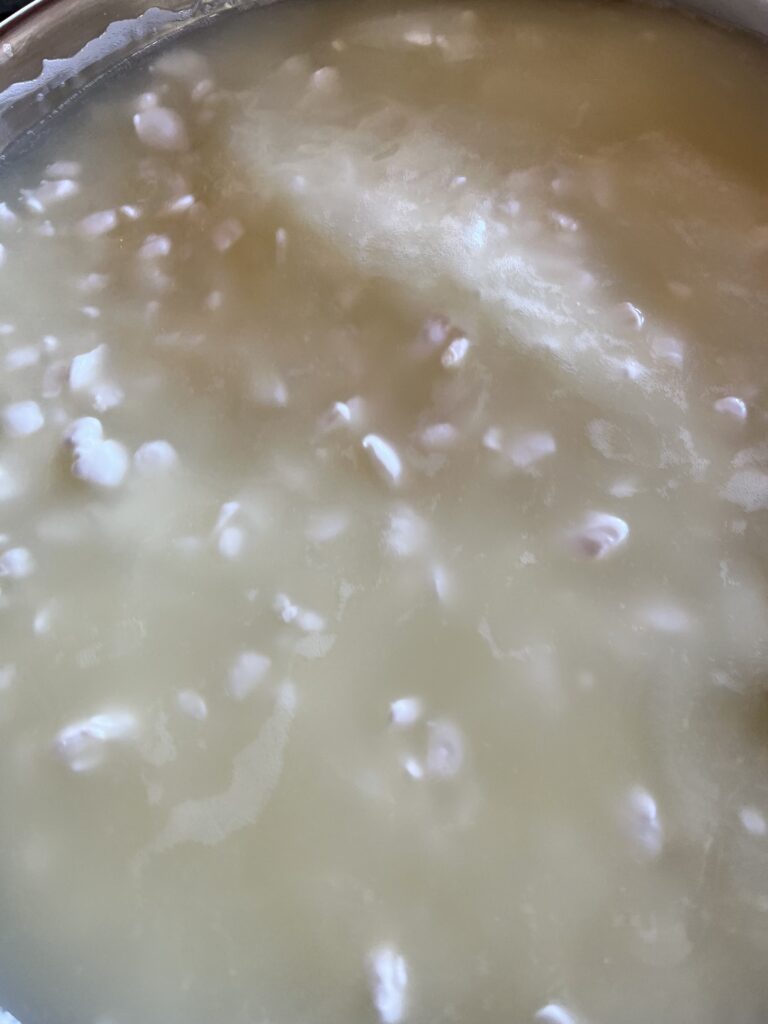
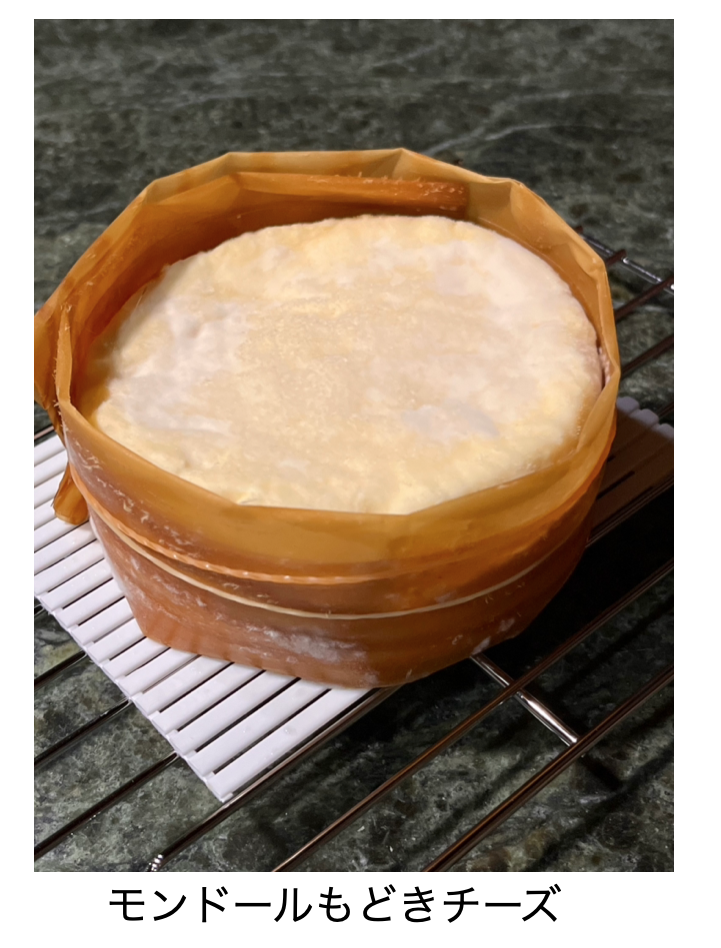
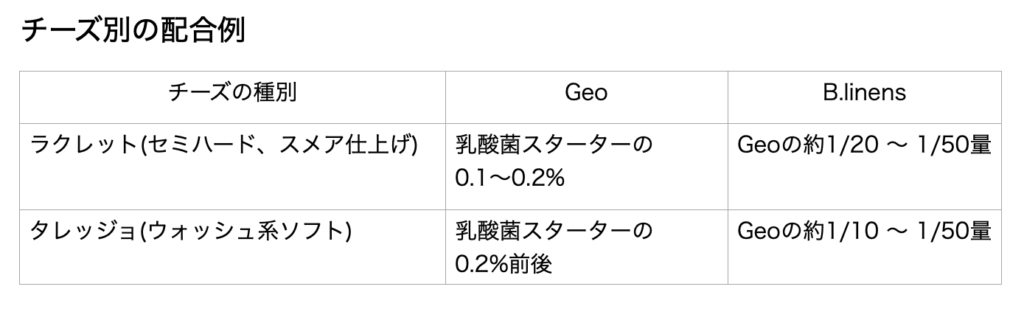
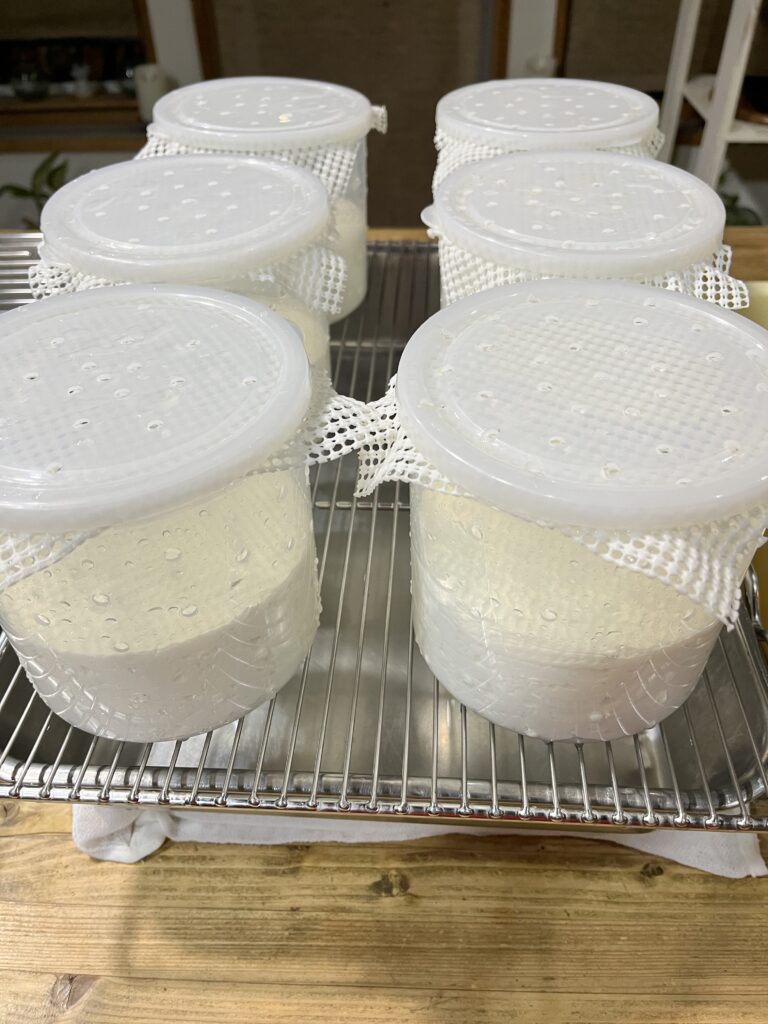
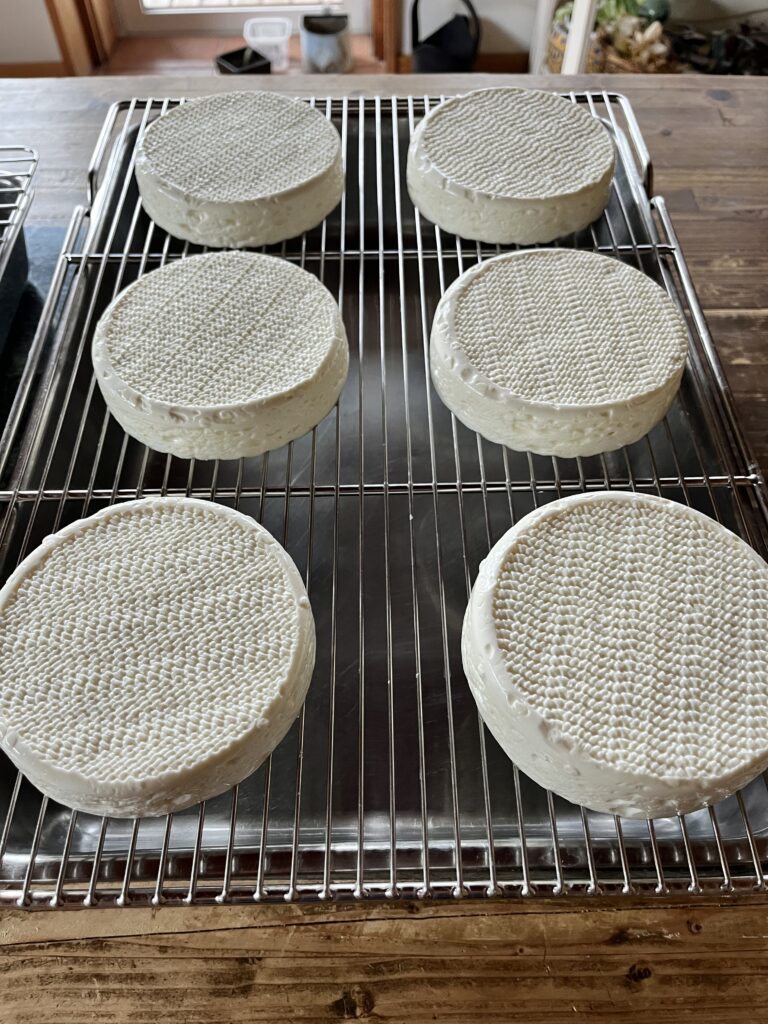
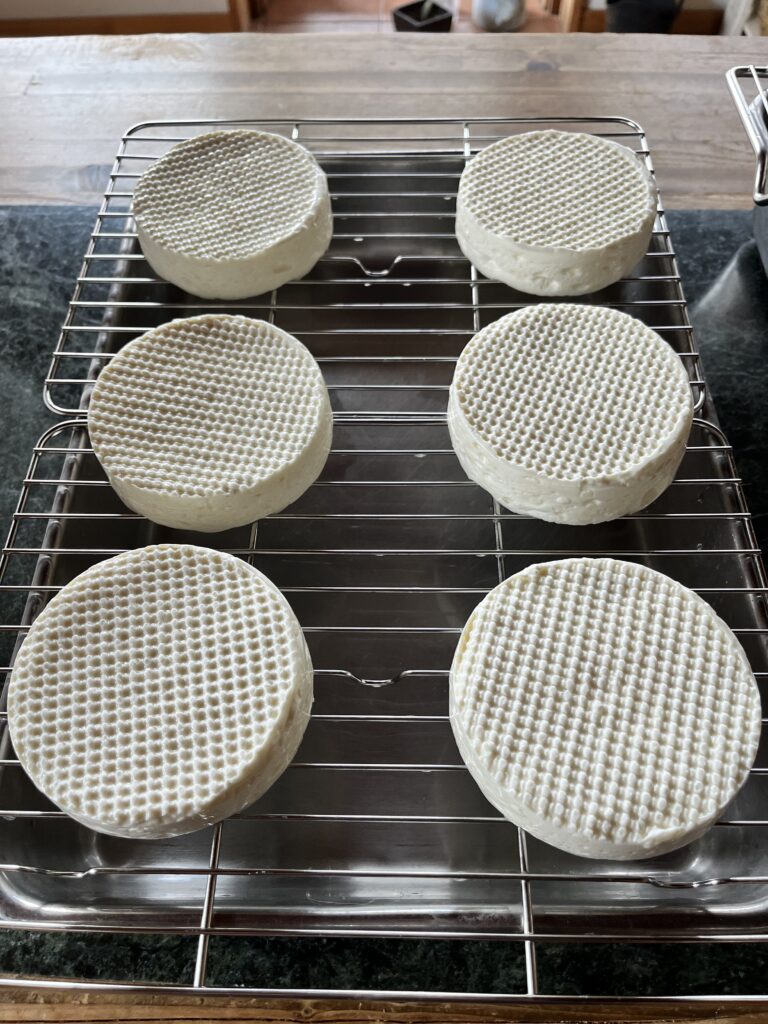
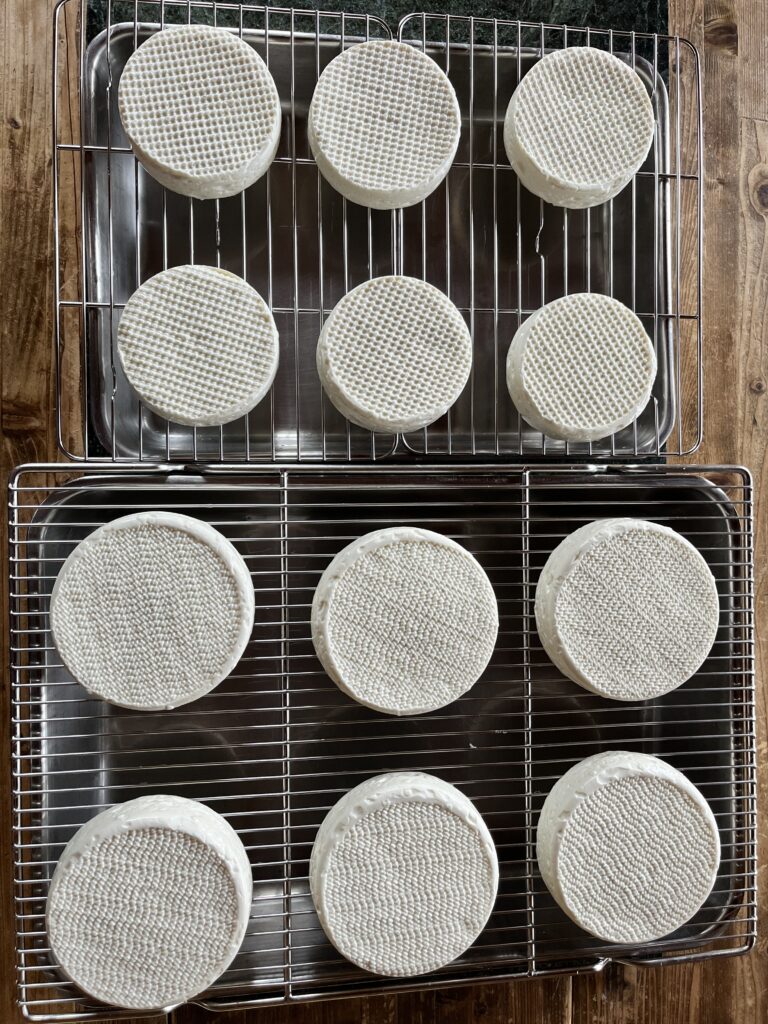
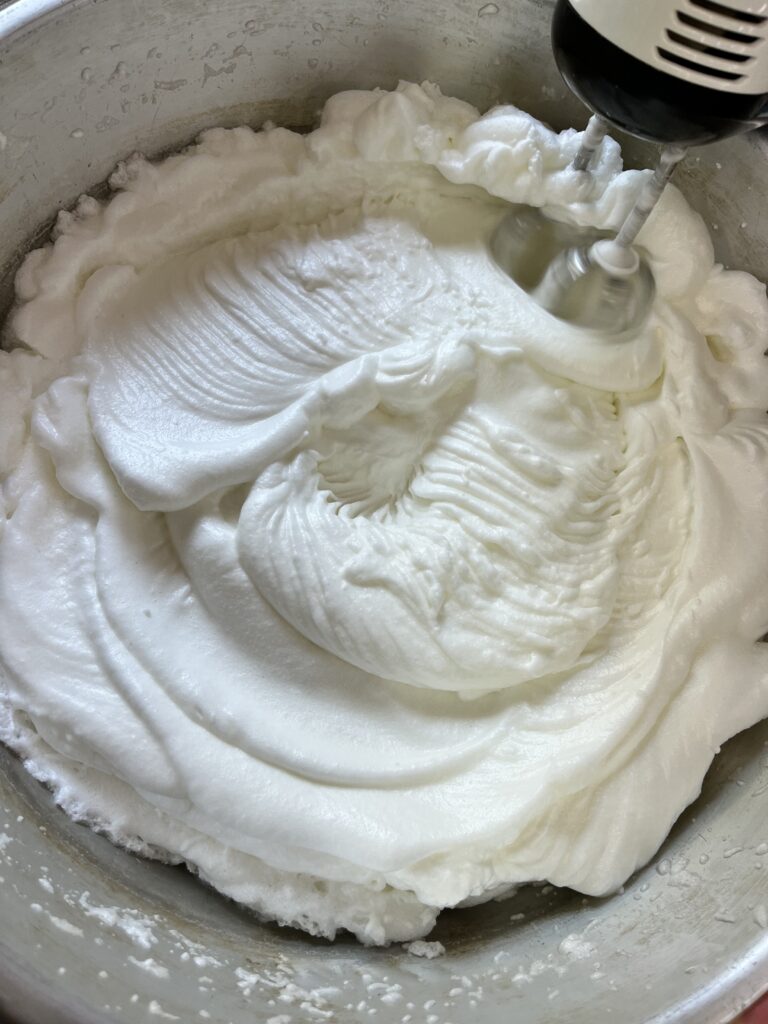
すると ① 脂肪球がどう変わるか → ② 凝固ネットワークとの関係 → ③ 食感への影響などの流れとして整理しくれました。
① 脂肪球がどう変わるか ホモジナイズUHT乳では脂肪球径が 0.2–1 µm となり、表面の脂肪球膜が破壊されて脂肪球表面に超高温殺菌処理で変質したホエータンパク質(β-ラクトグロブリン、α-ラクトアルブミン)がκ-カゼイン複合体として表面を再被覆する。これによって脂肪球が「疎水粒子」から「タンパク質でコーティングされた疑似ミセル」になる。
② 酸凝固時に脂肪はどう取り込まれるか ・非ホモ乳の酸凝固ではカゼインミセルが主役で脂肪球はネットワークの空隙に閉じ込められるだけ (物理的トラップ)となる。 ・ホモジナイズUHT乳の場合は脂肪球は表面にκ-カゼイン複合体を持ち、pH低下でカゼインミセルと同時に電荷中和されネットワーク形成に直接参加する。つまり脂肪球がフィラー(ネットワーク空間の詰め物)ではなく、チーズの構造要素となる。
③ -1 脂肪取り込みの3様式 a ネットワーク内包型(理想) 微細脂肪球が均一に分散し、カゼイン複合体と連結することから、結果としてなめらかでクリーミーであり離水が少ない。
b ブリッジ型(過剰ホモ・過剰UHT) 脂肪球が複数ミセルを橋渡し局所的凝集核になることから、結果として粒状感がありザラついて崩壊性が増大する。
c 排除型(条件不適) pH降下が速すぎるたりCaが不足すると、結果として脂肪がネットワーク外に押し出されることから表面に油浮きやホエーの混濁が発生する。
③-2 食感への具体的影響 a なめらかさがアップ 脂肪球径の舌での感知限界は ≈2 µm であり、粒として感じないことからきめ細やかで滑らかな、軽い口当たりとなる。
b 弾性は減少し、塑性は向上する 脂肪球は硬い架橋を作らず応力を分散することから押すと潰れて戻らない。
c コクの感じ方 脂肪が構造に組み込まれているため口中での放出が遅くコクは最初ではなく後から感じる。
We are sharing the recipe we use to make cheese. However, please note that this recipe and the accompanying materials were created solely for the purpose of making cheese within our group, and we do not guarantee that you will be able to make cheese using these materials. Please verify any errors or unclear points before use.
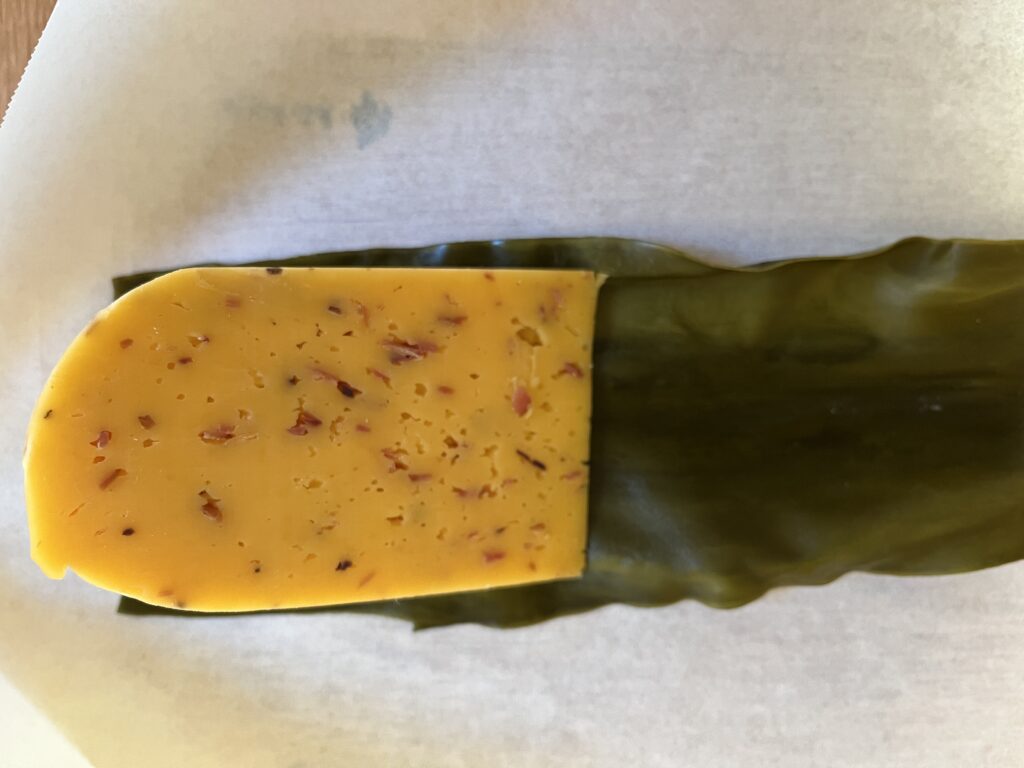
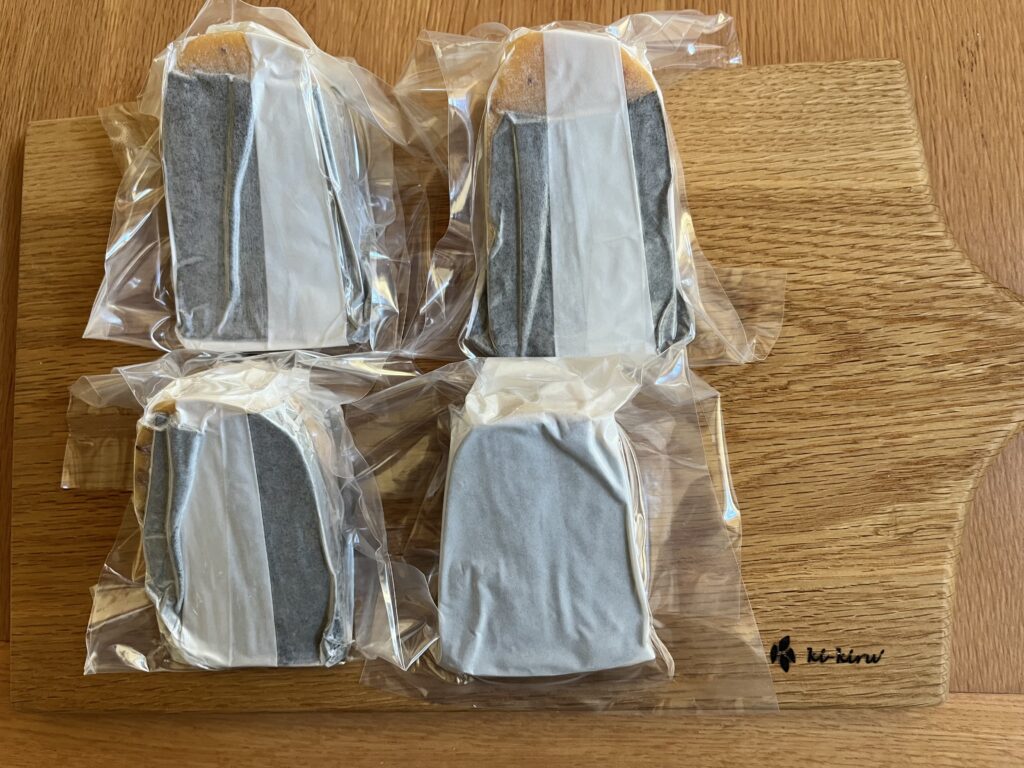
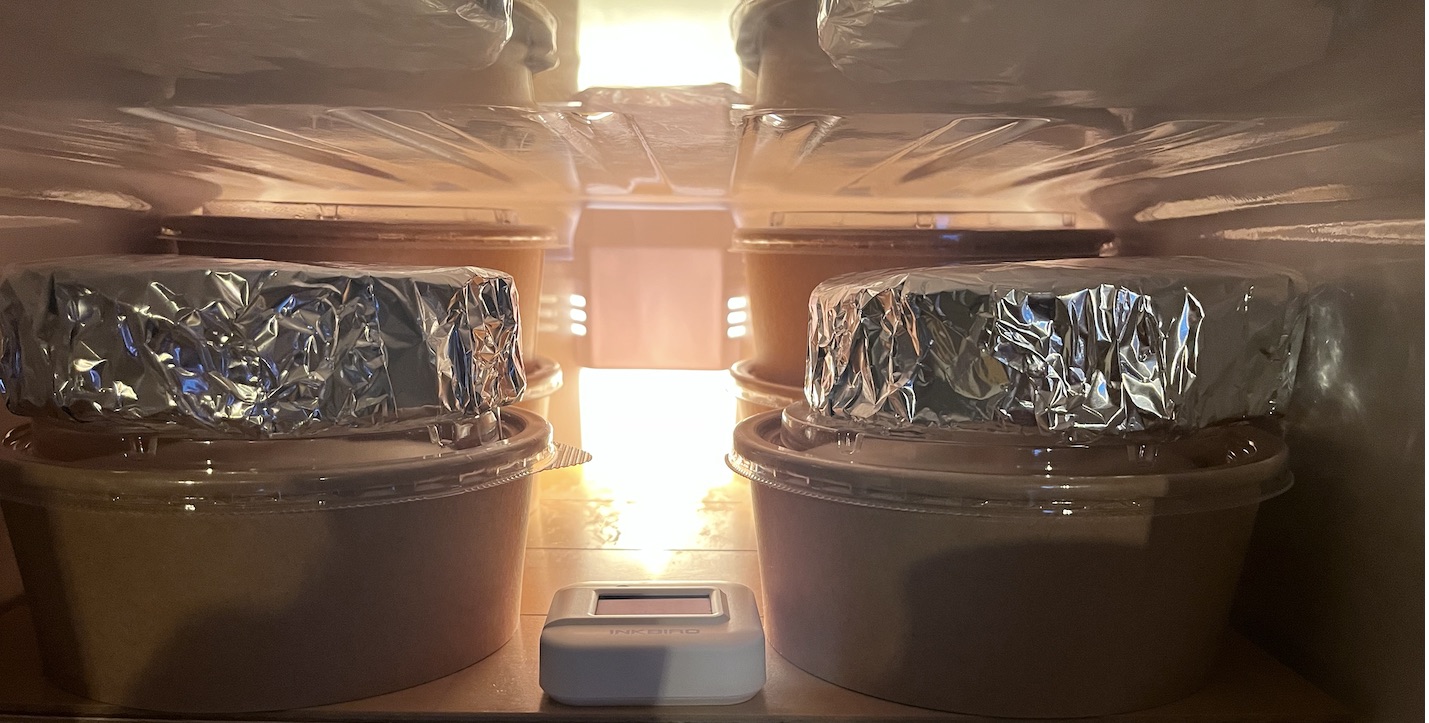
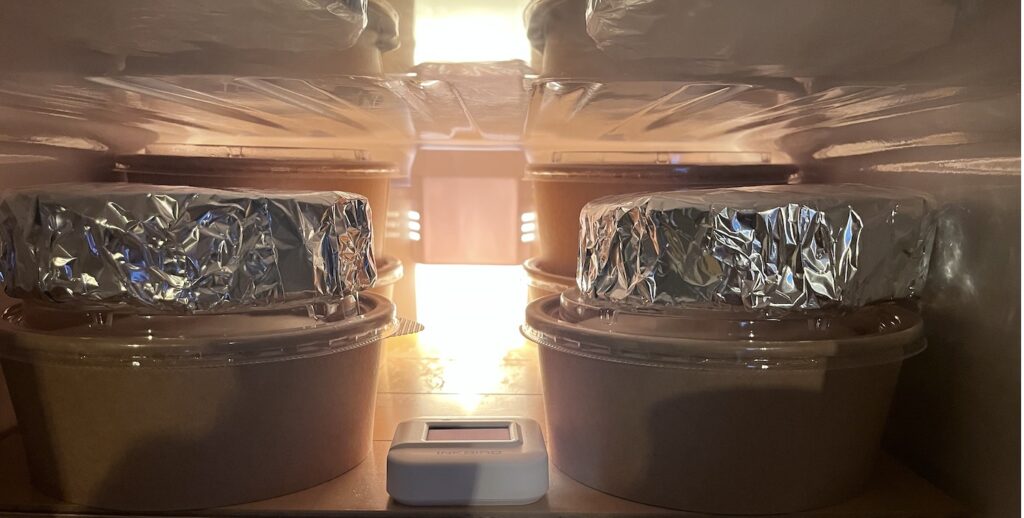
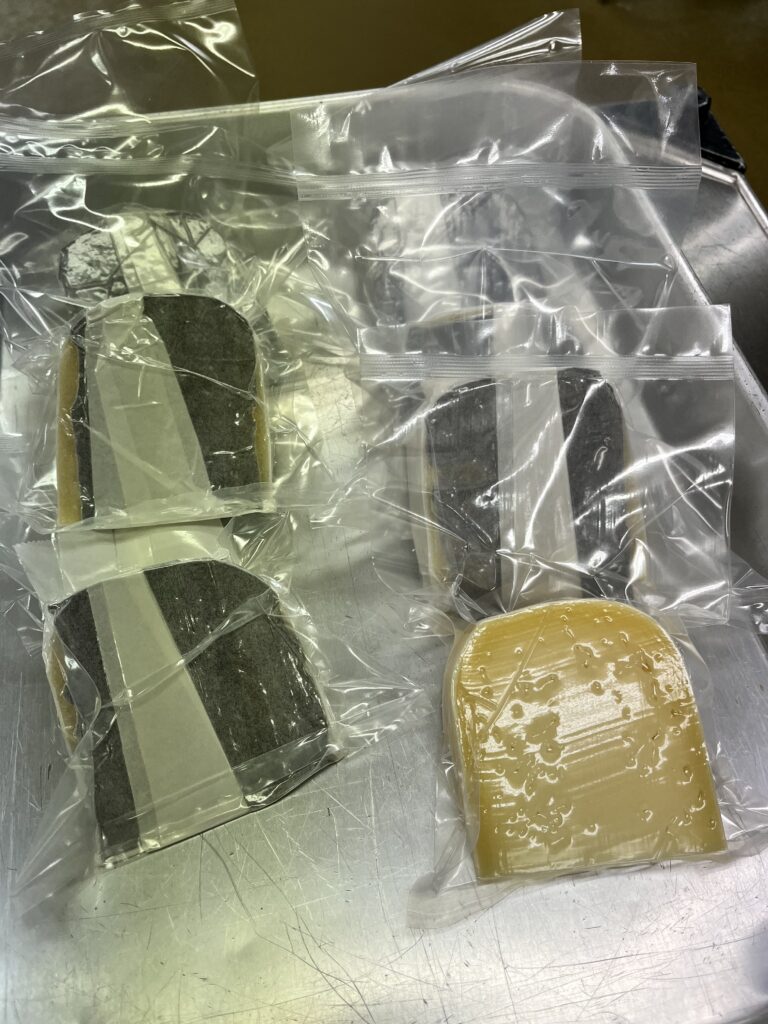
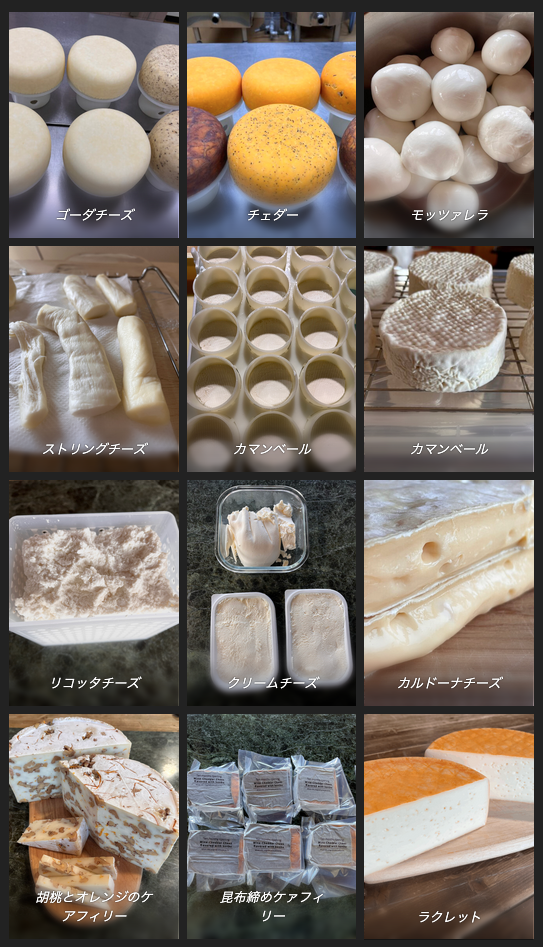
Our group receives raw milk from local dairy farmers and uses it to make various types of cheese. So far, we have made Cheddar, Parmesan, Mozzarella, String, Camembert, Ricotta, and Cream Cheese. Additionally, members have created unique blends by adding wine, pepper, herbs, chili peppers, and even “konbu-jime” (a semi-hard cheese cured with kelp). Aging is done in refrigerators or cases in each member’s home. While the freshly made cheese is the same, the taste and aroma vary depending on the aging environment. Bringing aged cheese that has been aged for over three months, cutting it, and tasting it together is a fun way to appreciate the differences in environment and care. Personally, I am experimenting with making cheeses such as Caithness, blue cheese, raclette, and soft cheese using thistle rennet. Going forward, I aim to challenge myself by exploring cheeses from around the world, refining my production and aging techniques, and sharing cheese culture and craftsmanship with others.
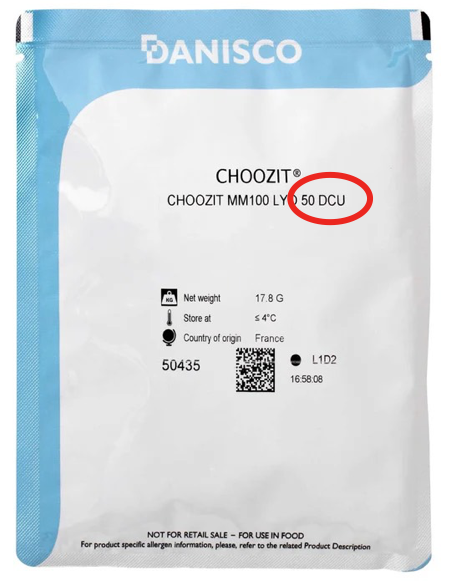
レンネット(凝固剤)はミルクを凝固させるために加える酵素で、その強さ(力価)は、国際規格ISO11815(2007)で定義された International Milk Clotting Unit (国際ミルク凝固単位 )で表記されています。そこで、使用するミルクの量とレンネットの強さがわかればレンネットをどれくらい使えば良いのかを簡単に計算できる表を作りましたので掲載します。
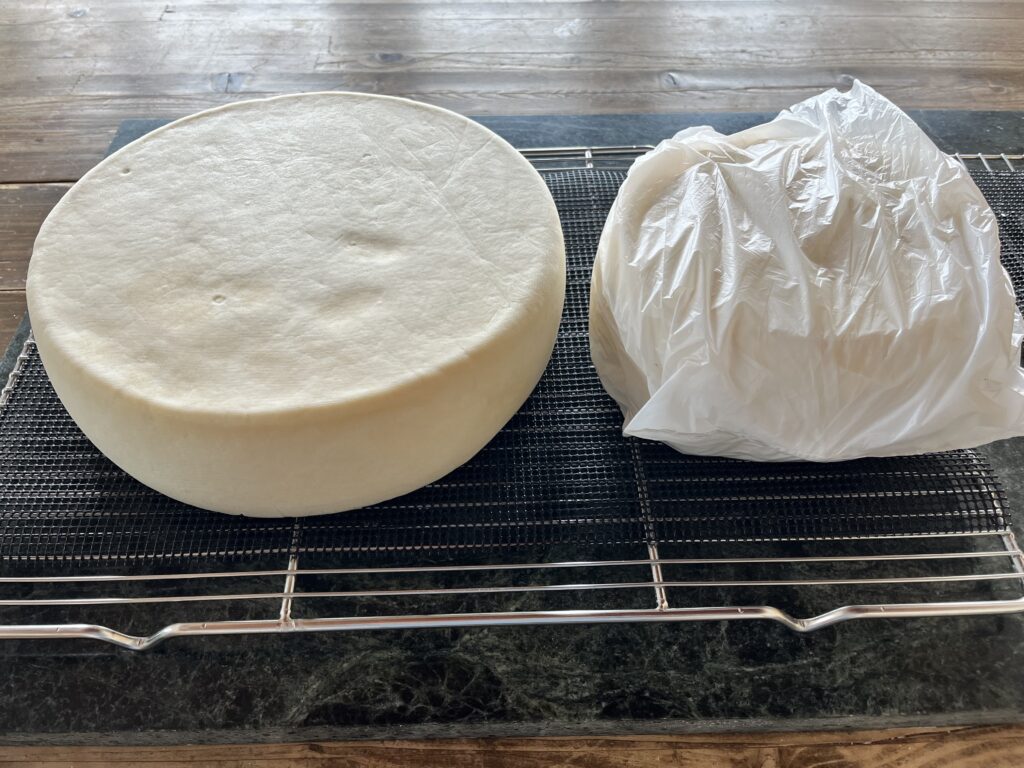
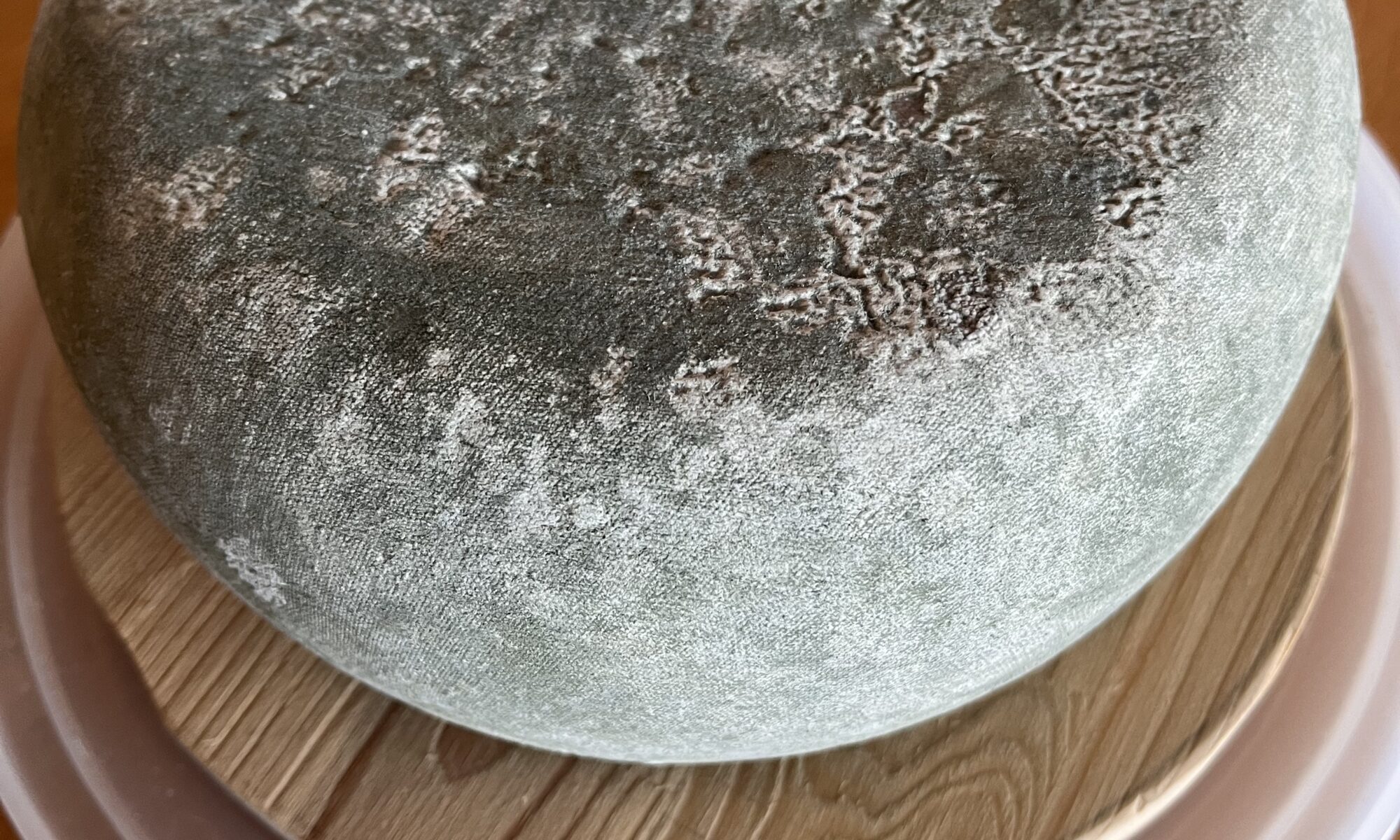
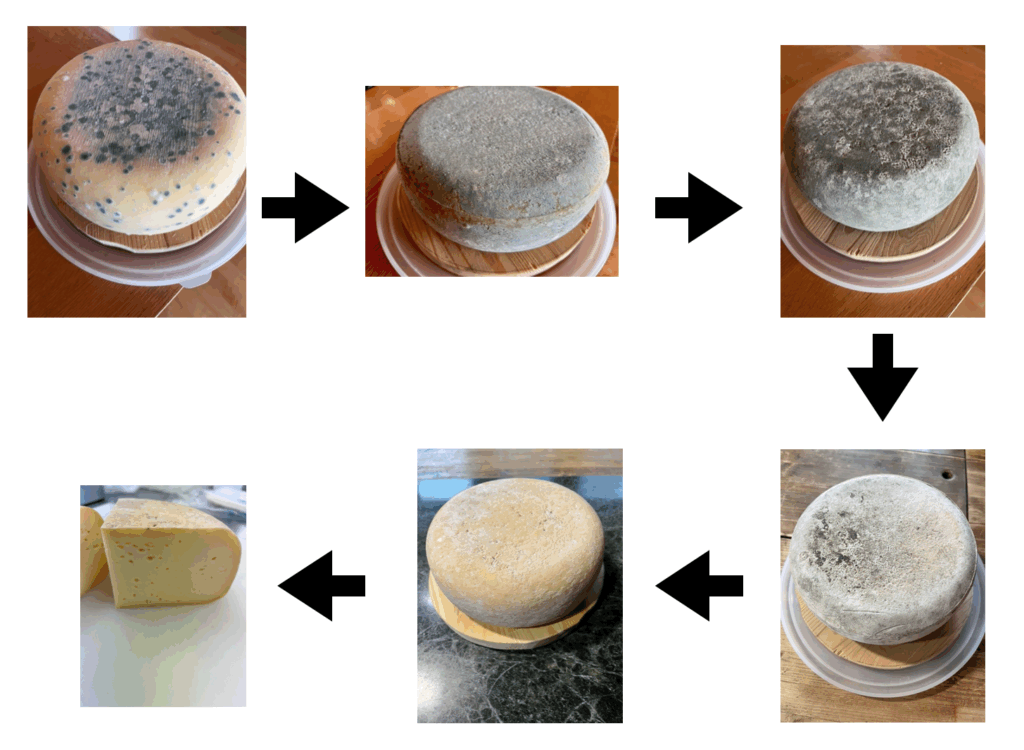
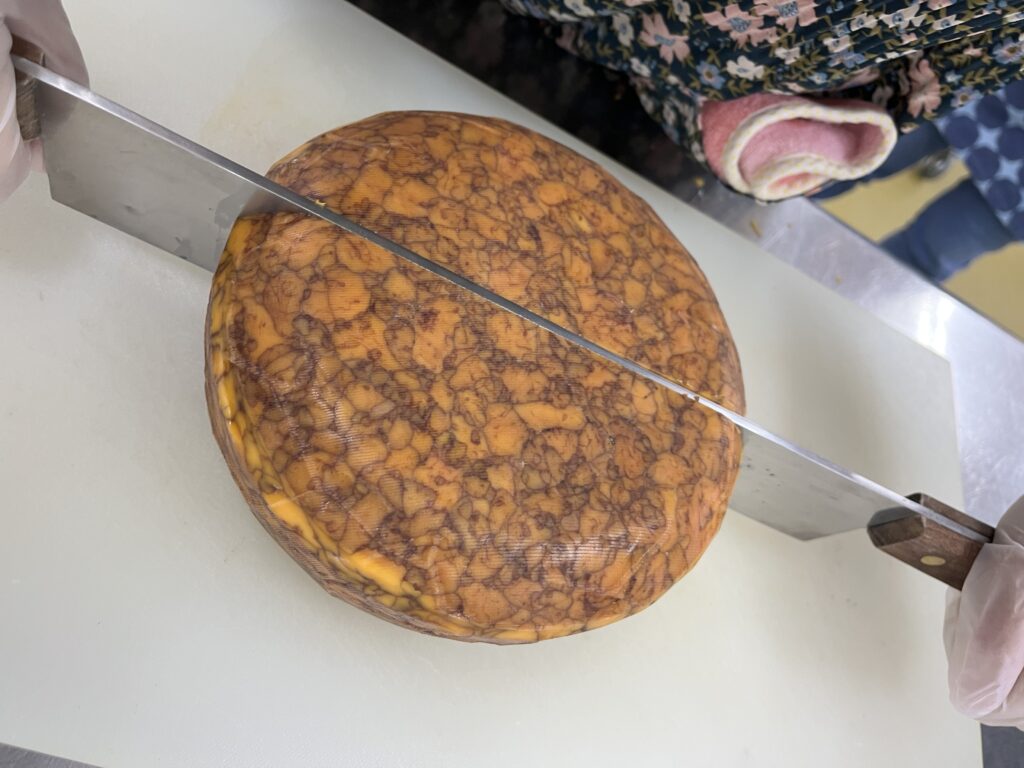
The Gouda cheese, which is being aged with mold, was completely covered with mold, so we brushed it for the first time. To prevent the mold from scattering, we removed it inside a plastic bag, but more mold came off than we expected. We believe that the brushing has distributed the mold spores almost evenly throughout the cheese, so we expect more mold to grow next time.
My late cheesemaking teacher taught me that mold, which grows naturally on the rind of cheese, is not necessarily bad and helps regulate moisture and break down protein and fat. However, I was concerned about the appearance and flavor, and when blue mold or other molds appeared, I would remove them thoroughly with salt. When I looked up mold on Gouda cheese again, I found that many resources recommend that if blue mold or other mold appears, it should be removed cleanly with salt or vinegar. On the other hand, some foreign cheesemaking videos, although not Gouda, show examples of cheeses being aged with mold all over them, and some people say that the mold acts like a natural vacuum pack. In my own experience, black mold tends to penetrate into the interior of the cheese, while other molds seem to stay on the surface rind and not penetrate into the interior. So now I am experimenting to see what flavors Gouda cheese will have when aged with molds other than black mold.
レンネットの必要量 単一強度レンネット(シングルストレングスレンネット)とは、pH6.5で温度30~32°Cのミルク1,000kgを30~40分間で固めるのに200mlで足りるレンネットの力価と考えられています。国際規格ISO11815(2007)で定義された International Milk Clotting Unit (国際ミルク凝固単位 ( IMCU/ml or g : レンネットの力価))で言うと約250IMCU/mlとなります。 すなわち1kgのミルクを固めるのためには、50IMCU/mlの力価を持つレンネットが必要ということになります。このことから使用するレンネットのIMCU値とミルクの量が分かればレンネットの必要量を次の計算で求めることができます。
ミルク量 ( kg ) × 50IMCU/ml ÷ 使用するレンネットの力価 ( IMCU/ml ) = 必要量 ( ml )
The one with holes has a distinctive smell from the blue mold. The one with yellow mold also has a sweet smell from the fermented koji. When the white mold increases more, it will enter the secondary aging process.
私のカマンベーチーズは精製塩を使用して乾塩法で加塩していますが、ここでも塩の種類が議論のまとになることがあります。そこでカマンベールチーズにおいて塩の違いが熟成や香味にどのように作用するかを研究している資料があるかどうか探してみるとSpringerOpenと言うサイトの中にPhysicochemical changes during 4 weeks ripening of Camembert cheeses salted with four types of salts(4種類の塩で塩漬けしたカマンベールチーズの4週間の熟成期間中の物理化学的変化)と言う論文(アドレスは下にあります。)を見つけました。 この論文では精製塩、ベークド精製塩、天日塩、ヒマラヤ岩塩の4種類の塩を加塩に使用した場合のチーズの物理化学的変化(チーズの構成、熟成中のpH変化、生存生菌数の変化、水溶性窒素の変化、乳糖と有機酸の変化、タンパク質の加水分解による変化、揮発性脂肪酸の変化、質感の変化)と官能評価が書かれています。 官能評価では「 4種類の塩で塩漬けしたカマンベールチーズは、4 週間の熟成後、pH、生菌数、WSN、炭水化物の加水分解、有機酸、テクスチャー、タンパク質分解、 揮発性化合物、官能特性において、少しずつ異なる パターンを示した。精製塩を使用したカマンベールチーズの味覚スコアは、他の3種類の塩を使用した ものより有意に高かった。結論として、カマンベールチーズの製造には不純物を含まない精製塩を推奨すべきである。」と書かれていました。 この論文だけでは全てを評価できないと思いますが、この結果は私たちが以前「塩の違いによるチーズの味について」をブログで報告した結果に近いものであることから、カマンベールチーズの加塩にも精製塩を使用することにしています。
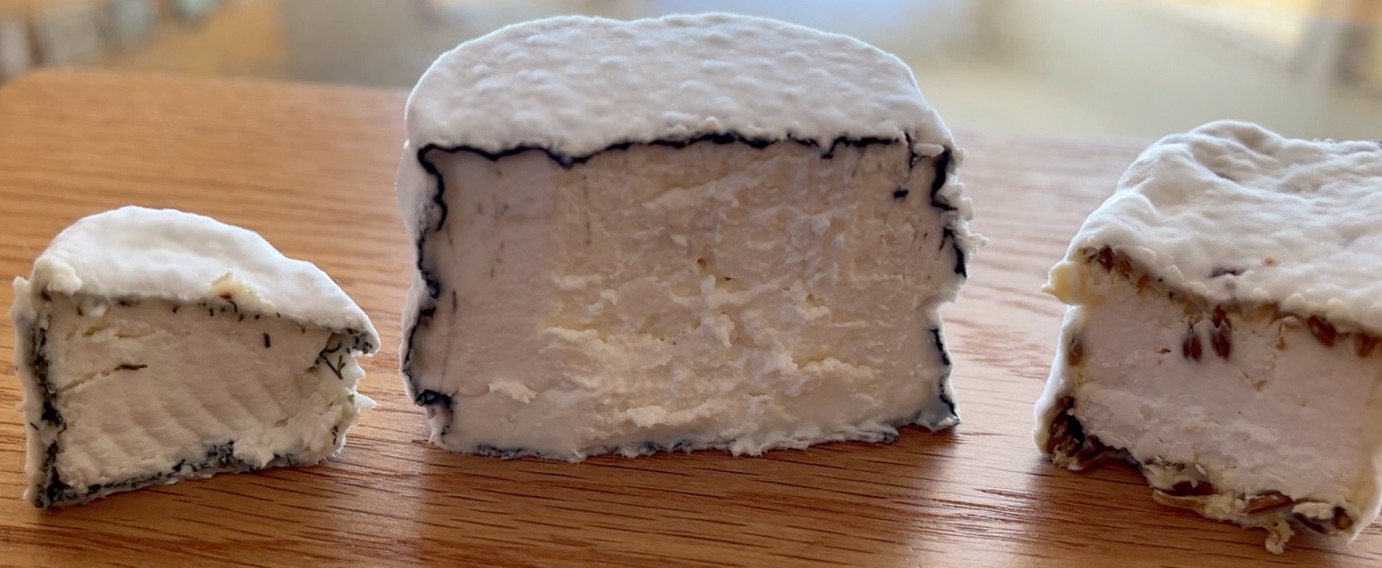
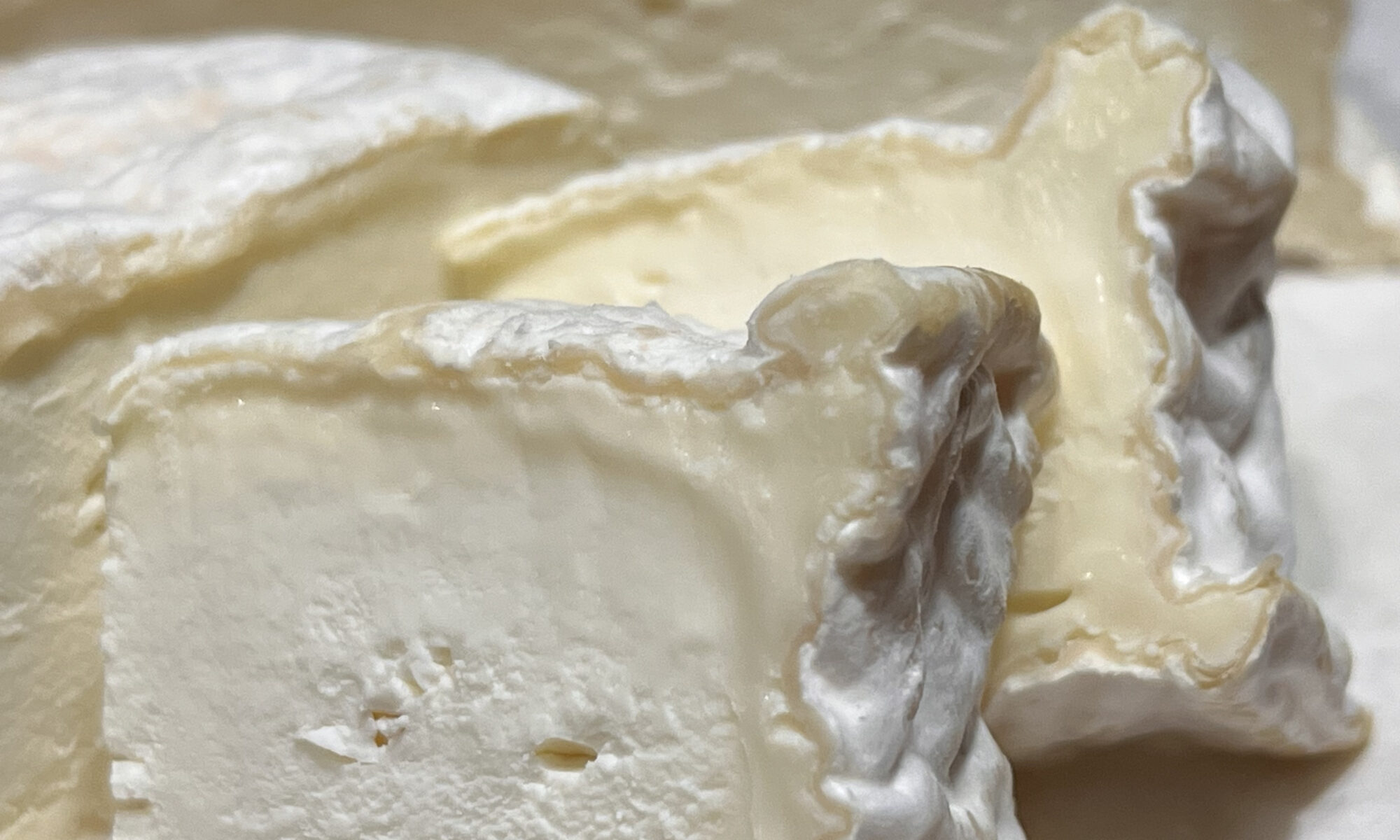
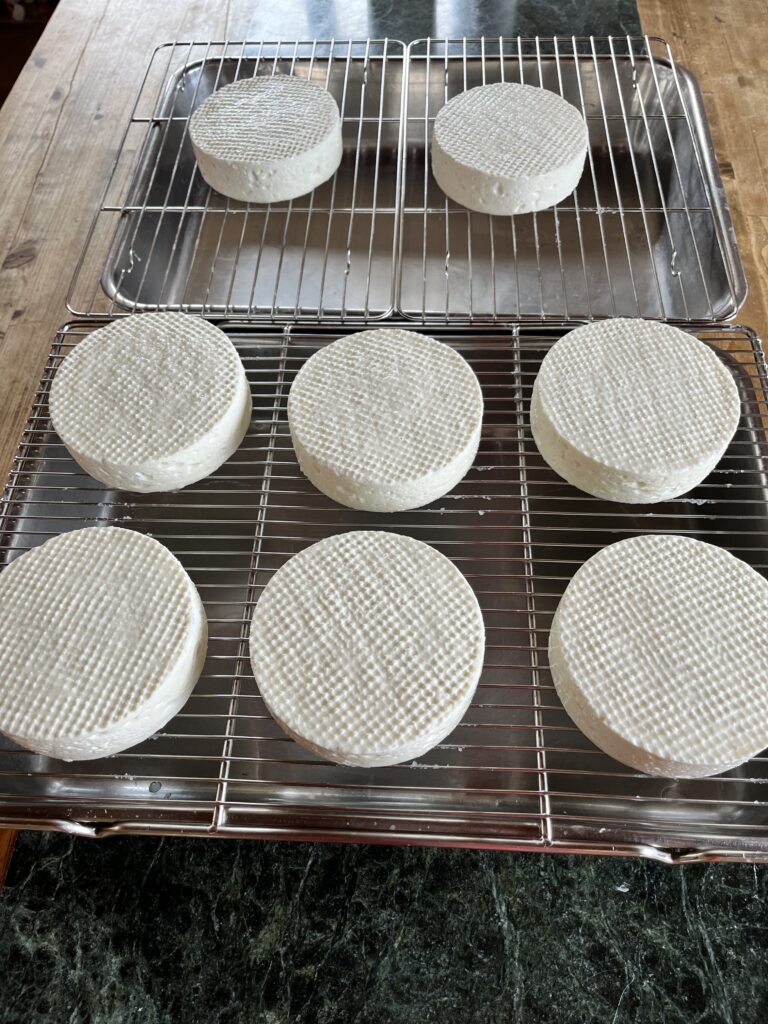
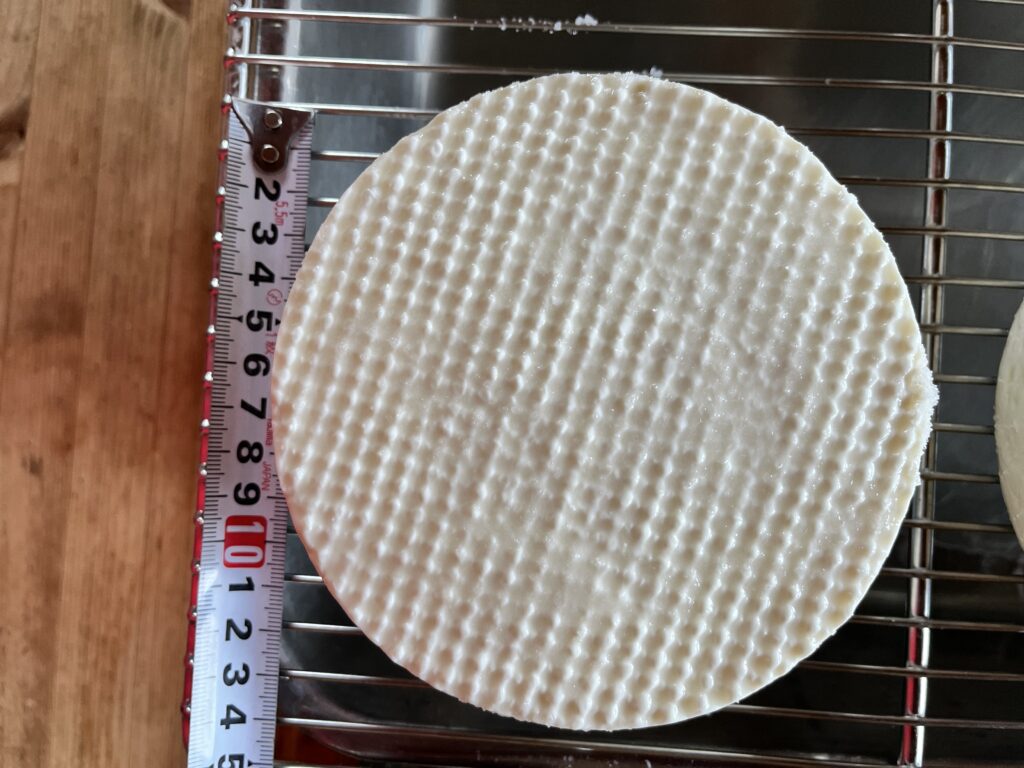
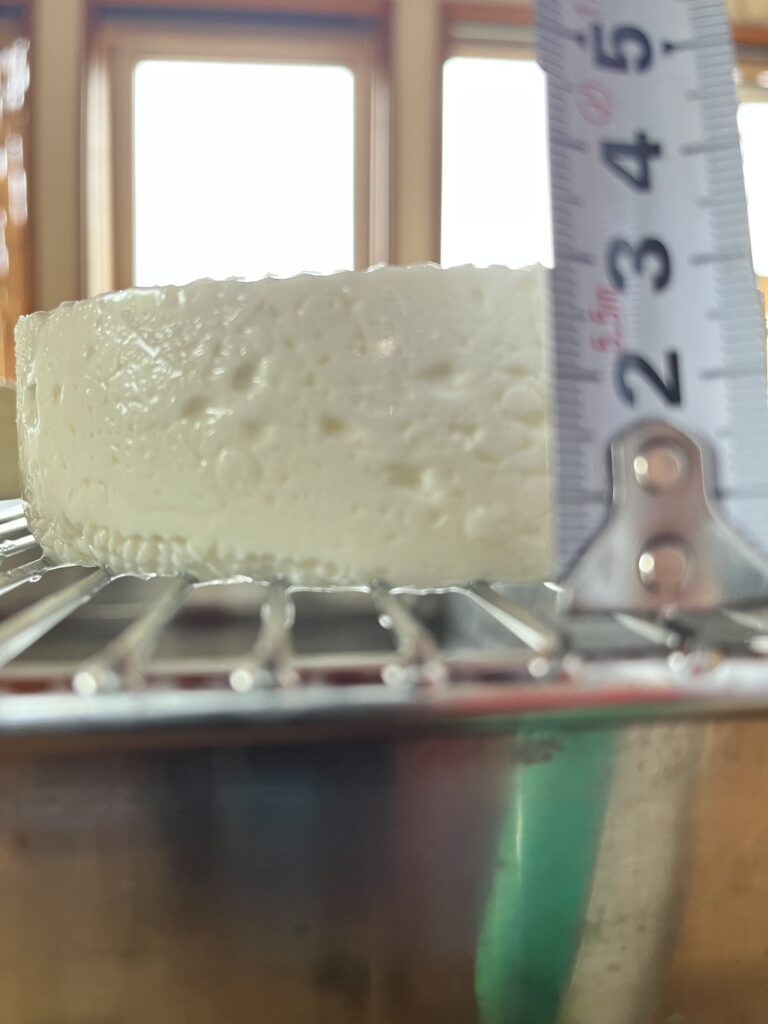
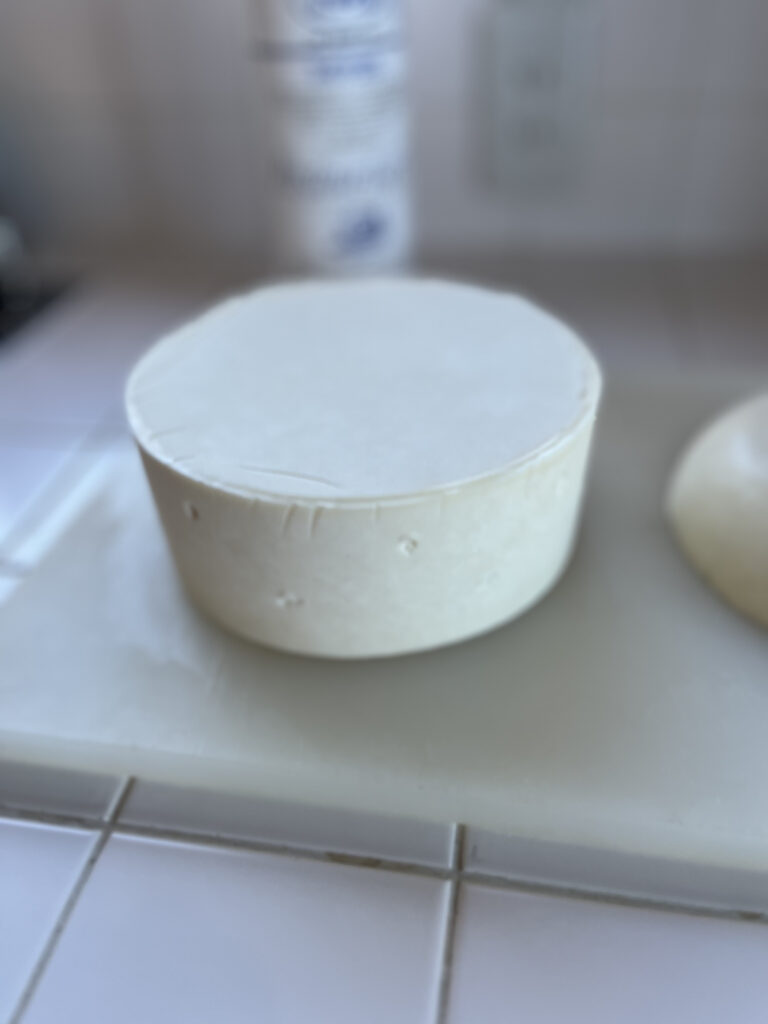
カマンベールチーズには国際個別規格(CODEX STAN C-33, 1973)があり、これによると直径6~8.5cm、高さ2.5~3.0cm、最低重量80gの円筒形のスモールと、直径10~11cm、高さ3.0~3.5cm、最低重量250gのスタンダード・モデルがあるようです。 さらにチーズのタンパク質は平均19.8%、脂肪は24.3%、水分は45~55%であるとされています。 今回作ったカマンブルチーズは直径10cm、高さ6.5cmと大きさの面でカマンベールと呼べるものでないことから、このサイズのカマンベール風チーズを作る際には個人的に「以平(いたいら)」と言うことにして、青カビなどを加えるときは「以平なになに」と呼ぶことにしようと思っています。 今回出来た「以平ブルー」は失敗したもののカットして食べると少し青カビの香味があり美味しいチーズで、ハードチーズと同様な大きさがありながら熟成に要する期間は30日あまりと早熟です。サンドウィッチや料理への応用範囲も広いことから、今後自分が作るカマンベール風チーズは「以平」を主として、青カビやドライフルーツ、ナッツなどを加えたもを作ろうと考えています。
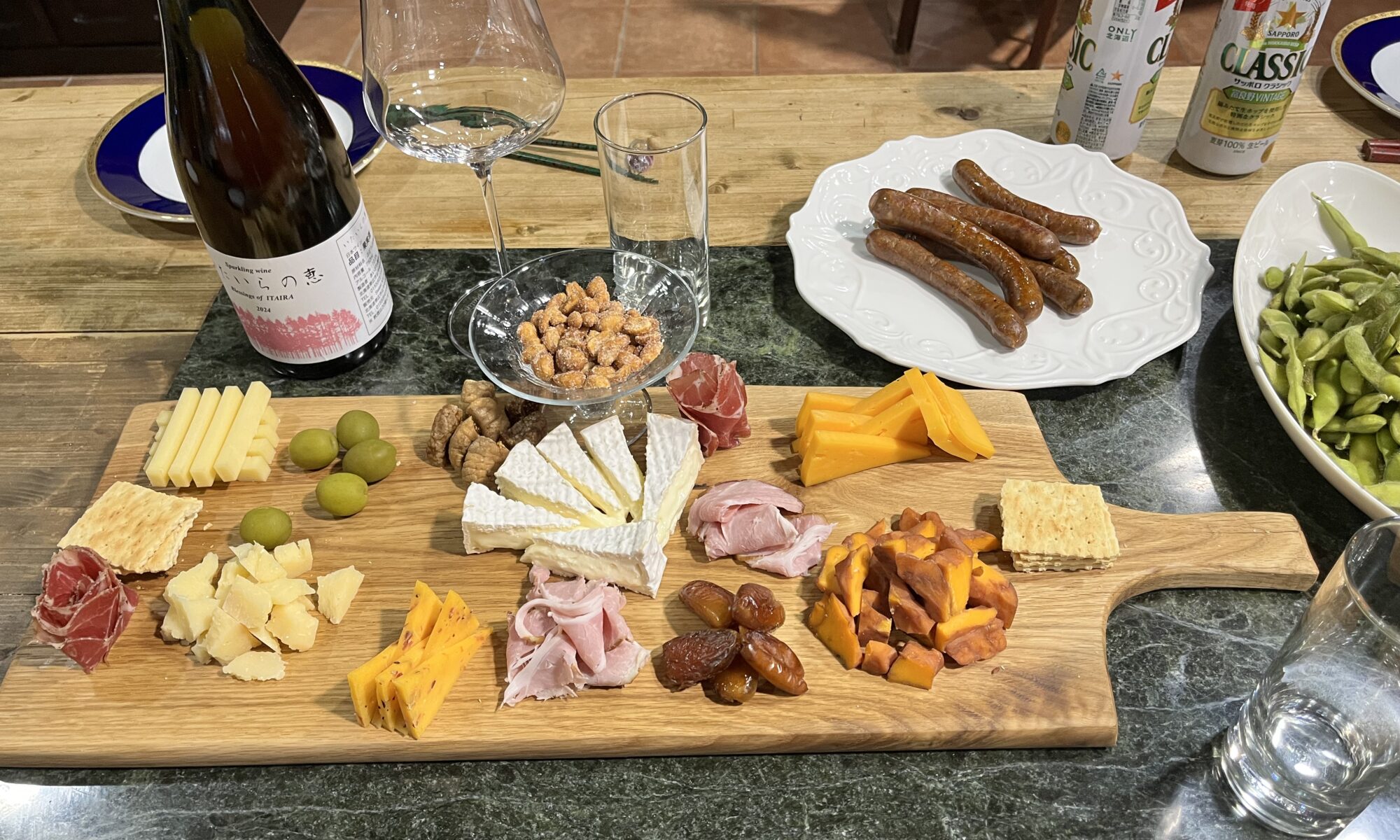
There is an international standard (CODEX STAN C-33, 1973) for Camembert cheese, which is available in two sizes: a mini size with a diameter of 6 to 8.5 cm, a height of 2.5 to 3.0 cm, and a weight of at least 80 g, and a standard size with a diameter of 10 to 11 cm, a height of 3.0 to 3.5 cm, and a weight of at least 250 g. The average composition of cheese is 19.8% protein, 24.3% fat, and 45-55% moisture. The Camembert-style cheese I made this time was 10cm in diameter and 6.5cm high, so it can’t really be called Camembert in terms of size, so when I make a cheese this size in the future, I’ve decided to call it “ITAIRA”, and when I add blue mold or something, I’ll call it “ITAIRA something”. The “ITAIRA Blue” I made this time was a failure, but when you cut it up and eat it, it has a subtle blue cheese flavor and is delicious, and although it’s about the same size as a hard cheese, it matures quickly and is ready to eat after about 30 days. It has a wide range of uses and can be used in sandwiches and cooking, so from now on I think I’ll make my own Camembert-style cheese mainly using “ITAIRA”, and adding blue mold, dried fruit, nuts, etc.
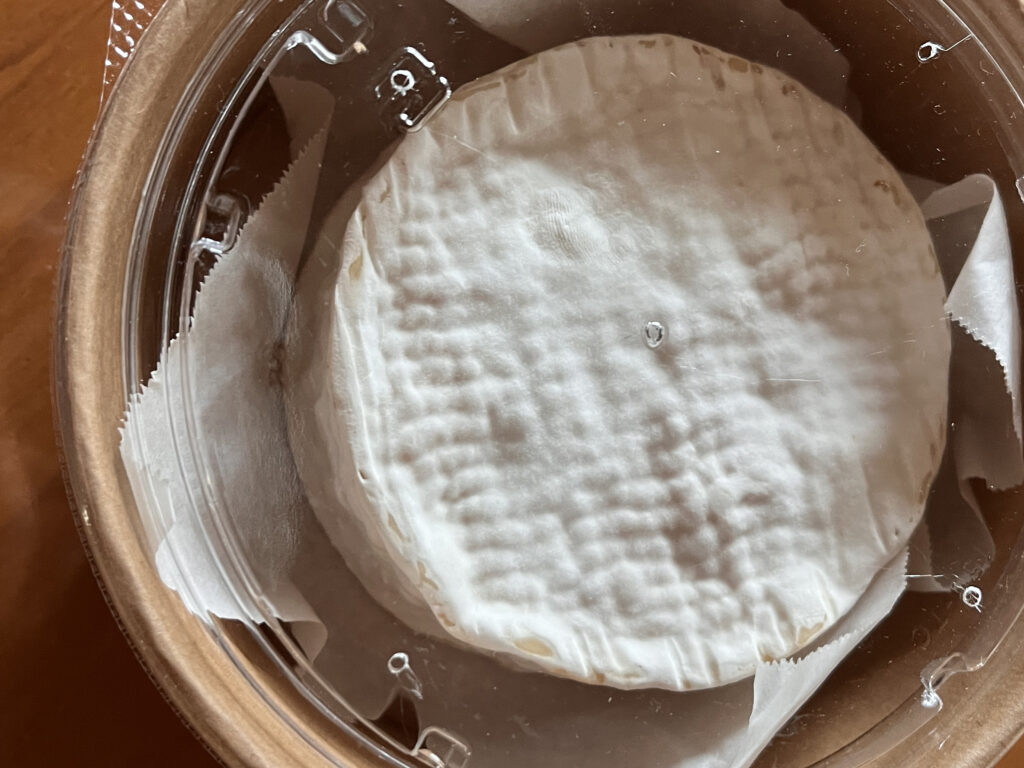
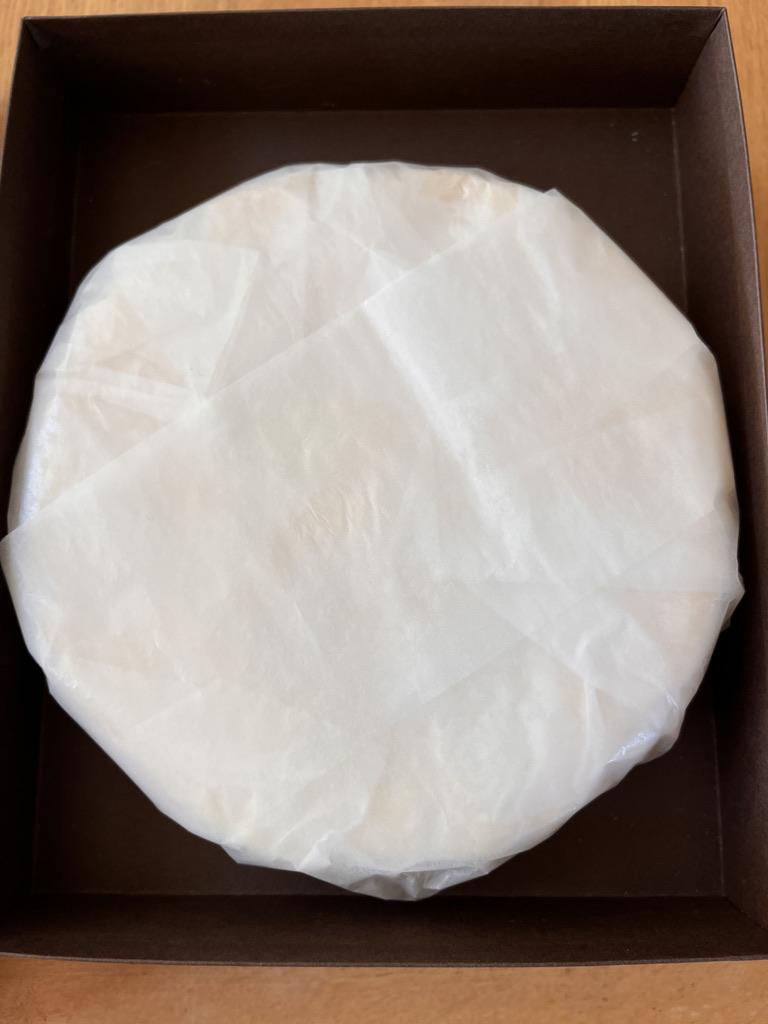
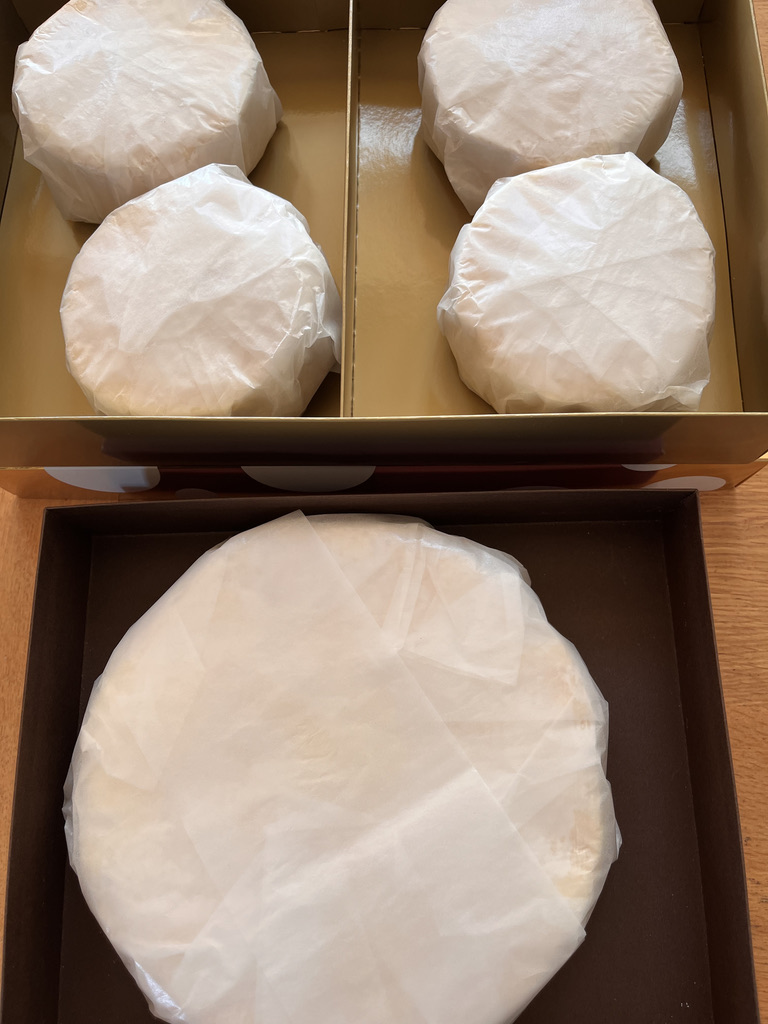
Start of secondary aging of Camembert cheese The cheese is now covered with a colony of white mold caused by penicillium, so we let it dry for half a day, then wrapped it in oven paper and placed it in ice cups to begin the secondary aging process in a wine cellar at a temperature of 7 to 8 degrees C. The ice cups will maintain the humidity, which will allow the white mold to multiply further. I am looking forward to the next two weeks.
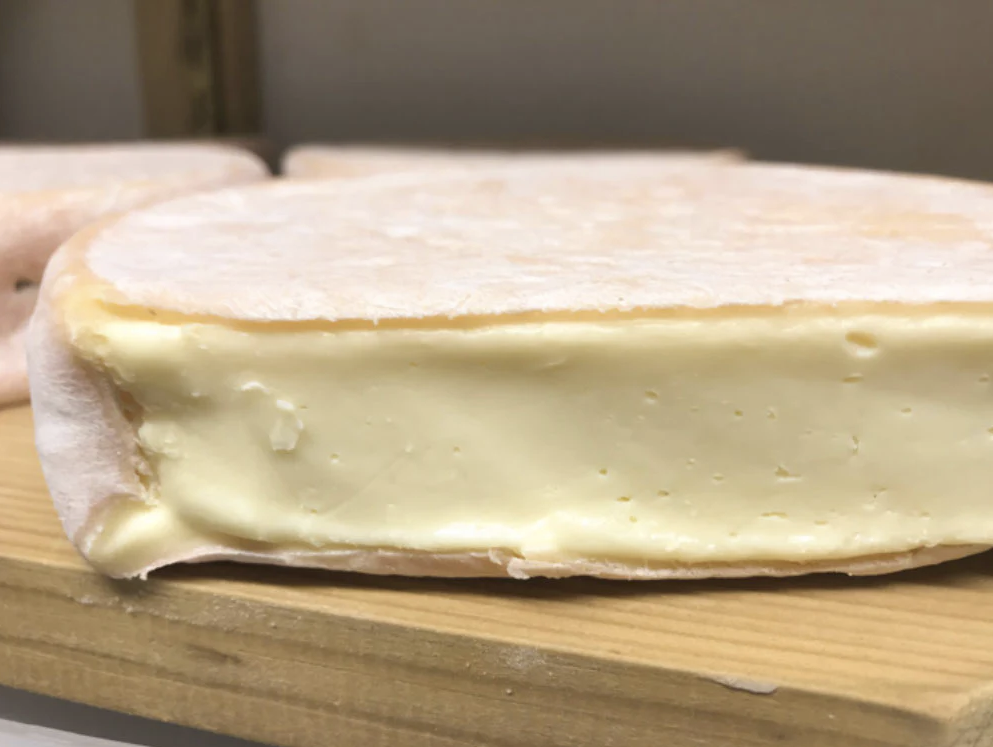
Ripening of Camembert Cheese After Camembert cheese is made, it typically develops a mottled white appearance due to the growth of Penicillium camemberti and Geotrichum candidum molds. The molds ripen the cheese for a minimum of three weeks, allowing the flavor to develop. This ripening process continues while the cheese is being packaged, and the stickiness of the Camembert increases as the ripening process continues. The milk from which Camembert is made contains lactose, which is converted into lactic acid by bacteria in the cheese. The mold on the surface of the Camembert breaks this lactic acid down into carbon dioxide and water, which lowers the acidity on the surface of the cheese, creating a concentration gradient of lactic acid, which moves more lactic acid toward the surface of the cheese, where it is also broken down, and the cycle continues. After a while, the pH in different parts of the cheese becomes uneven, which begins to affect the structure of the cheese. As the lactic acid decomposes, the surface pH changes from about 4.6 to a maximum of 7.0. This change in pH affects the solubility of calcium phosphate. In cheese, calcium phosphate holds together clusters of milk casein proteins called micelles. As the pH of the cheese increases, the solubility of this calcium phosphate decreases and it begins to precipitate near the surface of the cheese. This causes a concentration gradient of calcium phosphate in the cheese, which draws more calcium phosphate from the center of the cheese. This is an important factor in making the cheese soft.
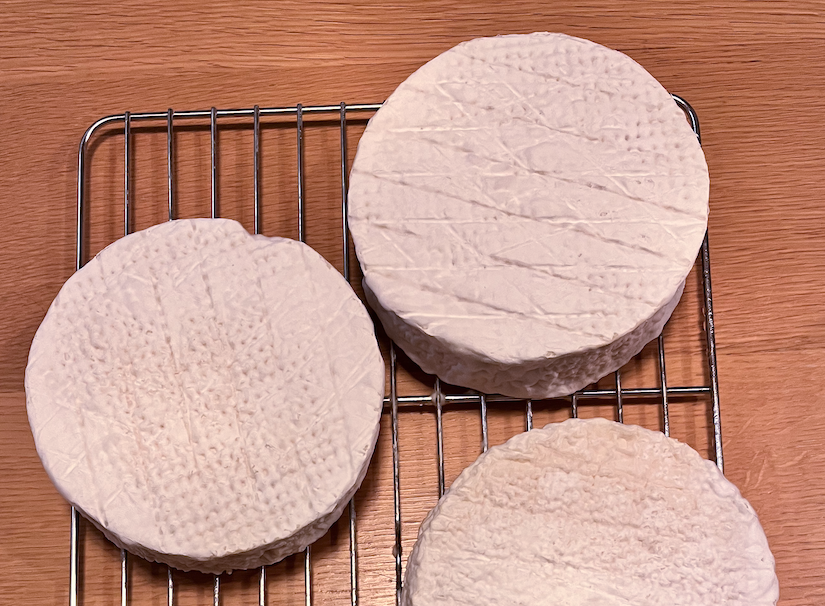
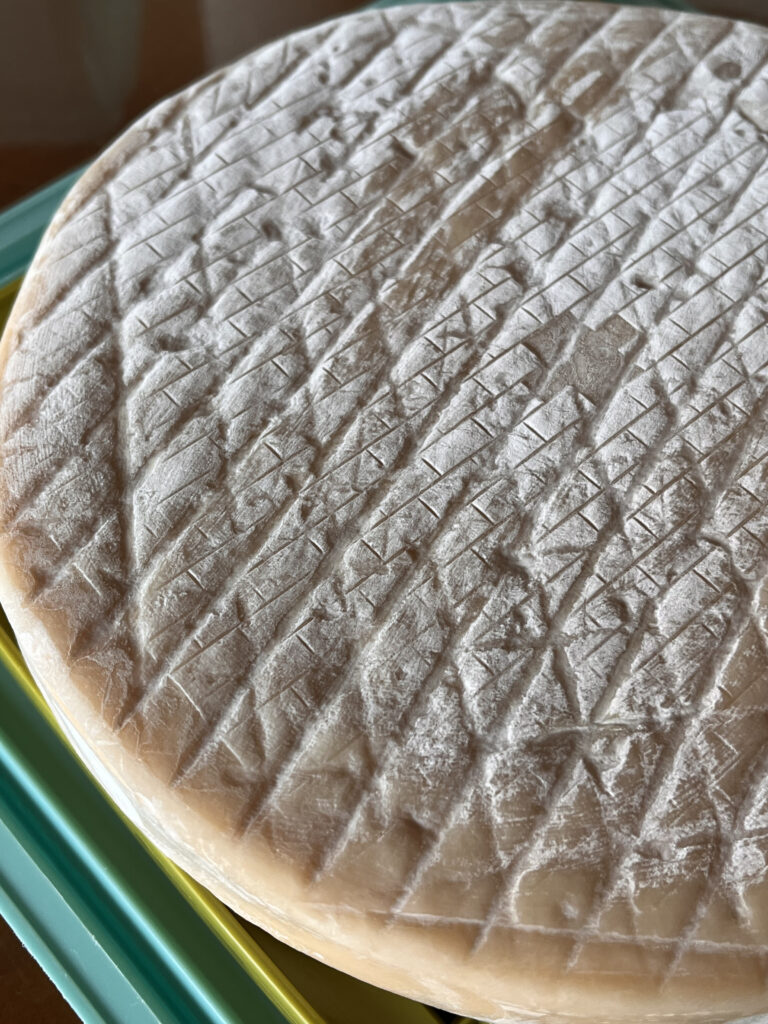
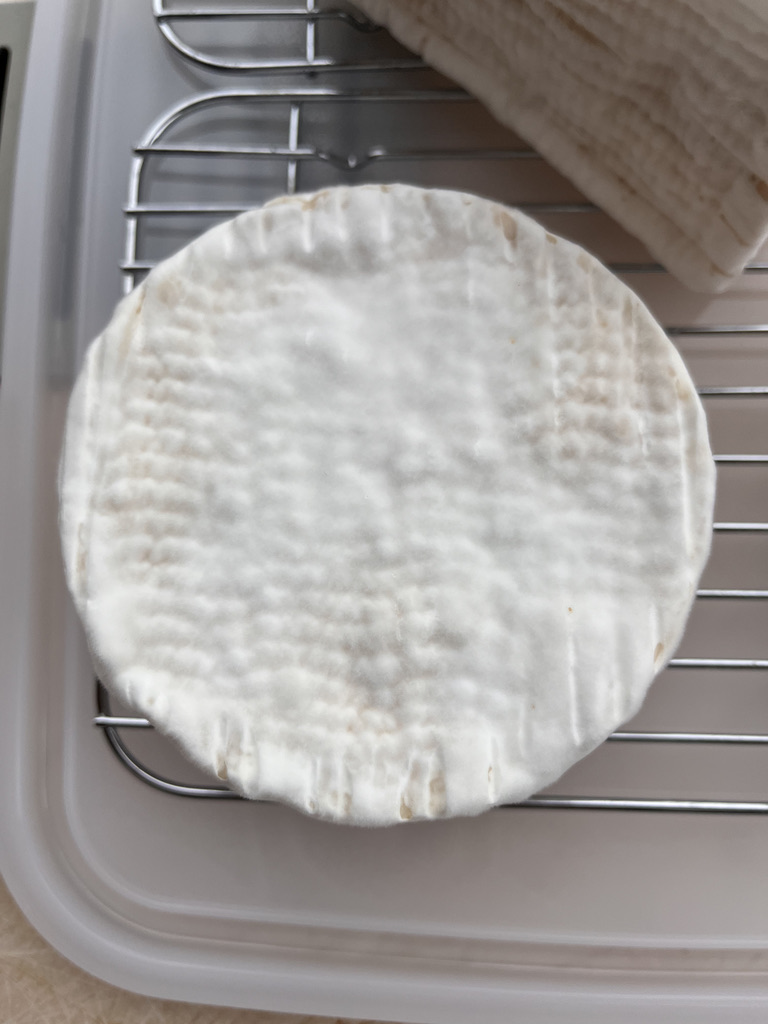
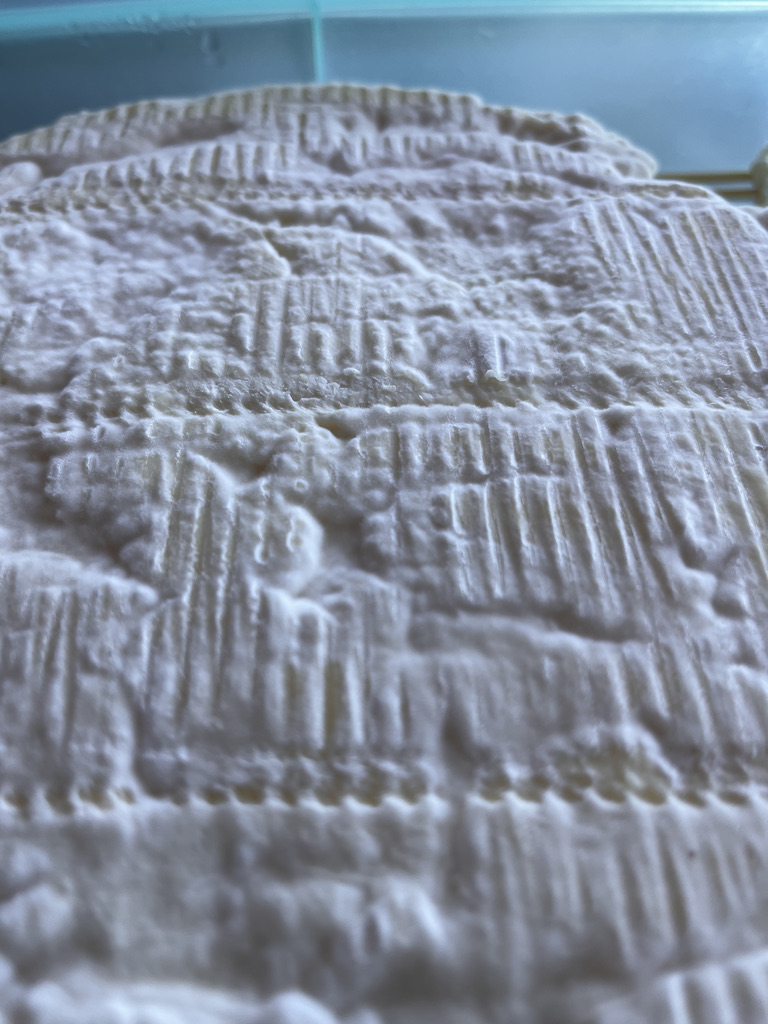
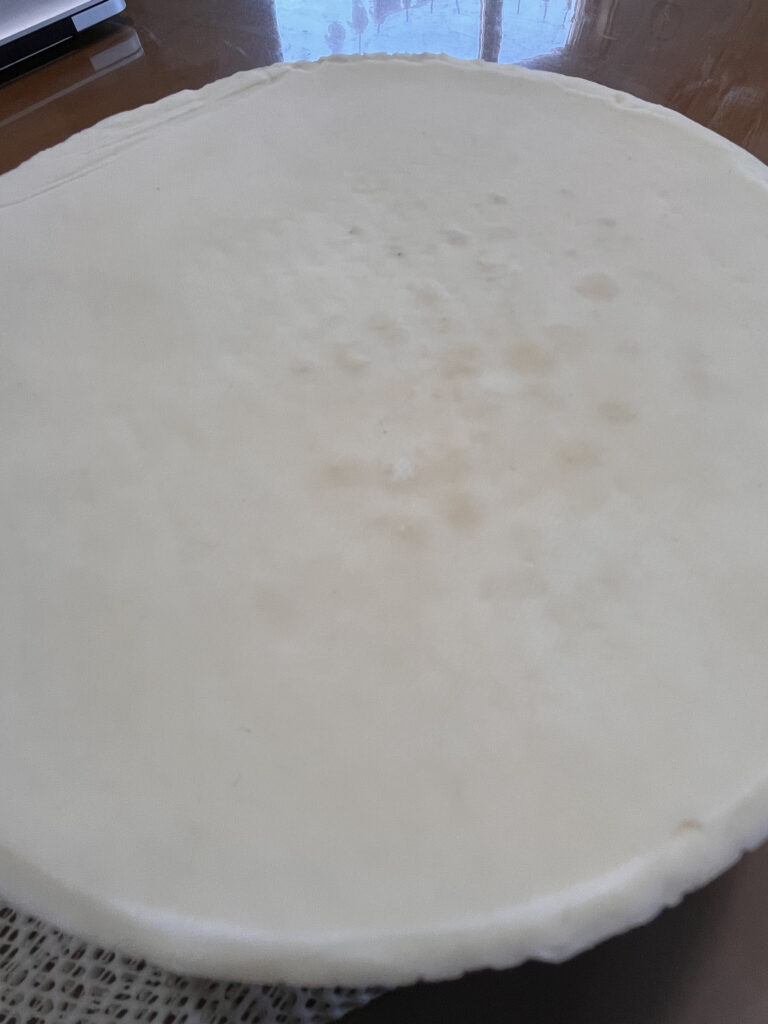
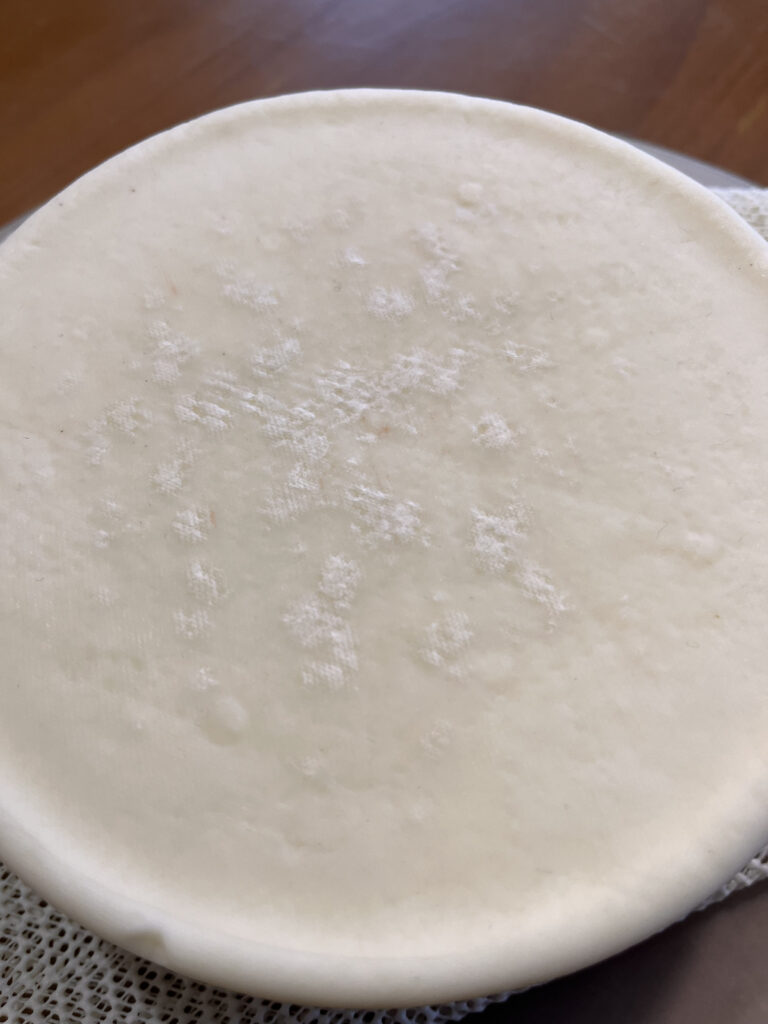
熟成開始6日目 G. candidumによる毛足の短いカビの他にP.candidumによるやや毛足の長い白カビのコロニーが見え、カマンベールチーズ独特の香りも強くなってきた。今週末には二次熟成に入れそうです。
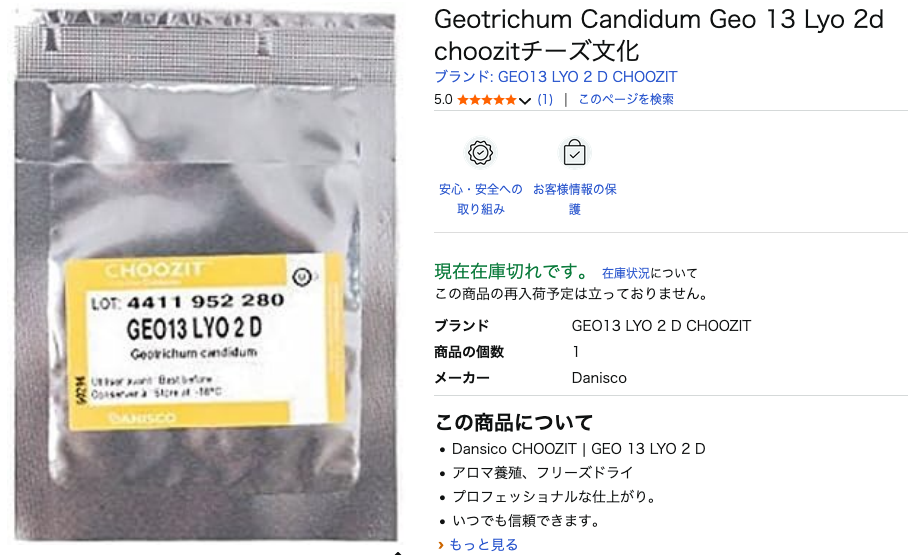
Sixth day of ripening In addition to the short-haired mold caused by Geotrichum candidum, a colony of white mold with slightly longer hairy legs caused by Penicillium candidum is visible, and the distinctive aroma of Camembert cheese is becoming stronger. It looks like it will be ready for secondary ripening this weekend.
Second day of ripening The entire cheese is now covered with a thin layer of small mold caused by G. candidum. In soft cheeses, G. candidum grows from the first day of ripening, while P. candidum begins to grow after one week. In five days, white mold caused by P.candidum should cover the cheese. I am looking forward to it.
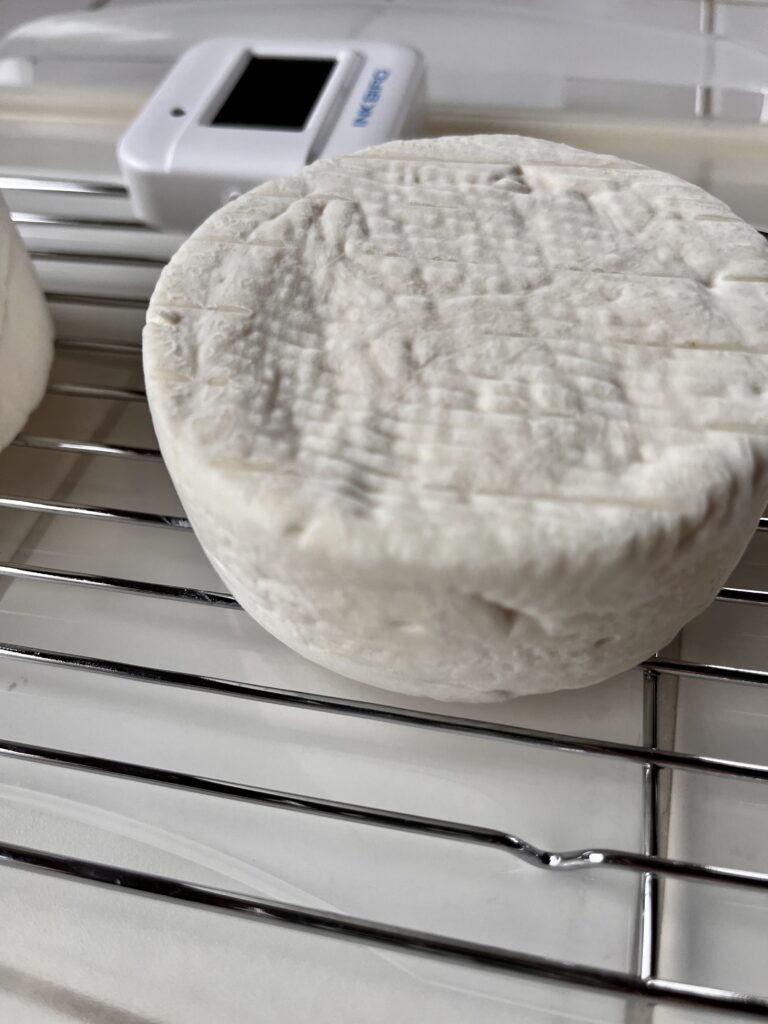
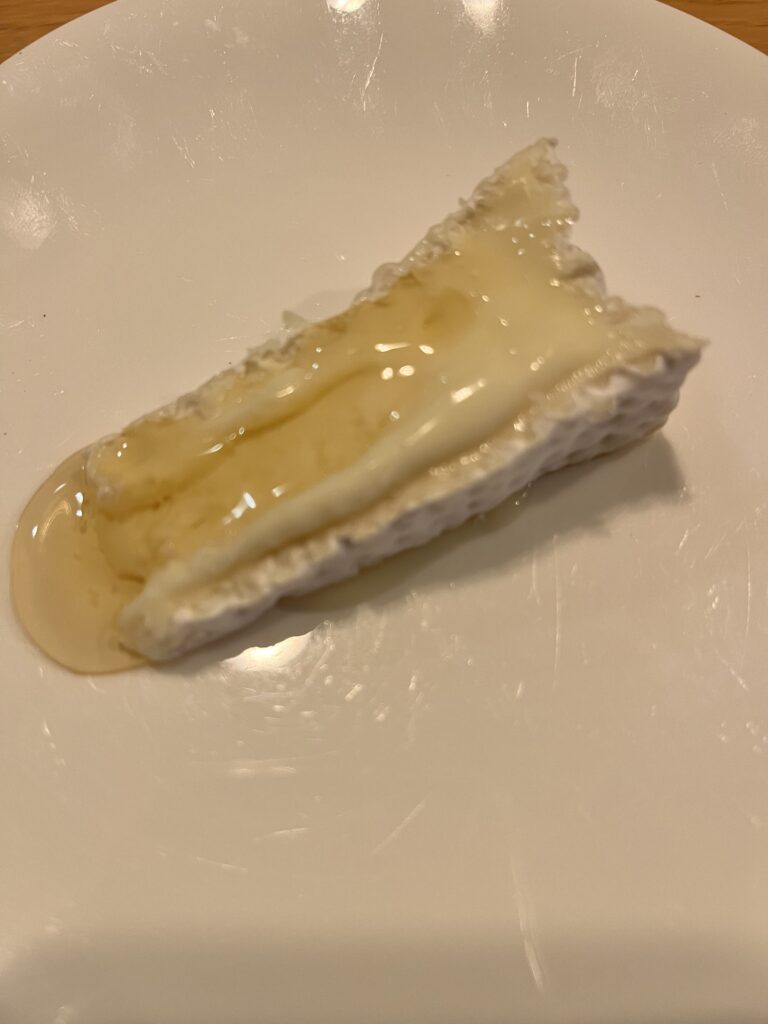
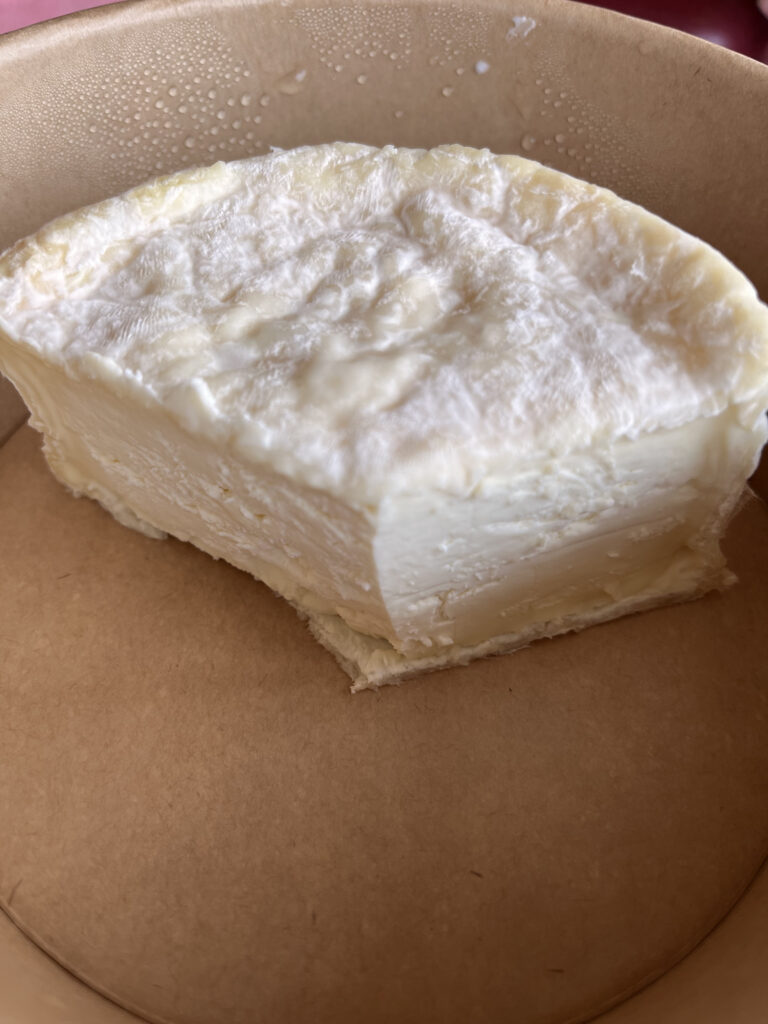
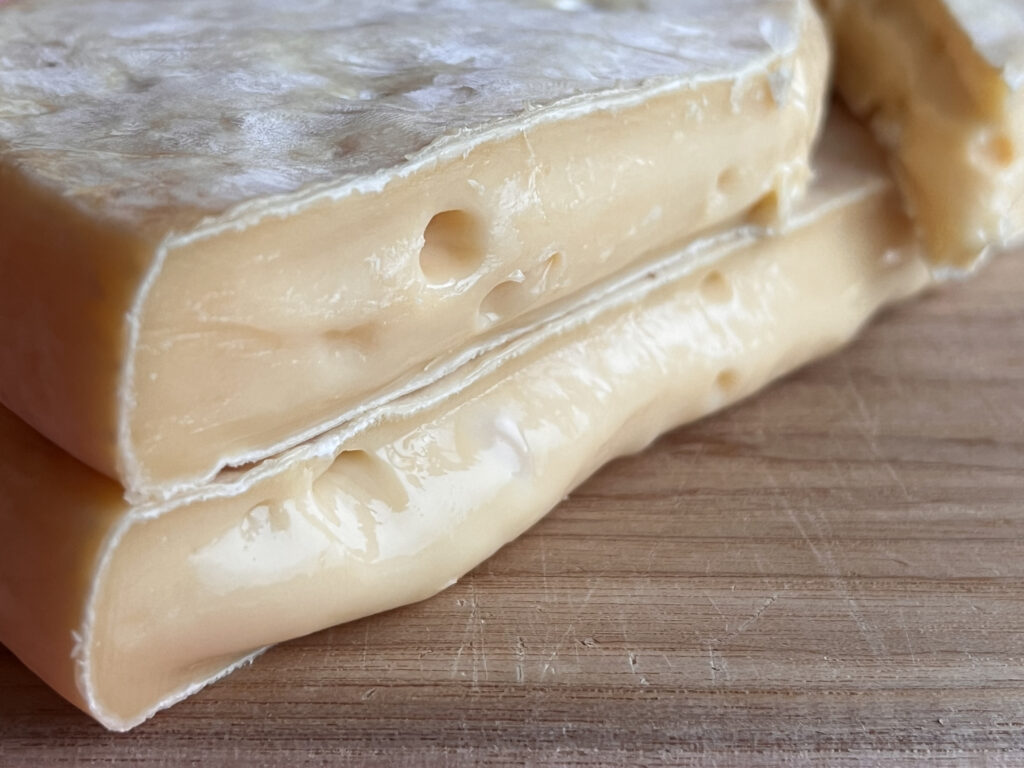
Secondary aging of Camembert cheese (made on 5/27) with Thistle Rennet added as a protease has started. After air-drying the rind, some cracks appeared and a little melted cheese came out from inside. It is the 10th day of ripening and the cheese seems to be liquefying considerably.
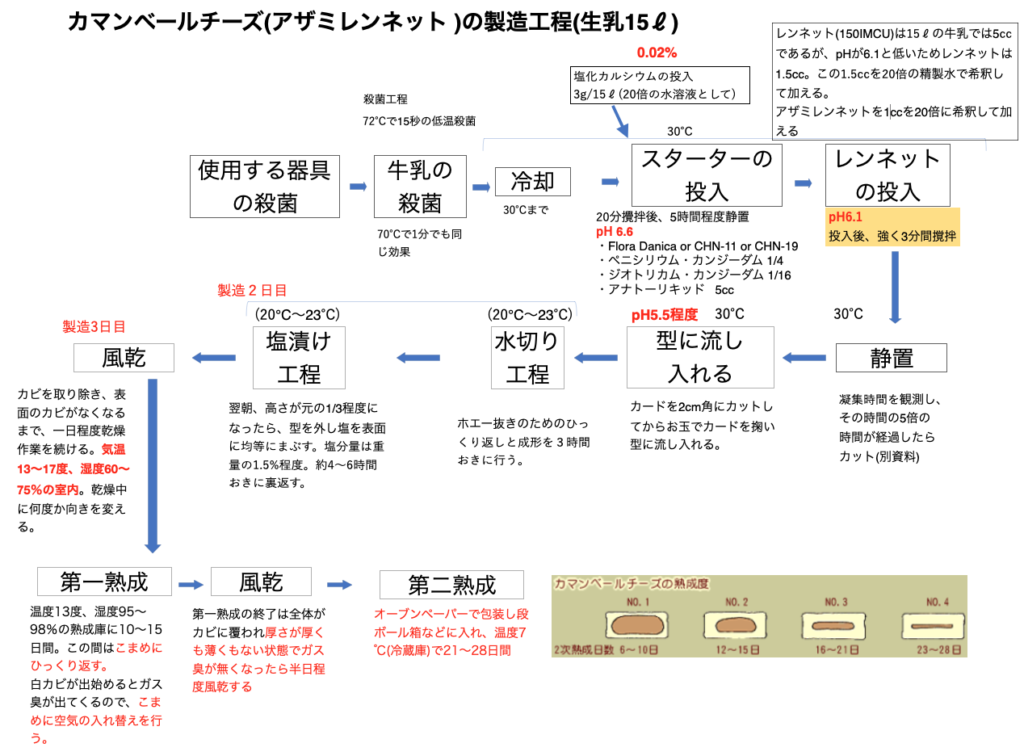
This is my third time making Camembert cheese. The goal is to produce a white surface and a yellowish, almost orange interior, with a quick second ripening and a prodigal texture. It is said that Camembert cheese is matured by hydrolyzing α-casein and β-casein in the cheese by the enzyme of mold fungus. In this case, we added Azamirennet as a protease to hydrolyze all the casein, which we believe will accelerate the secondary ripening process. However, since excessive degradation of β-casein can cause bitterness, only a very small amount of thistlelenet is used.
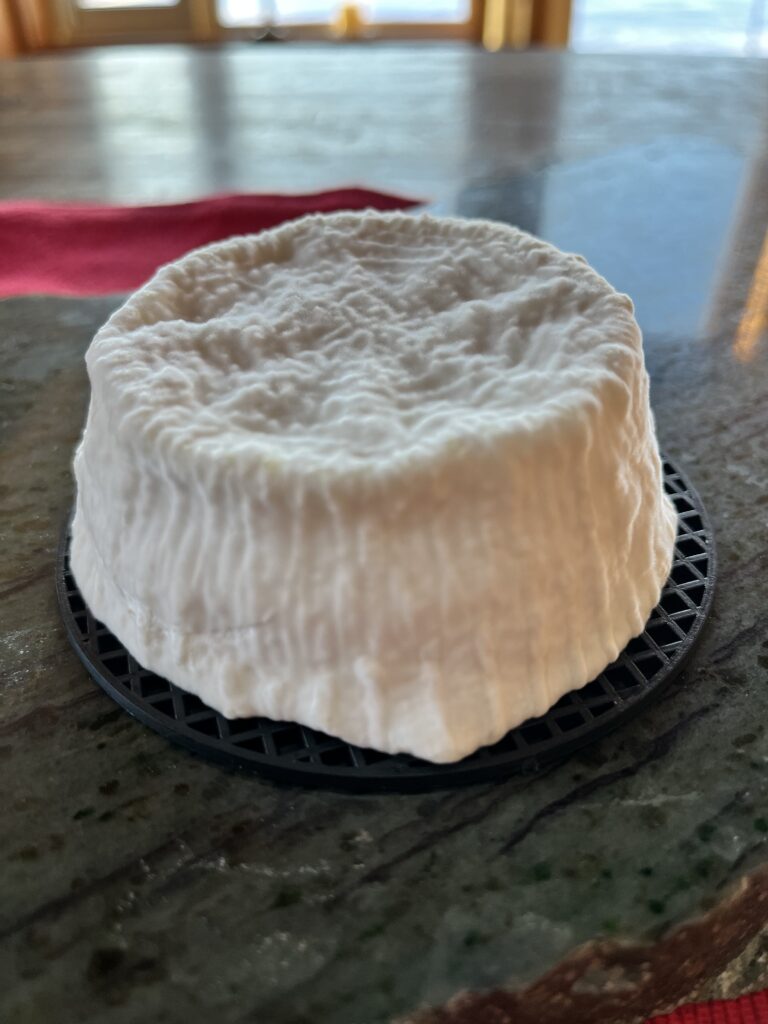
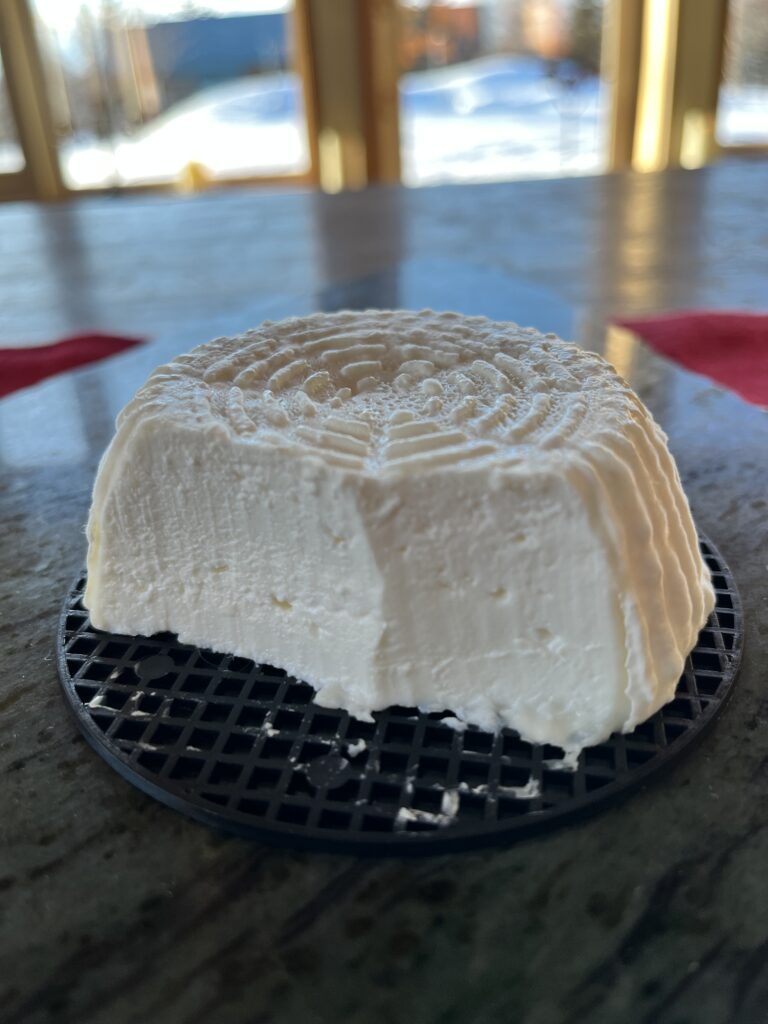
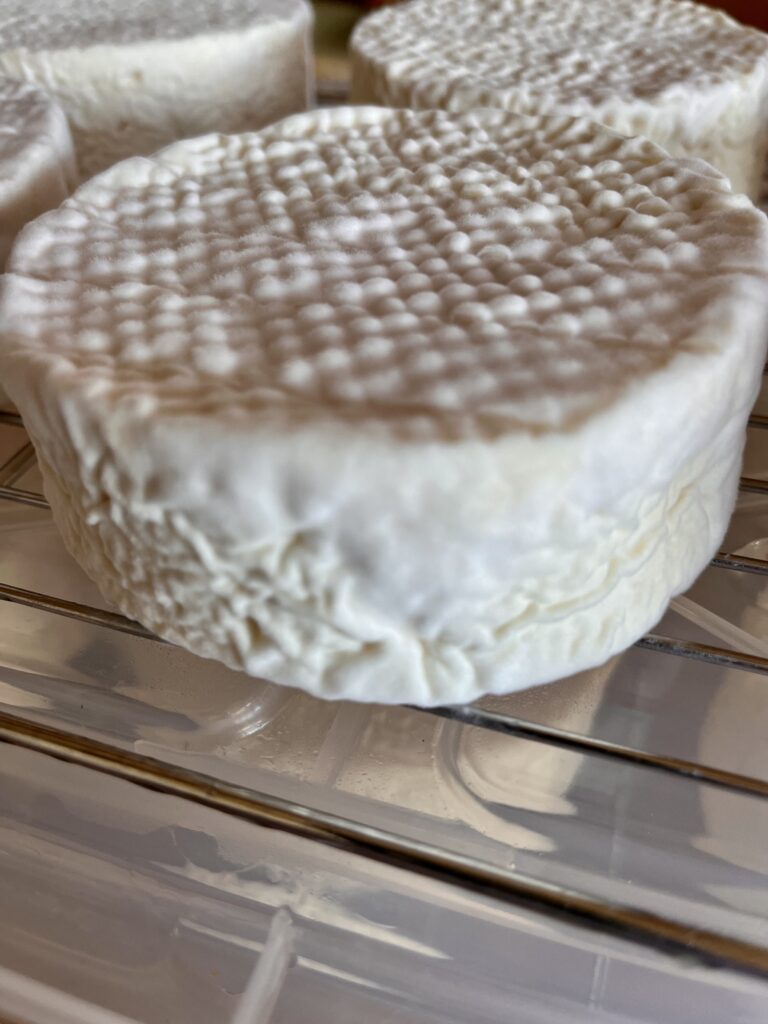
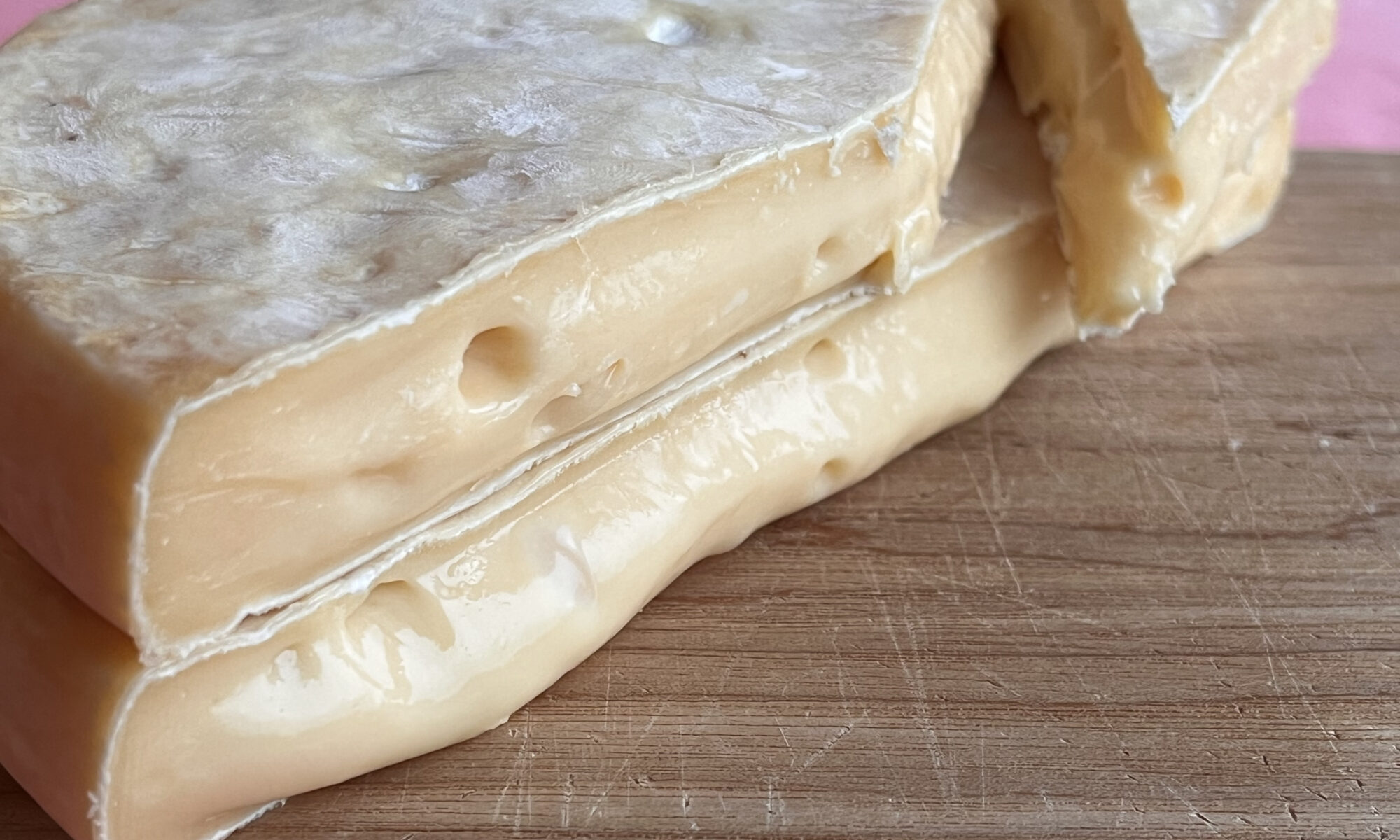
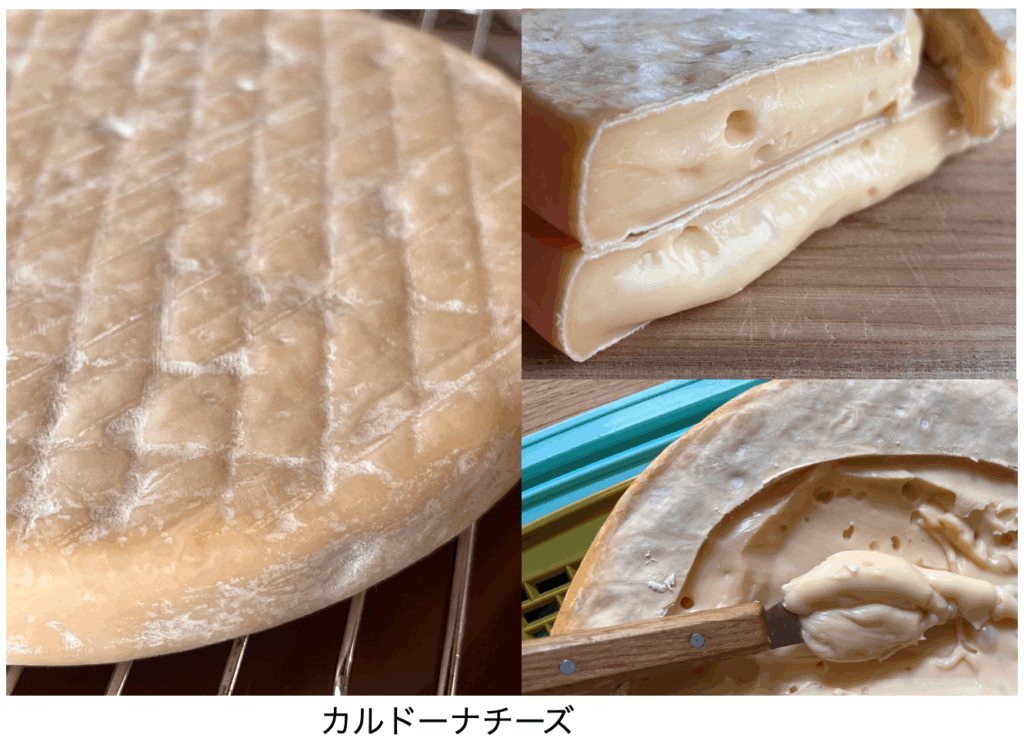
I cut one of the cardoona cheeses I made on April 22. When I cut it, the cheese came out from inside as if it was pushed out. It was the first time I had ever eaten it. I want to let the other one mature for another week or two and scoop it up with a spoon.
We will be making Camembert cheese for the third time. This time, we will culture the lactic acid bacteria and mold bacteria to be added and see if the target cheese can be made from the culture. We will add thistle rennet as a protease to see how fast the secondary ripening process will be, and we will also add annatto to give it a yellowish-orange hue. The goal is a white surface with an almost orange-yellow interior and a prodigal texture. We are also considering freezing and storing lactic acid bacteria, including mold fungi, as seeds for the fourth round of Camembert cheese making. If the preservation of the seed fungi is successful, we will be able to reduce expenses.
A white film of mold has appeared. The entire surface also appears to have turned a light orange color. The white film on the surface is wiped off in the wash, and the cheese is turned over and stored. This process is repeated every 3 to 5 days for about 3 weeks, and when the cheese is soft, the edges are tied with a strip of material to prevent it from spreading.
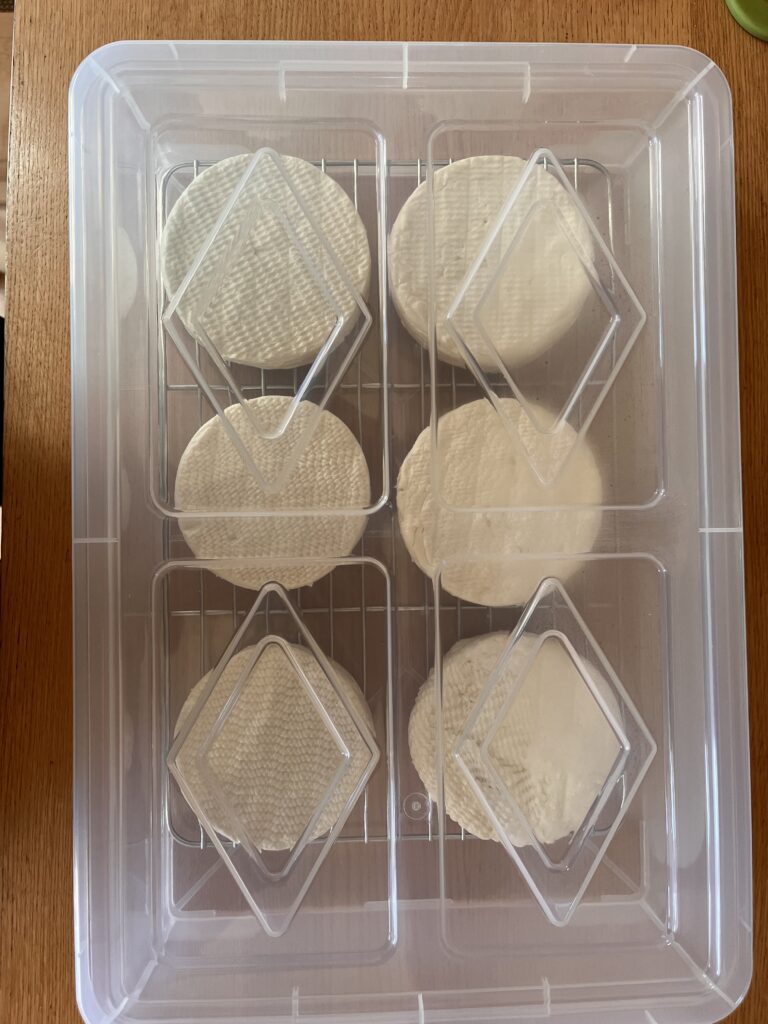
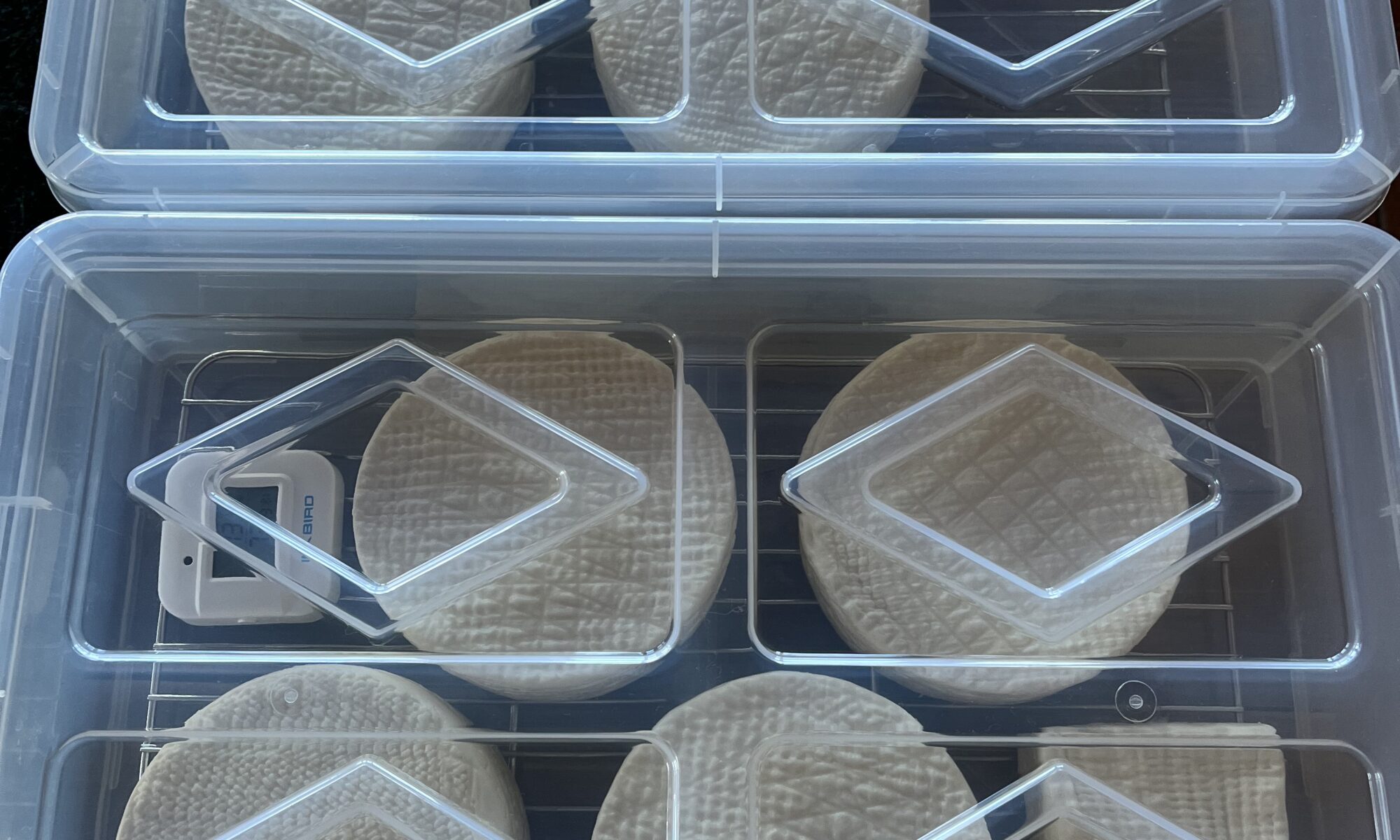
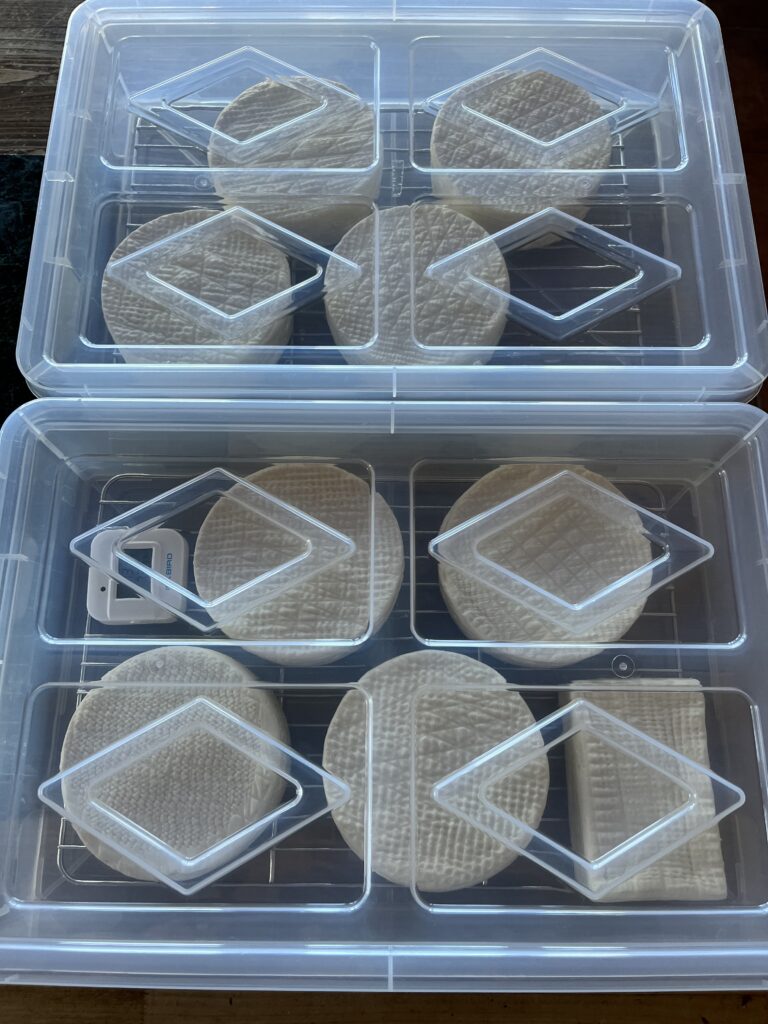
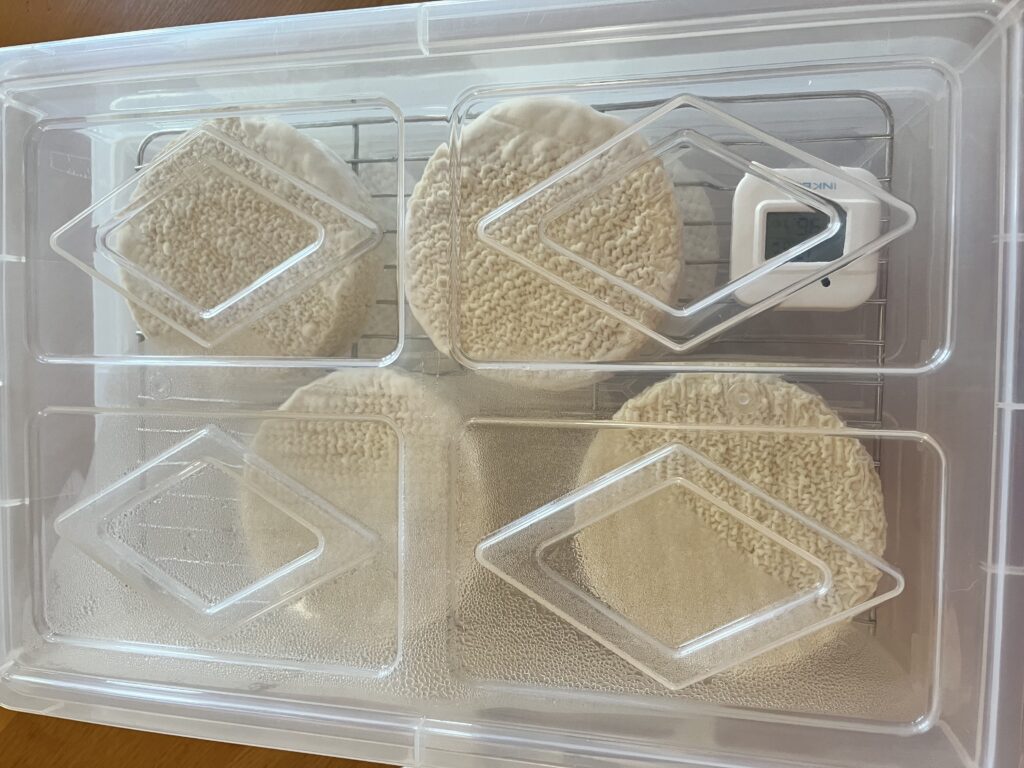
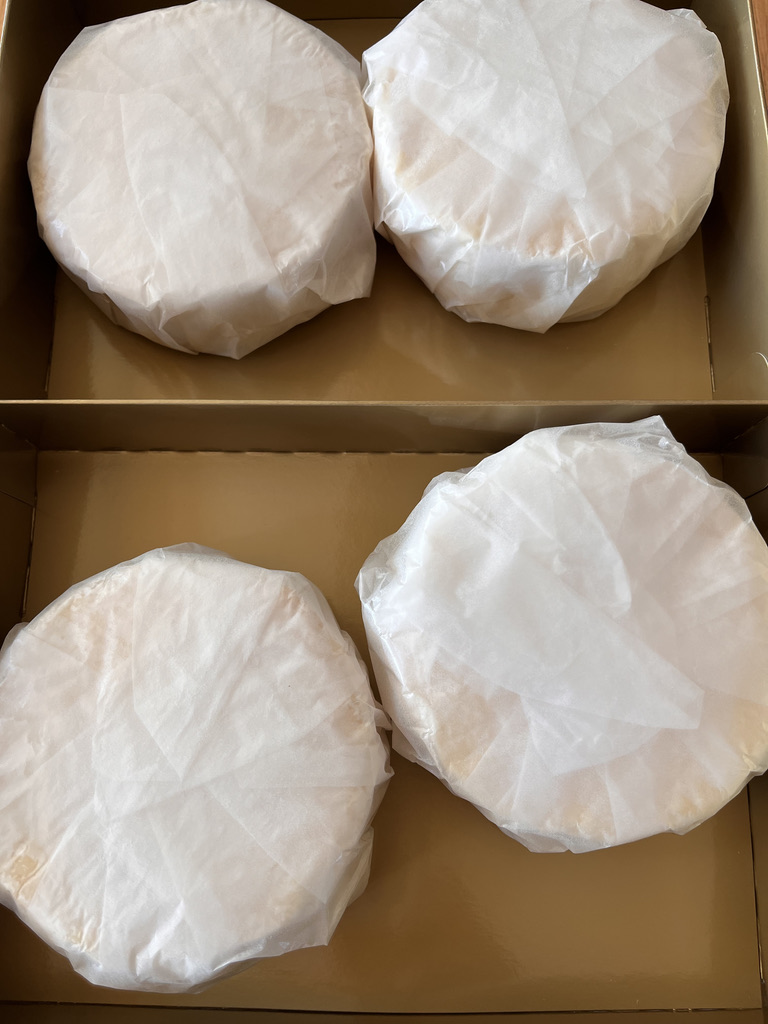
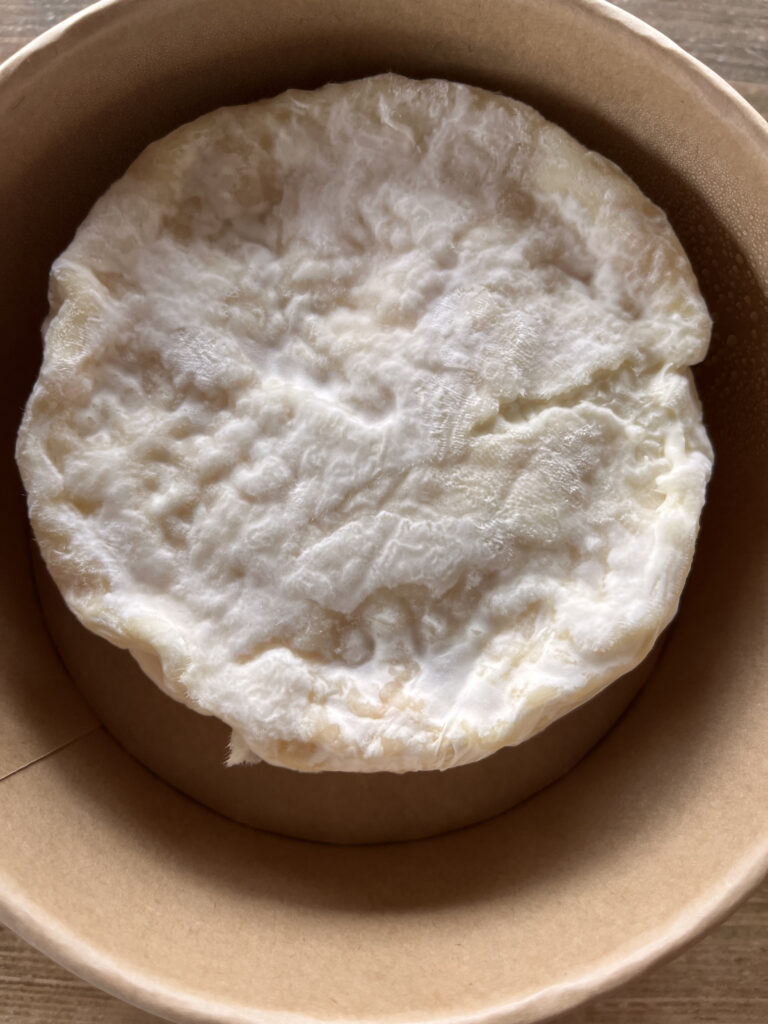
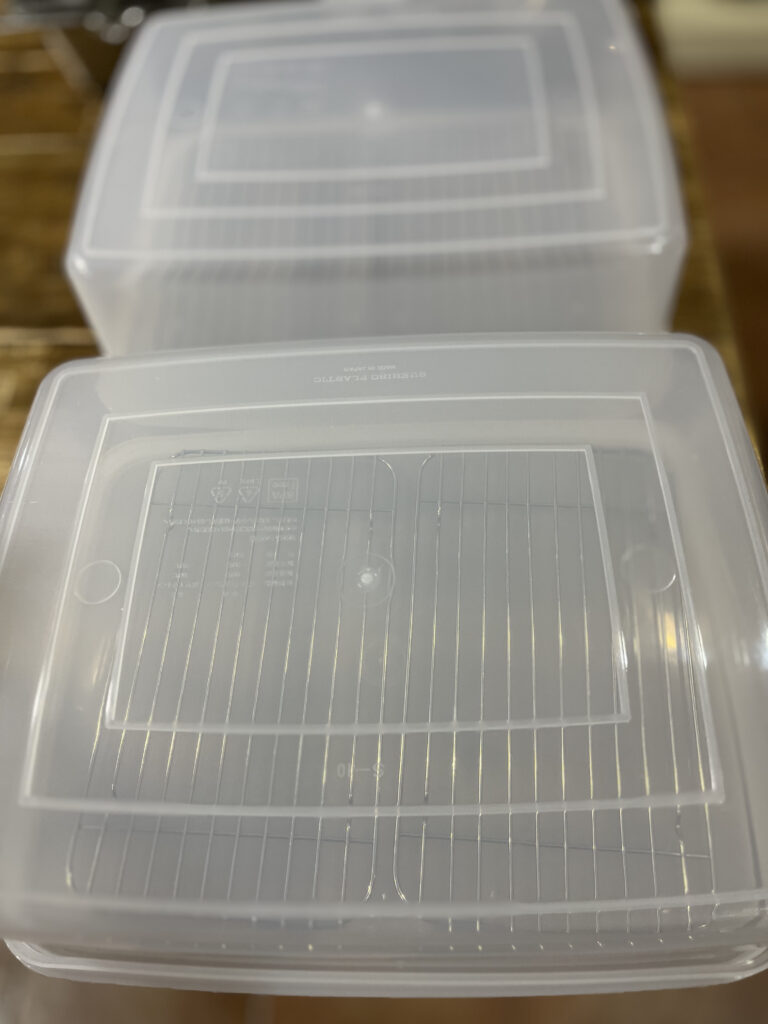
Secondary aging of Camembert cheese is usually done by wrapping it in wax paper and then placing it in a cardboard box or other container and aging it in the refrigerator. This time, as an experiment, some of the cheeses were stored in simple sealed containers used for lunch boxes. I have drilled a few small holes in the lid, as I have heard that sealing the container will cause excessive ripening. I am looking forward to seeing how it turns out. I would also like to use thistle rennet the next time I make Camembert cheese. According to the manufacturer’s description, Thistle rennet has a more active cleavage site than conventional rennet, which cleaves only kappa casein, and cleaves not only kappa casein but also alpha, beta, and gamma caseins. When added as a protease rather than used for coagulation formation, it works very well for cheese liquefaction, and the increased number of active cleavage sites results in a smooth and creamy final product, according to the researchers. It also appears that the use of thistle rennet can create the flavor of aged cheese in a very short time!
Camembert cheese, 10 days have passed since the first primary ripening. The thickness of the white mold has increased and the gas smell has decreased. A few days later, the cheese enters the second stage of ripening.
The second Camembert cheese I made also has white mold. It is doing well. It is now ripening to change the mistakes made the first time.
surface drying after salting If drying is not done properly, when the cheese is turned over after the mold has grown, the moldy part where the fingers touch the surface will peel off.
the wrong paper was used to wrap the cheese during secondary aging. When wax paper was used, it stuck to the cheese. This time, we plan to change to oven paper, which does not absorb moisture.
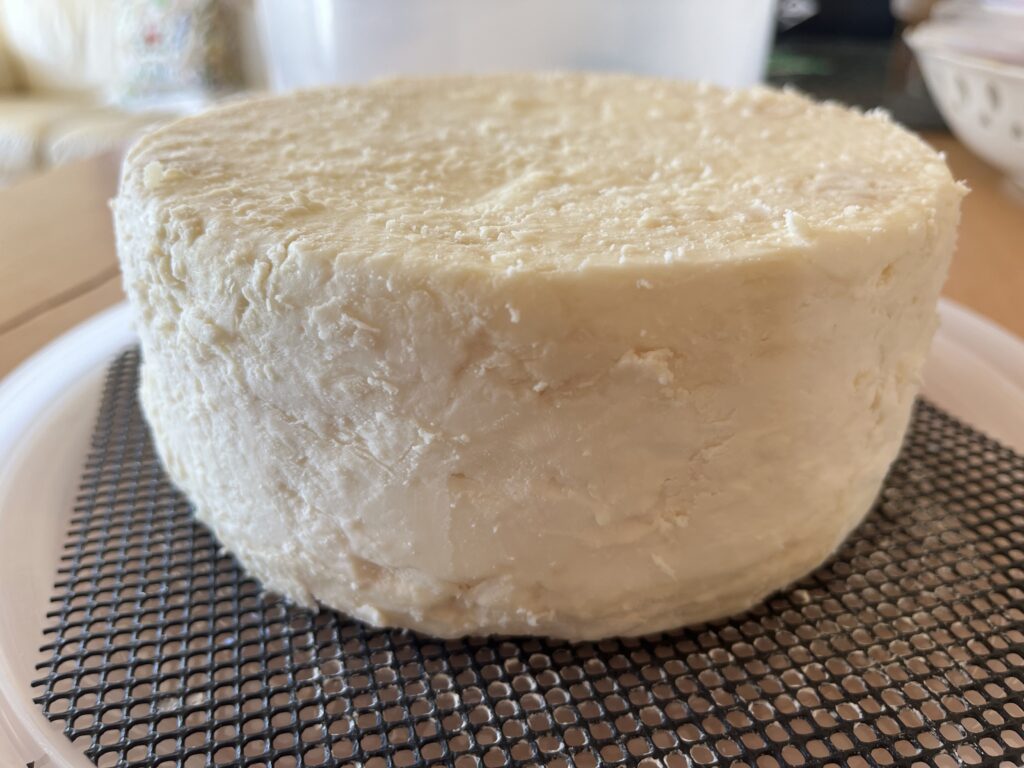
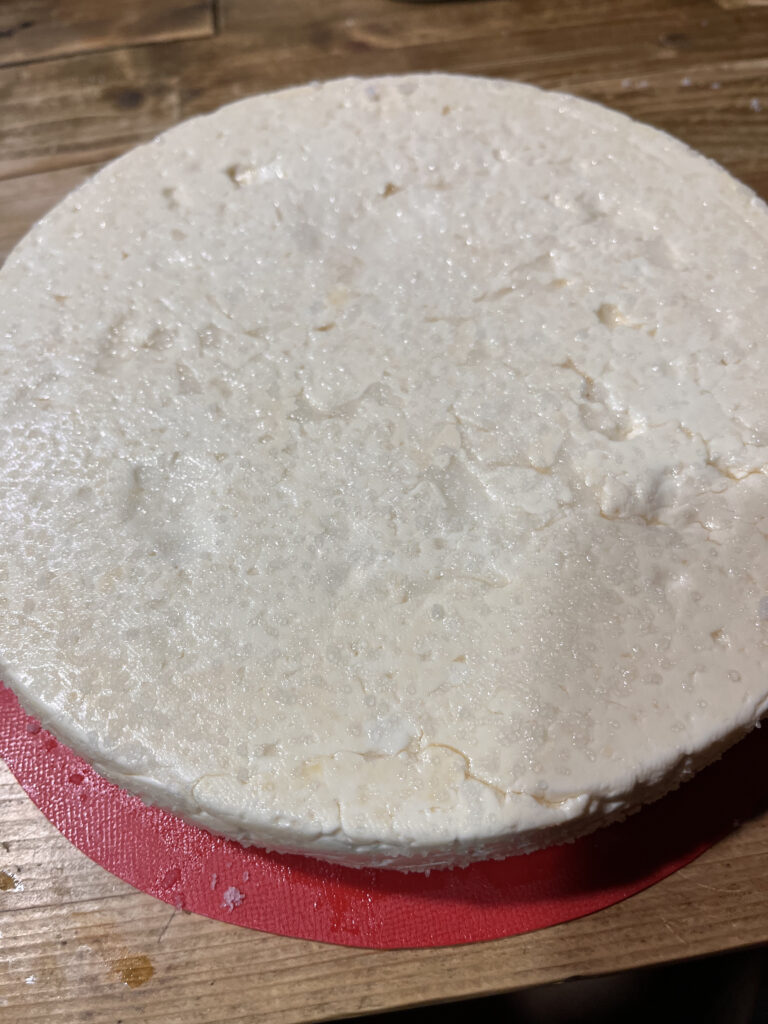
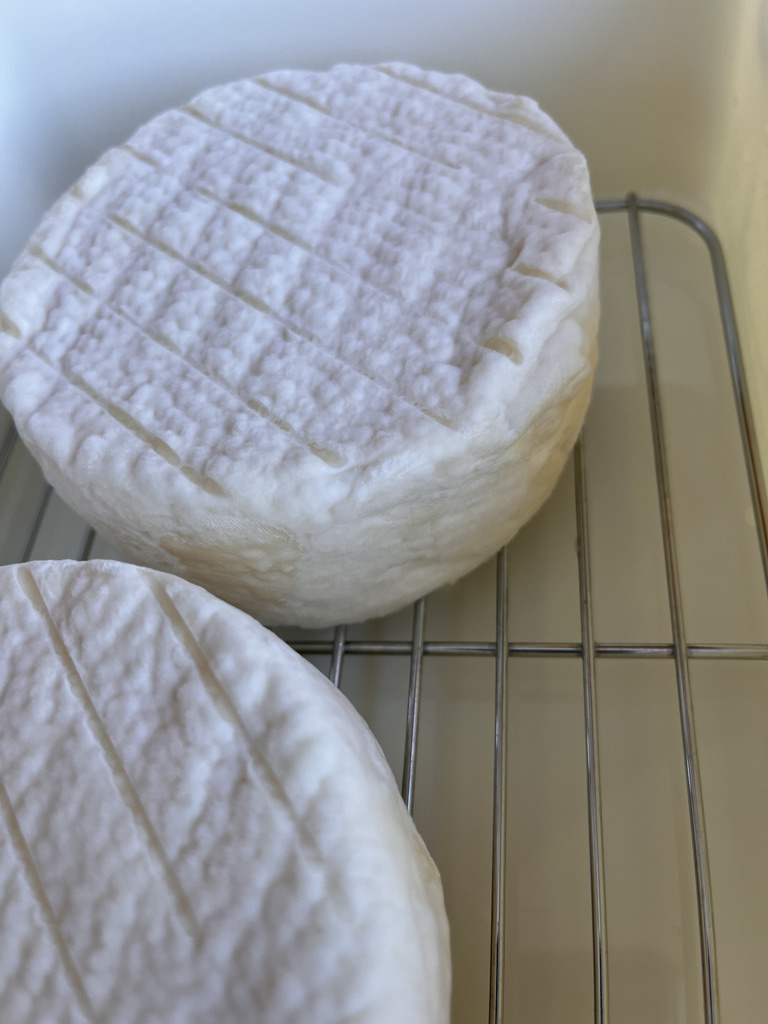
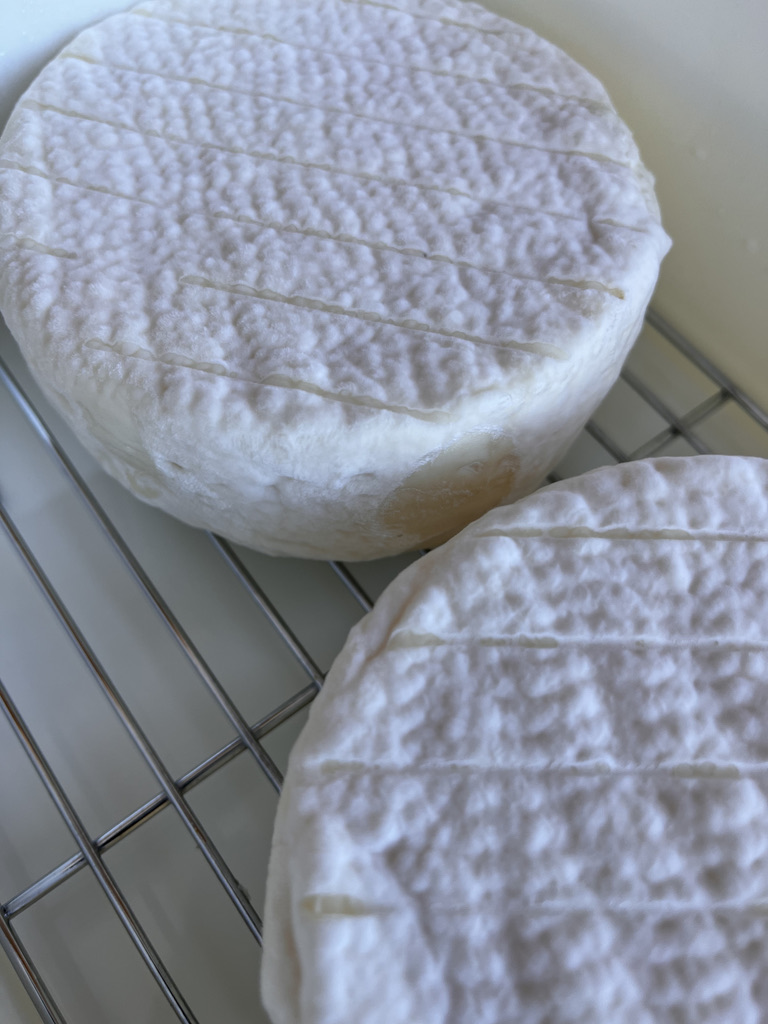
I made my first homemade Camembert cheese a month ago and it is now undergoing secondary aging. I am eating a little bit of it to check the ripening status and it is getting creamier day by day.
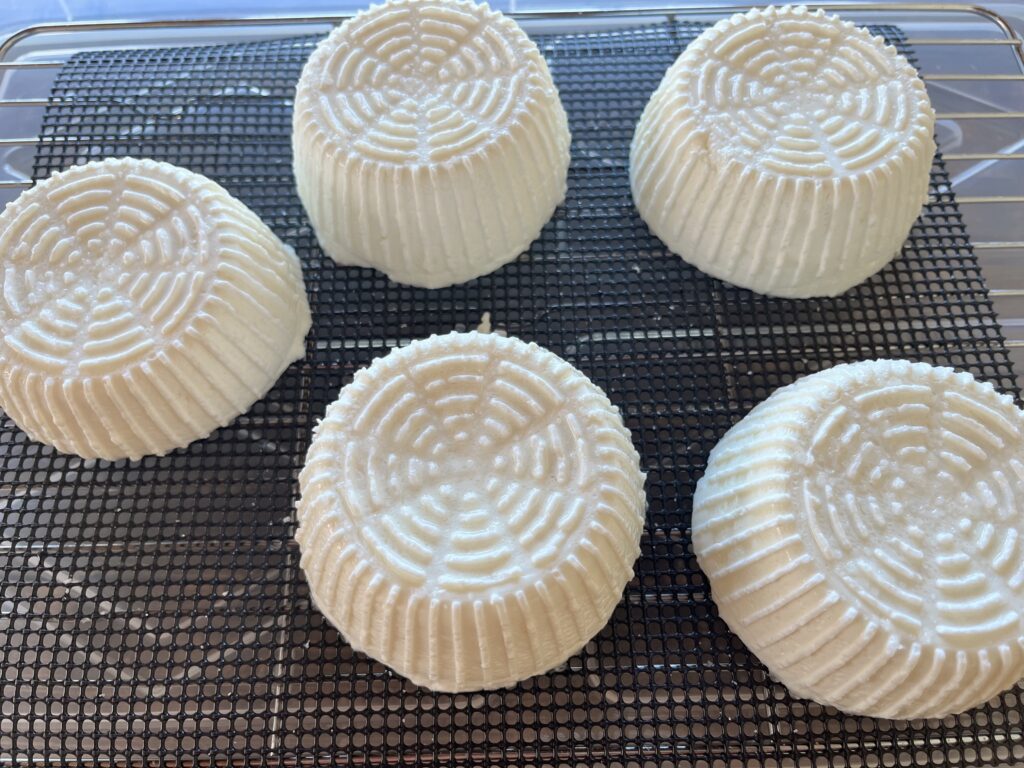
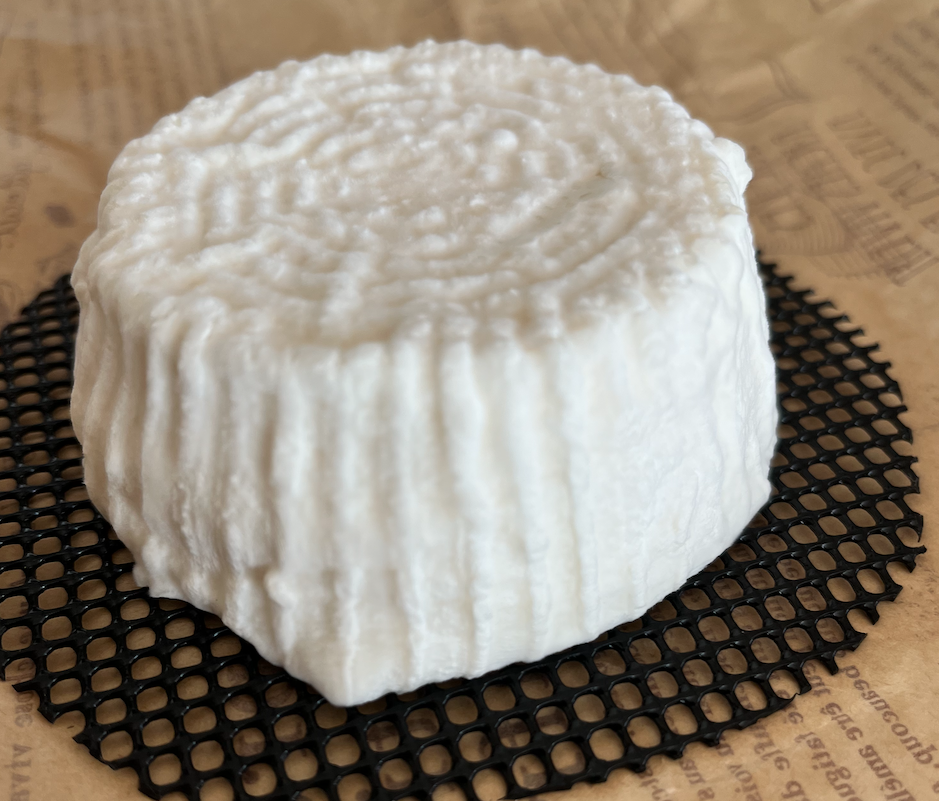
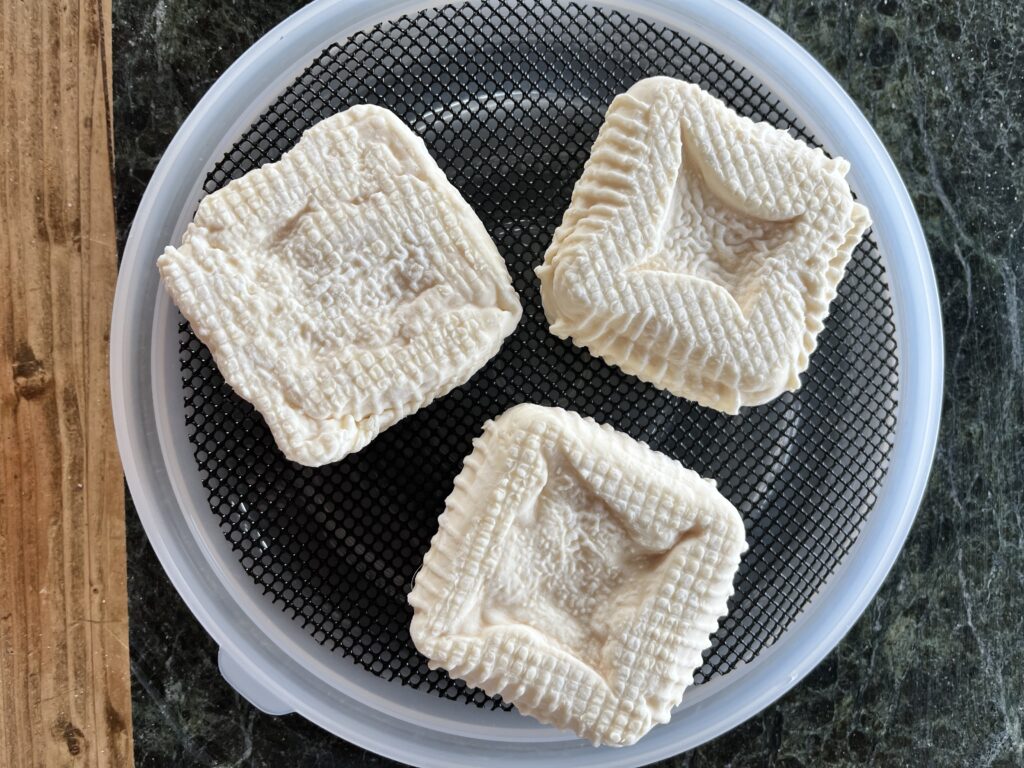
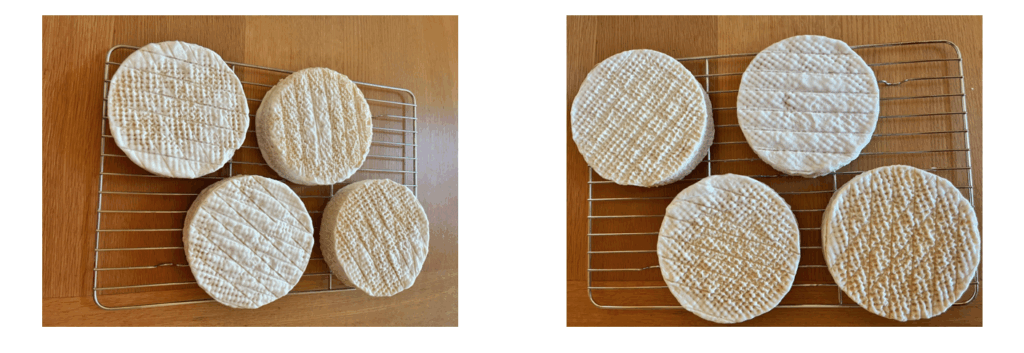
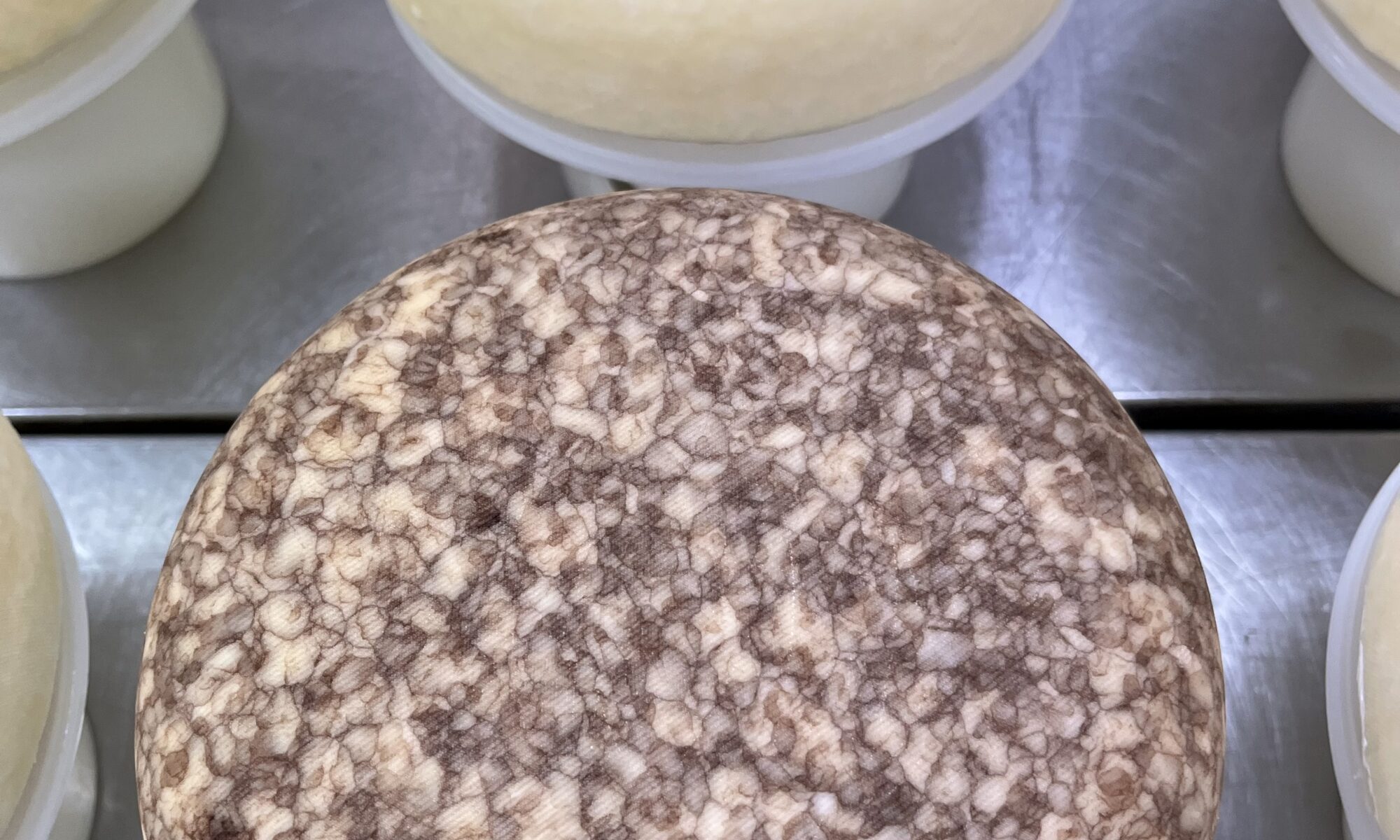
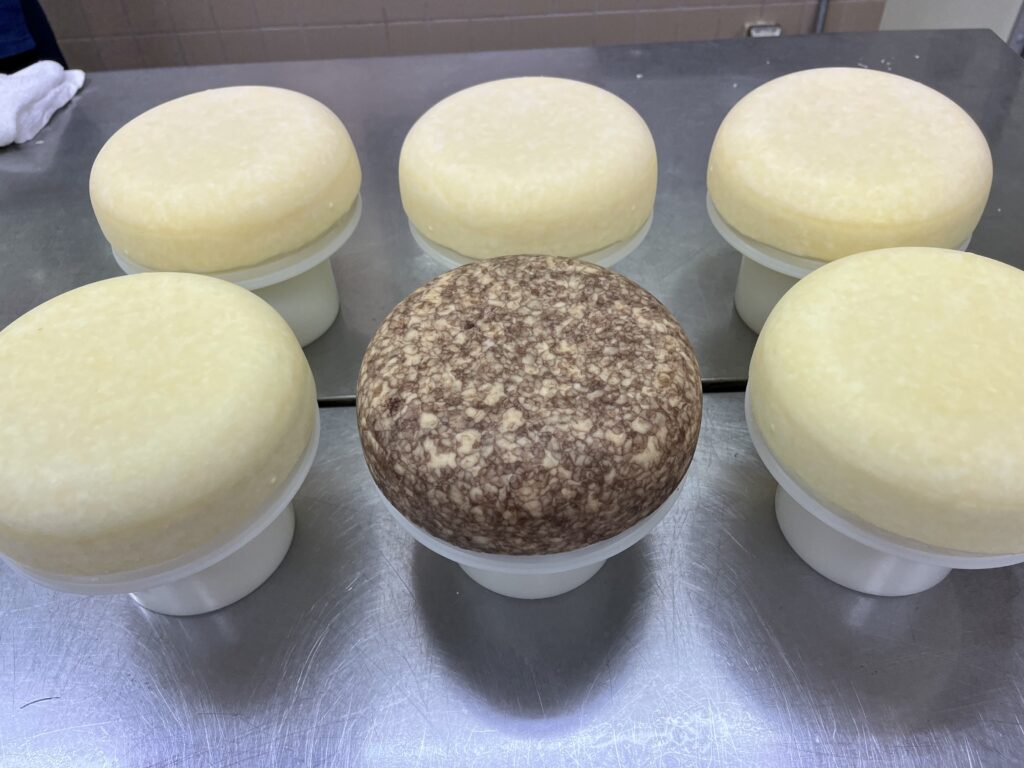
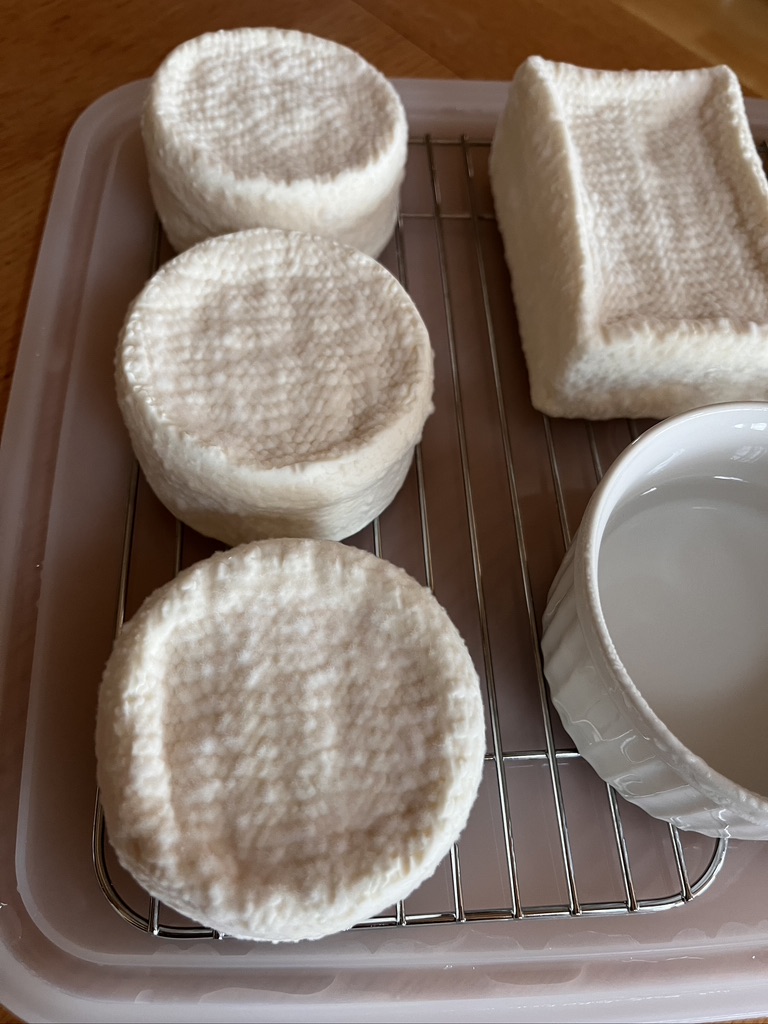
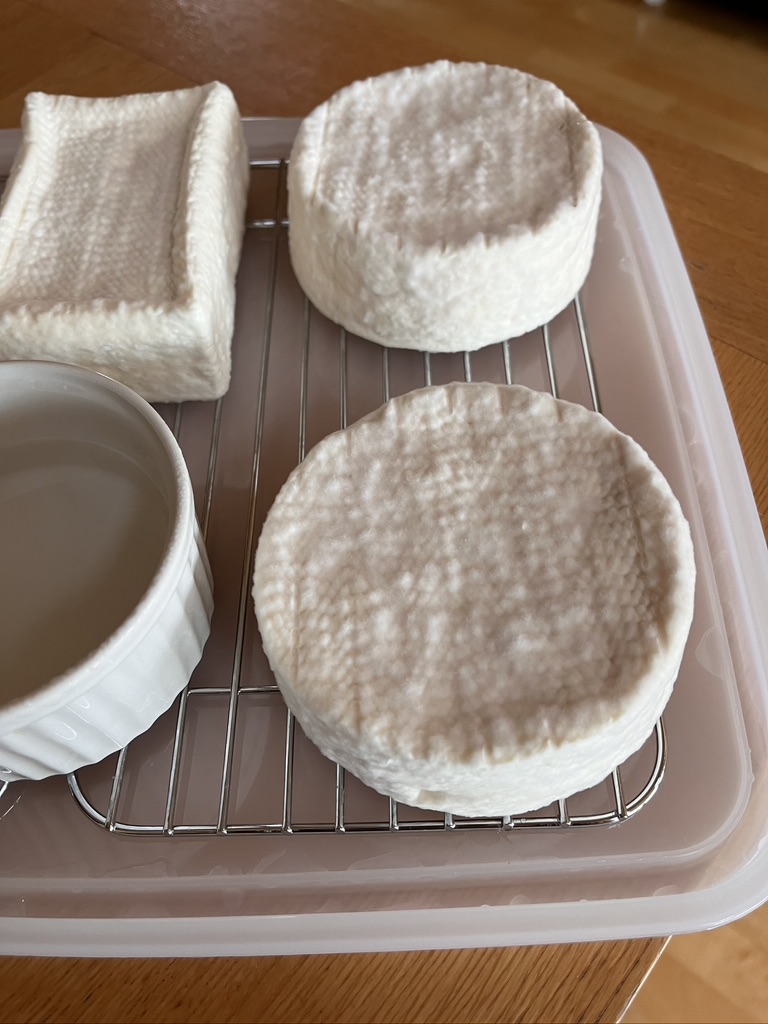
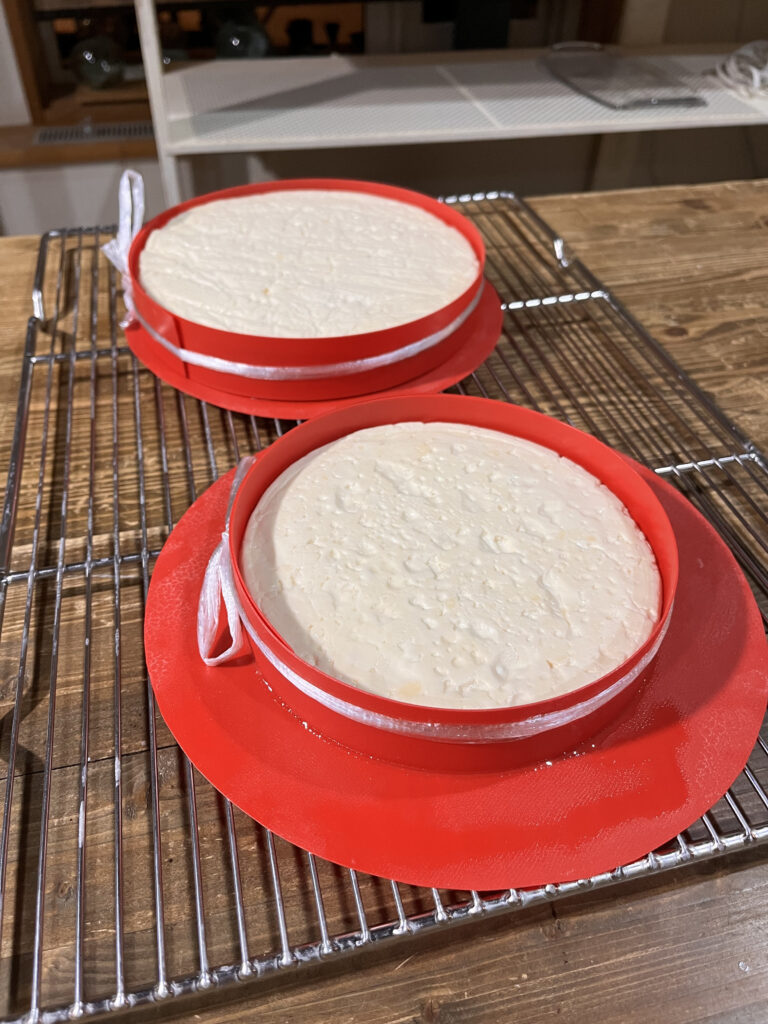
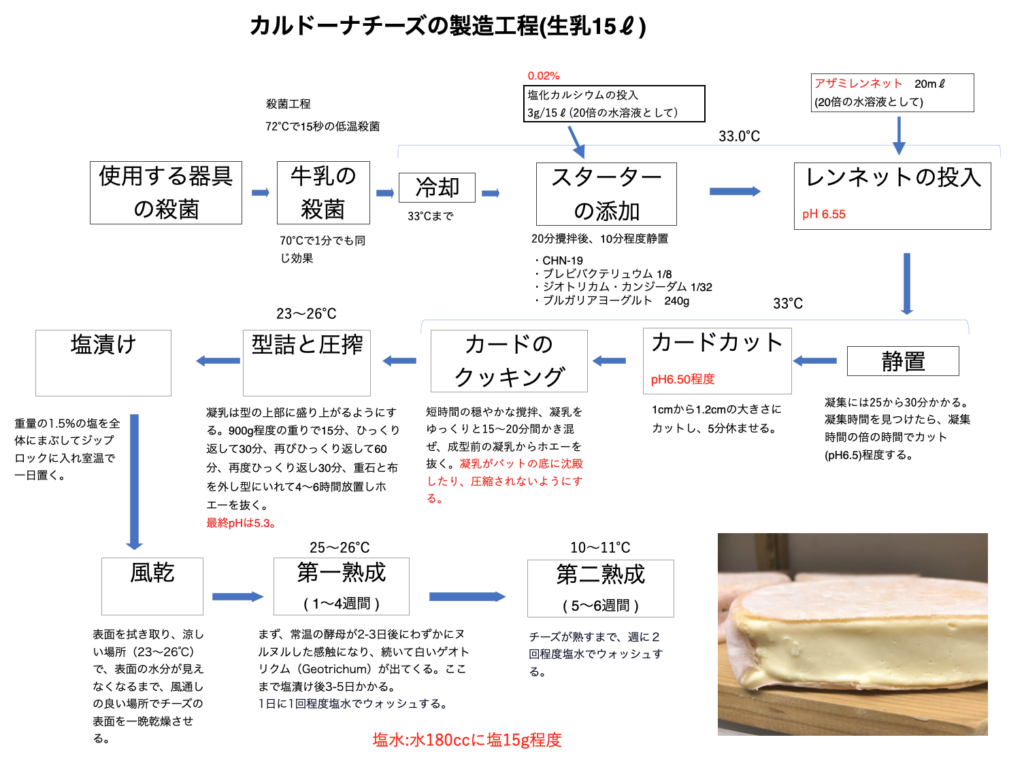
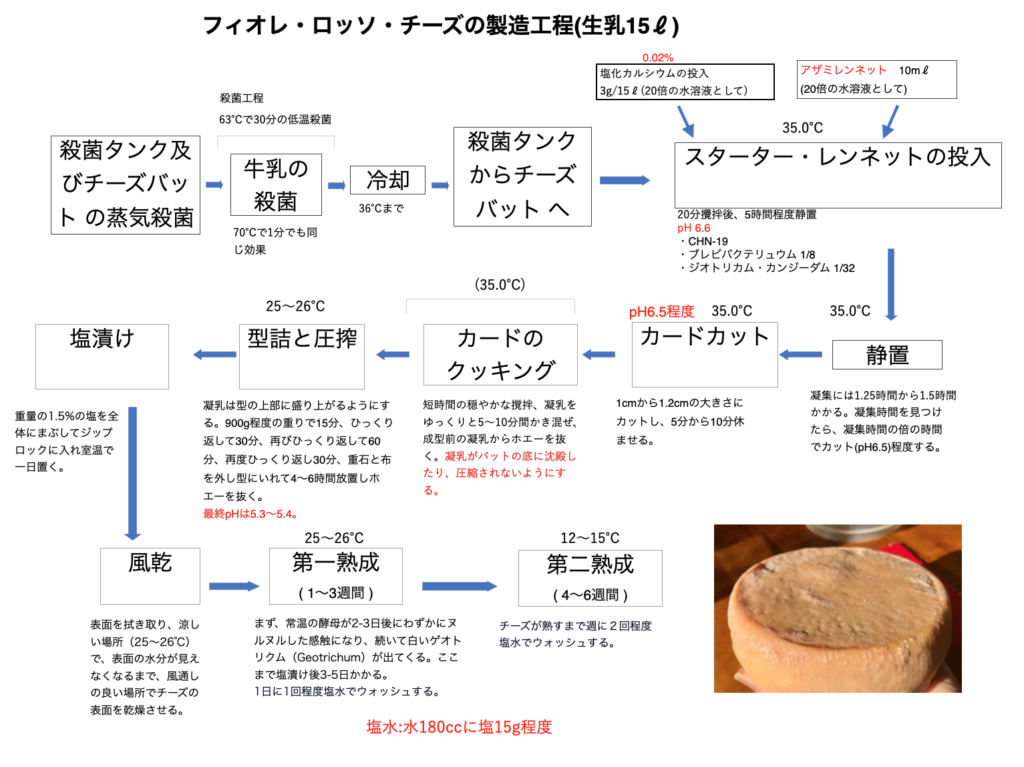
We originally planned to make Fiore Rosso cheese, but decided to make Cardona cheese because the ingredients used are the same and the method of making it is similar to other cheeses. Both cheeses are soft cheeses made from thistle rennet and aged for about a month and a half. It is slightly colored with annatto. After salting, the cheese is air-dried and belted to begin ripening. The reason for the belt is to prevent the cheese from losing its shape during ripening.
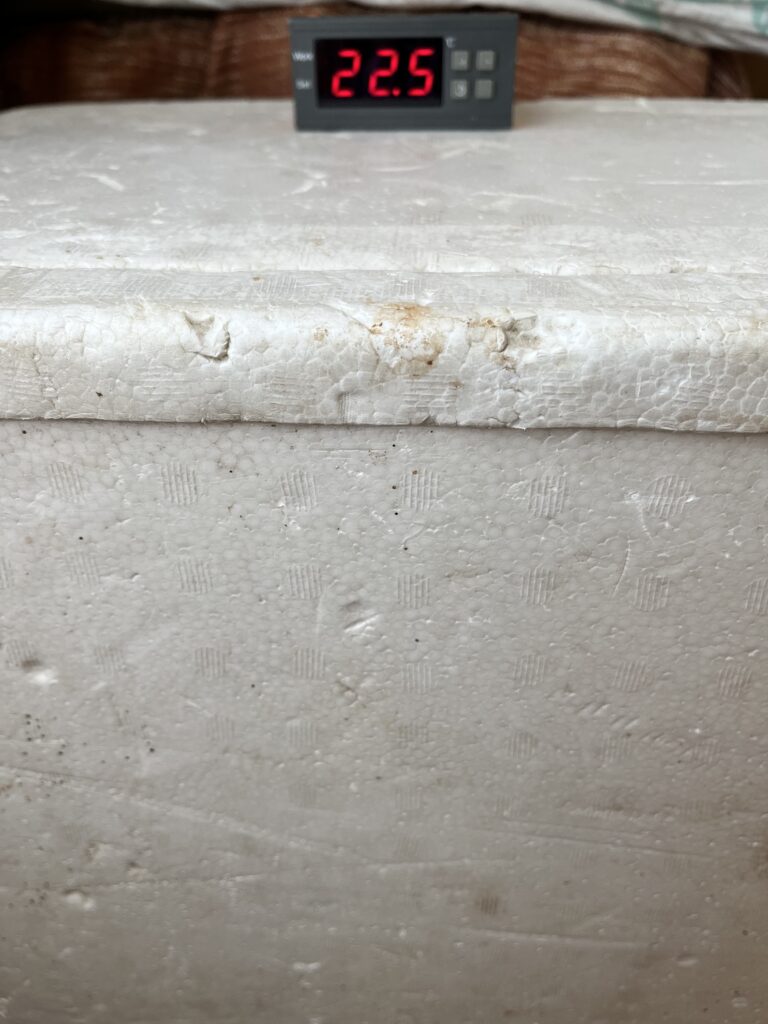
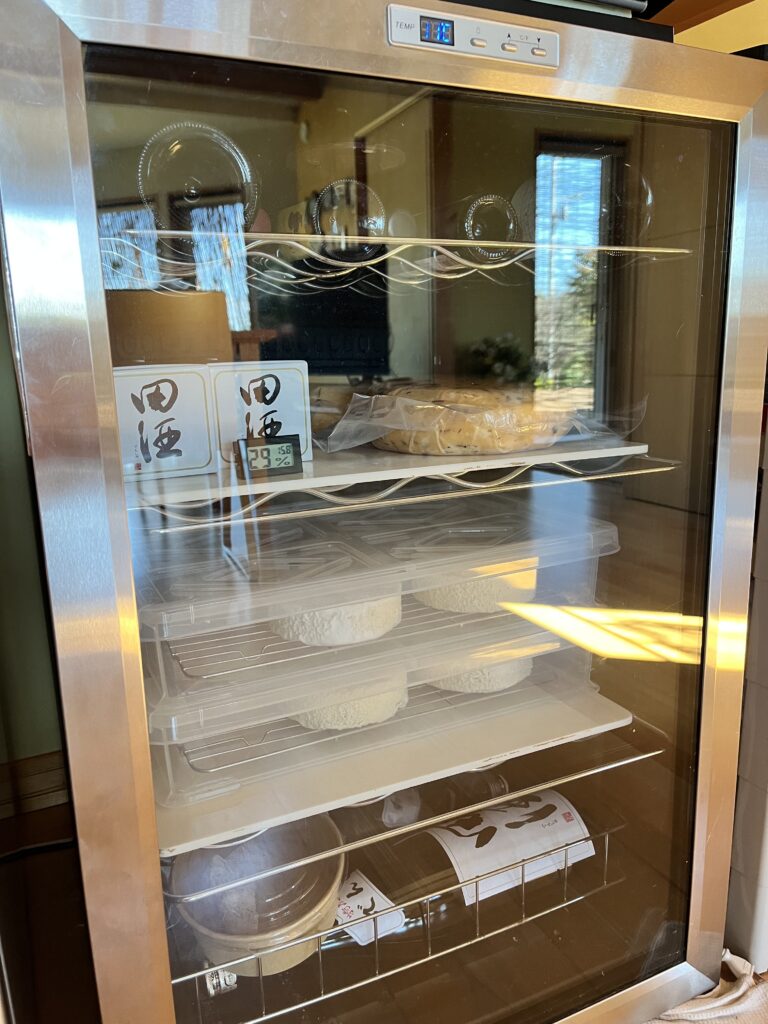
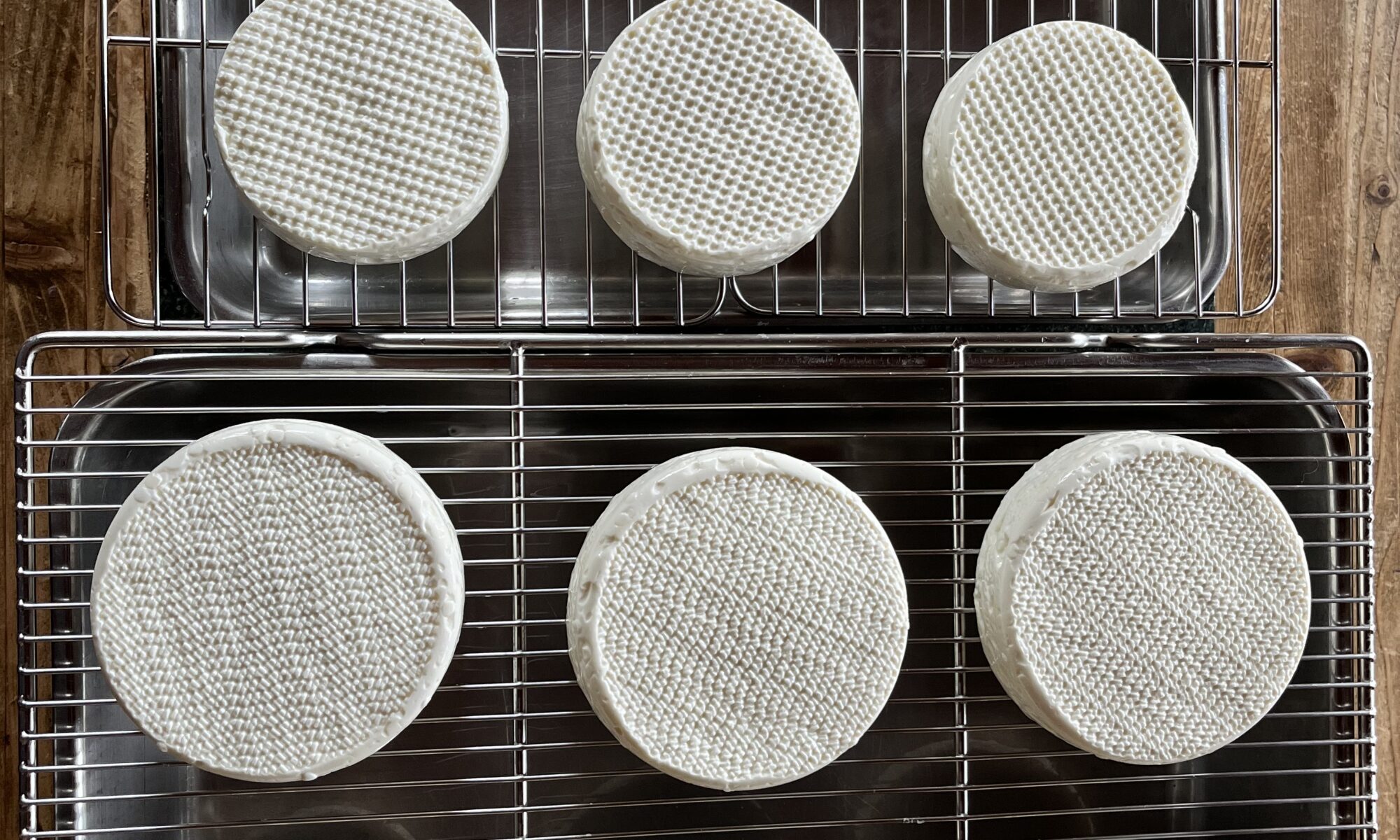
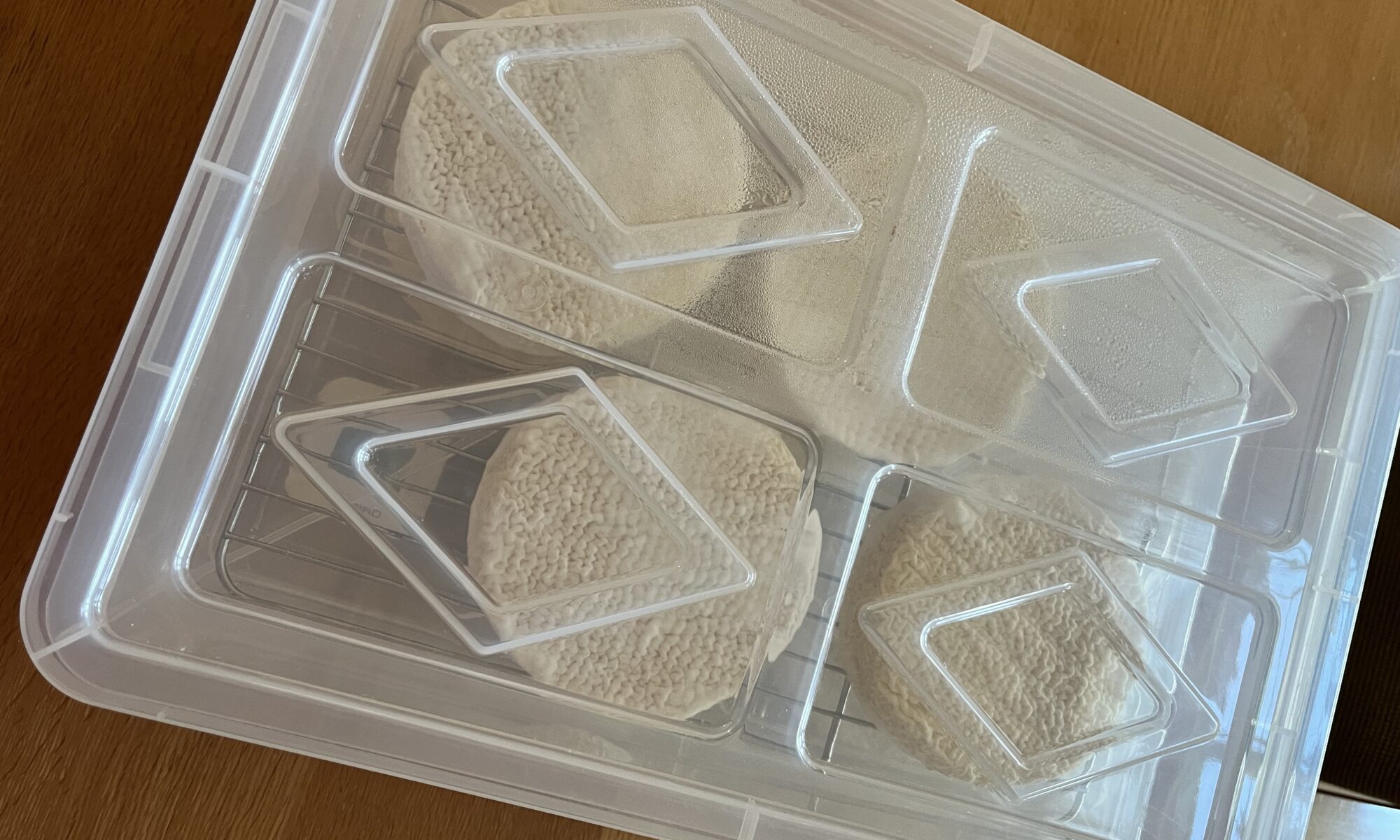
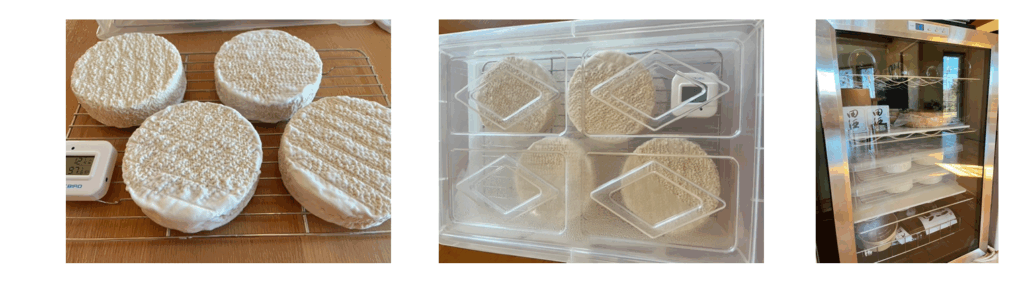
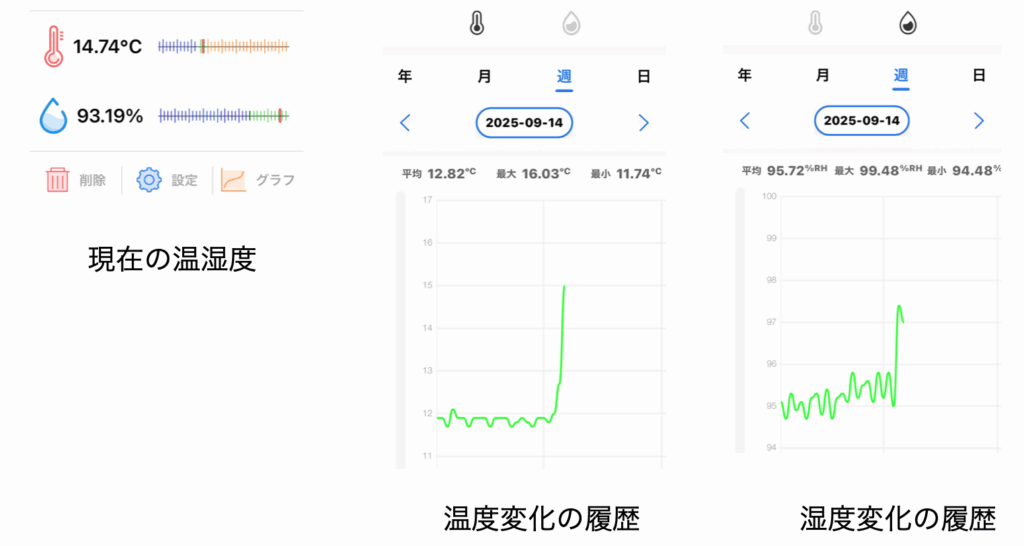
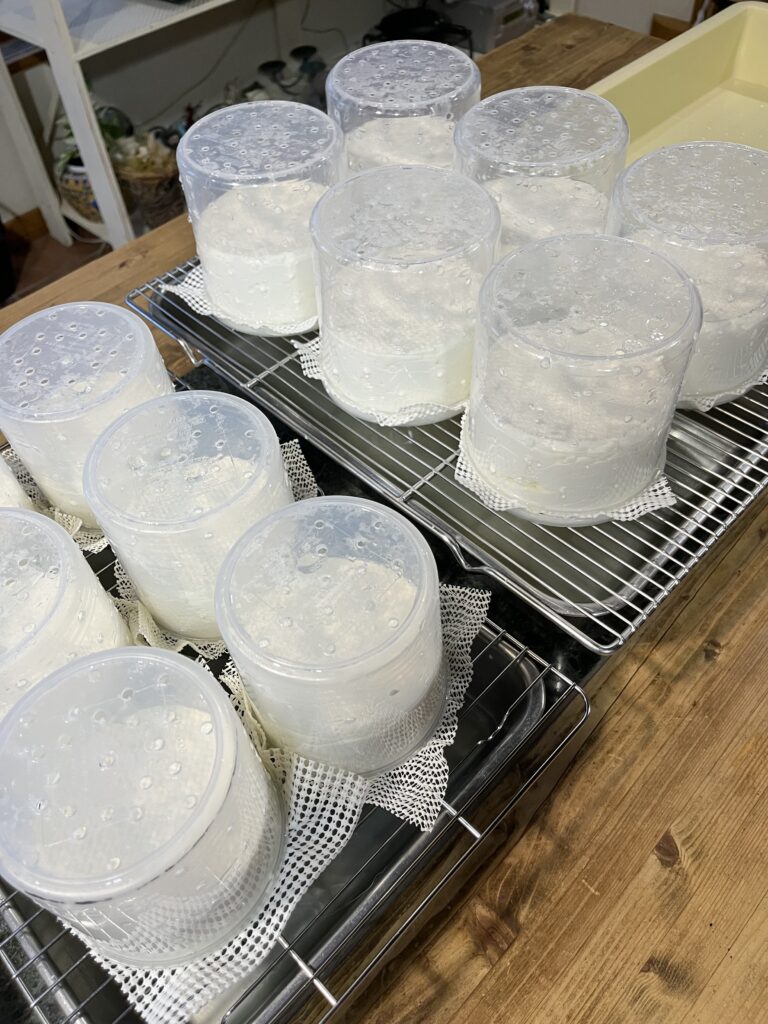
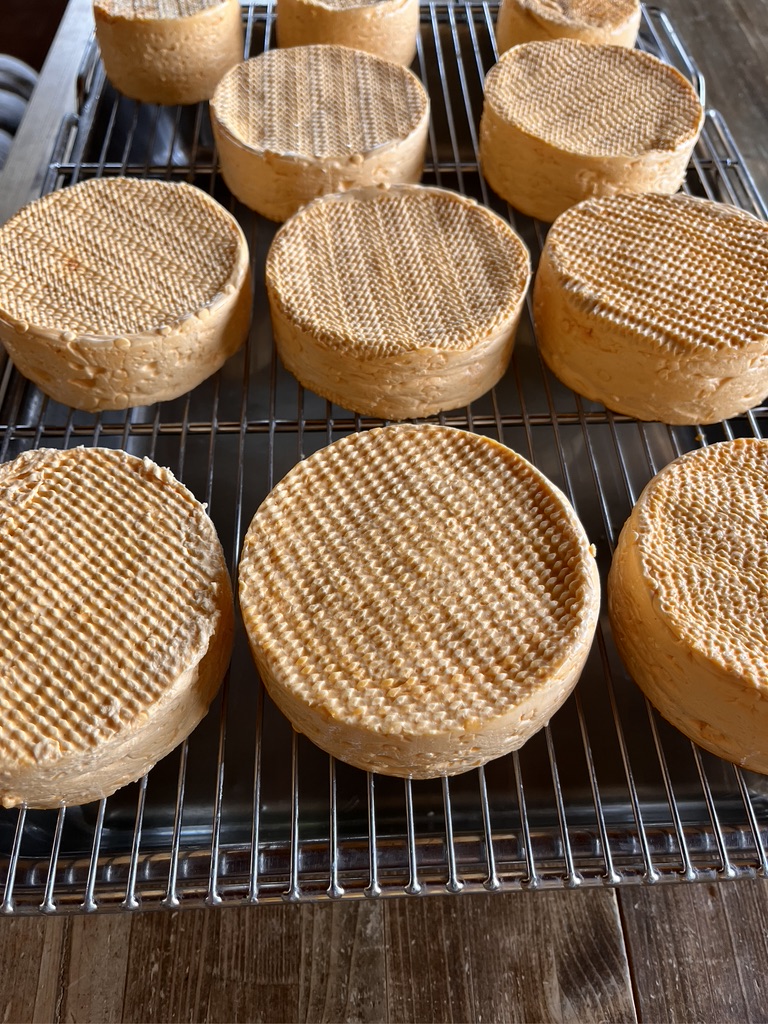
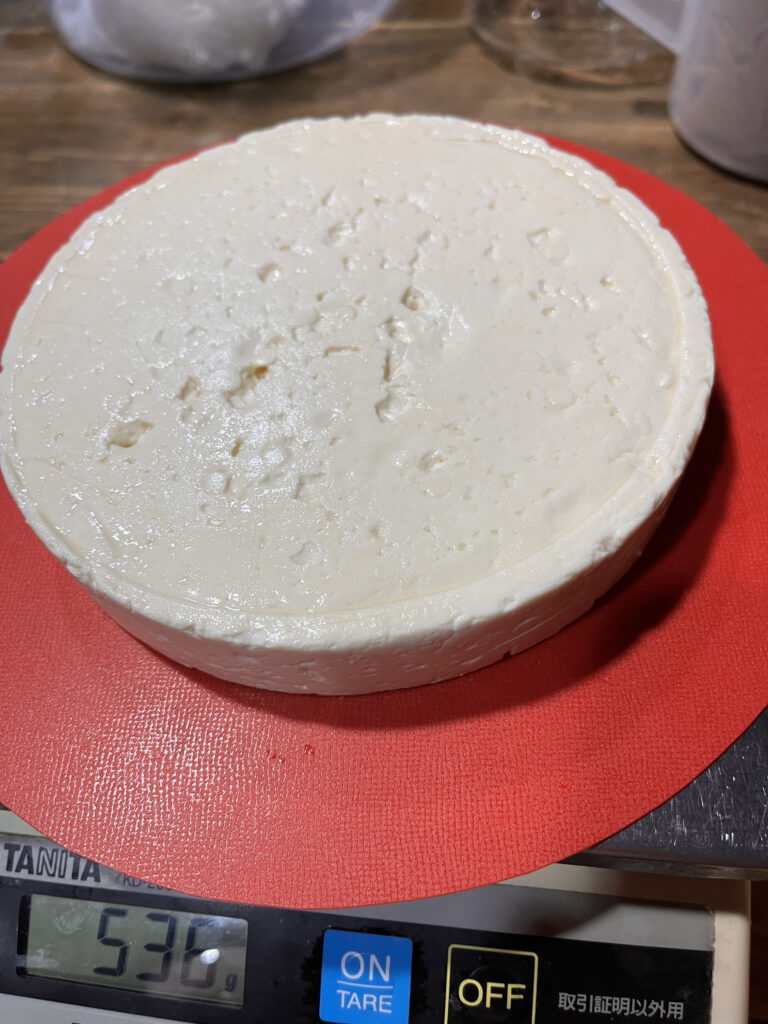
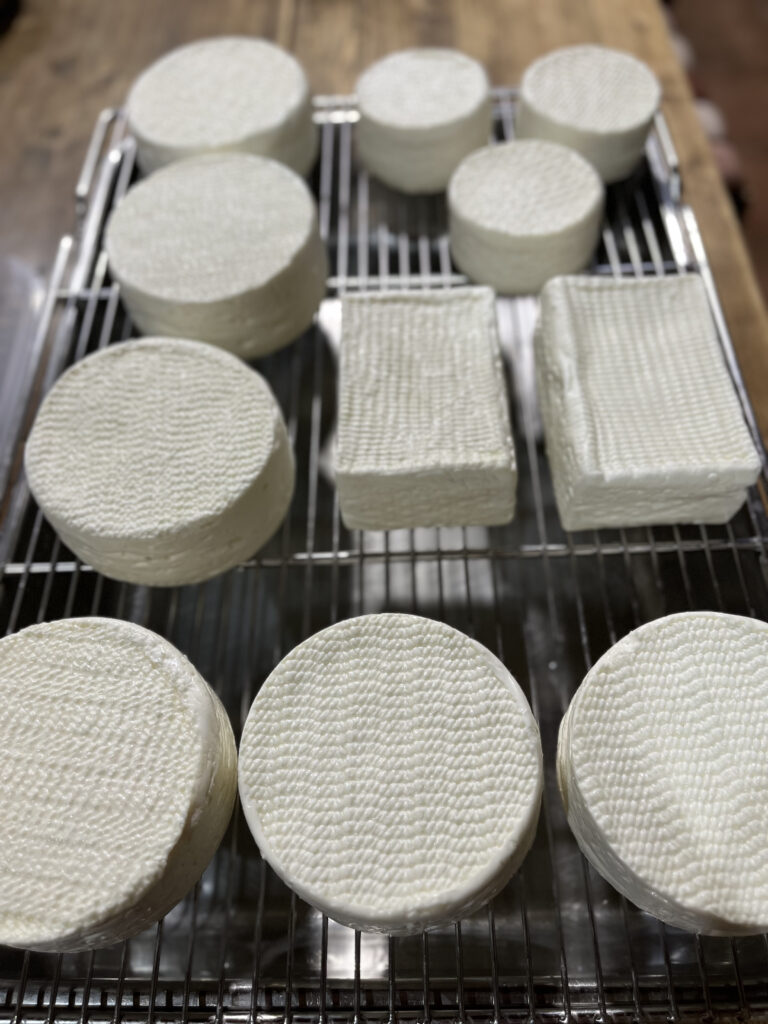
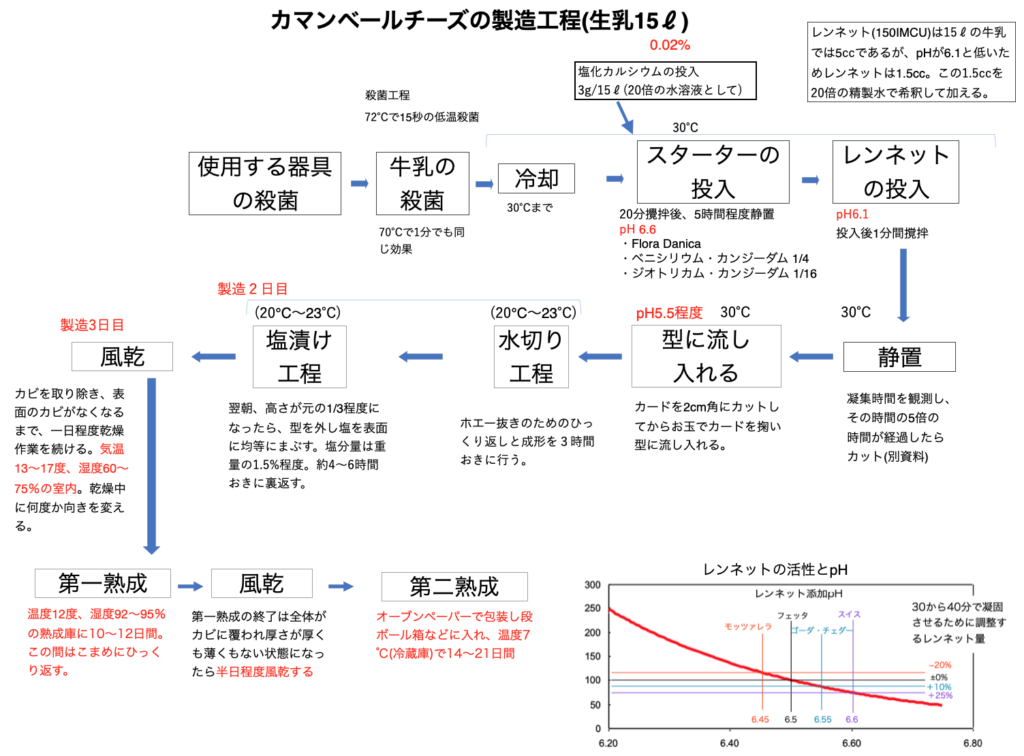
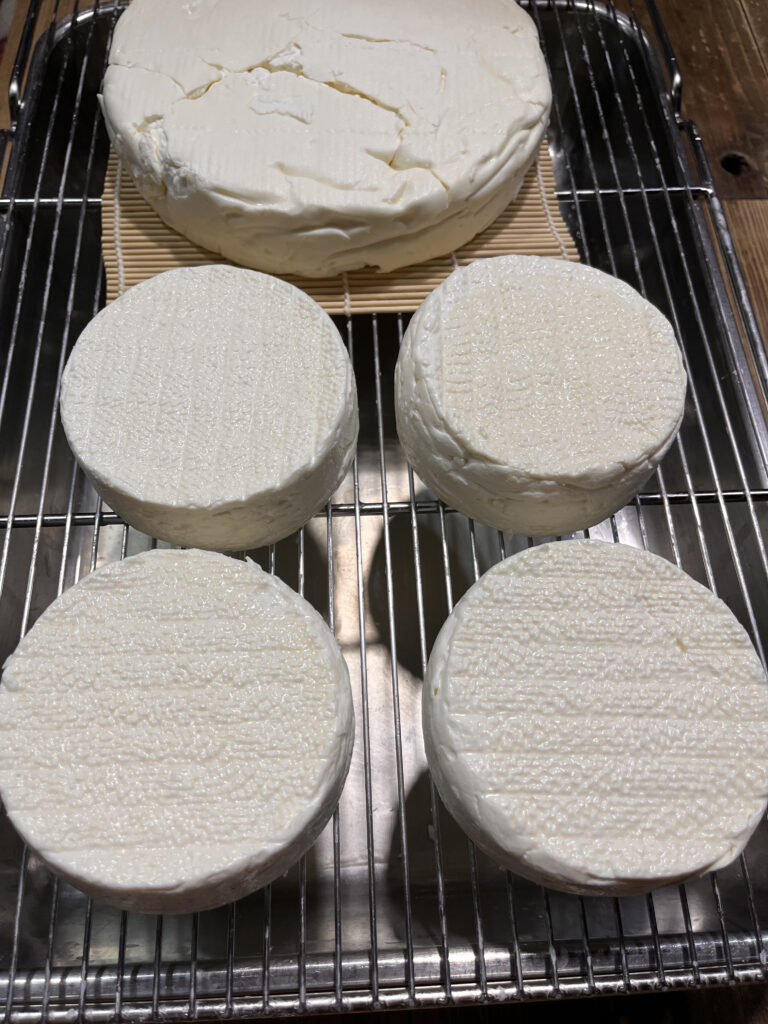
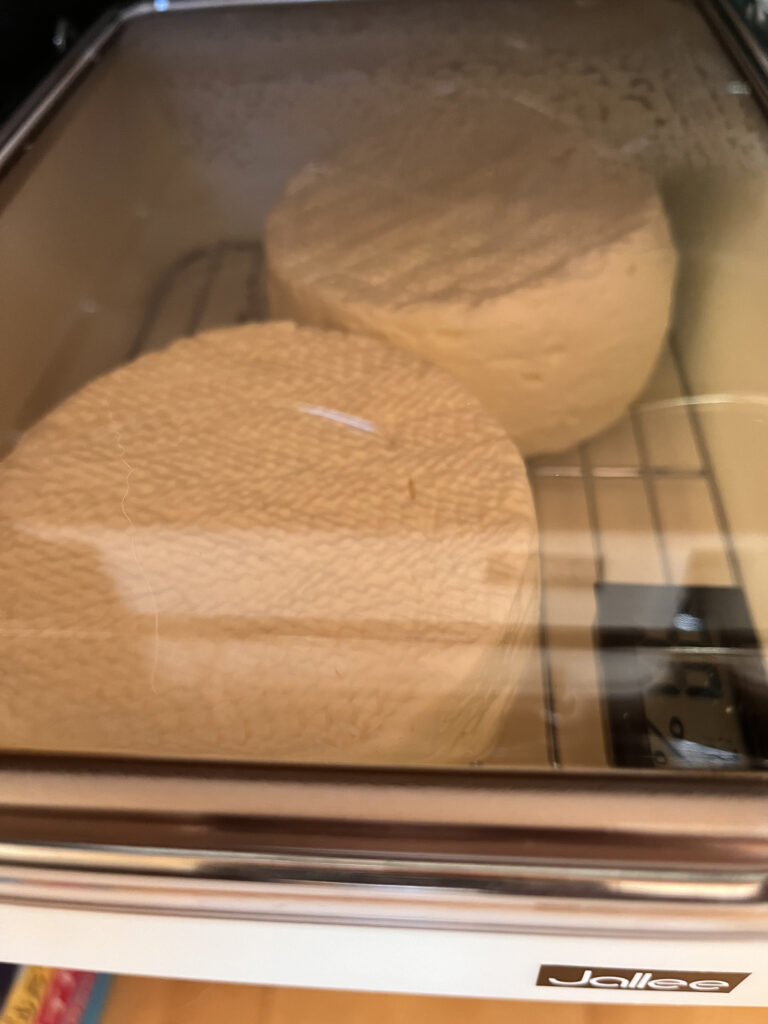
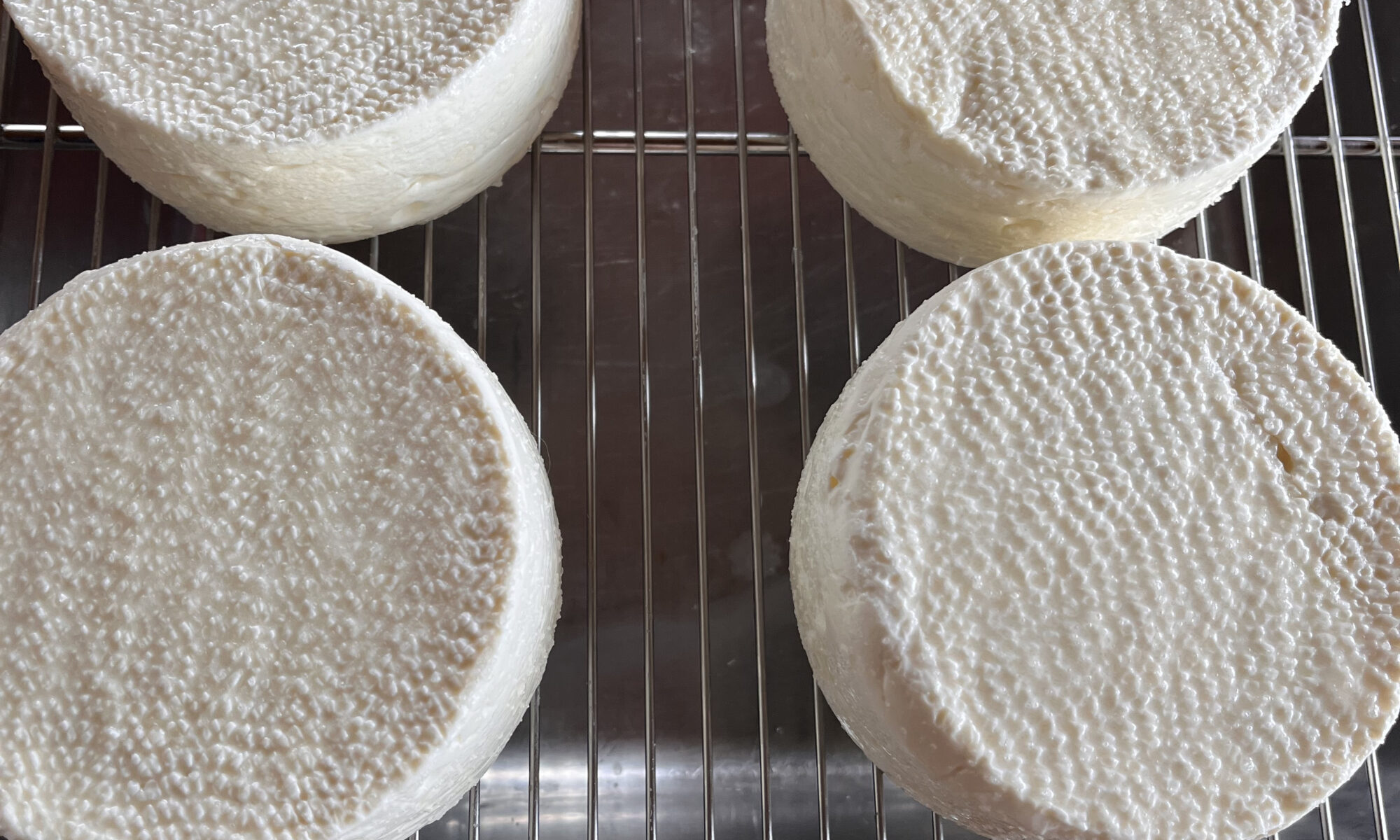
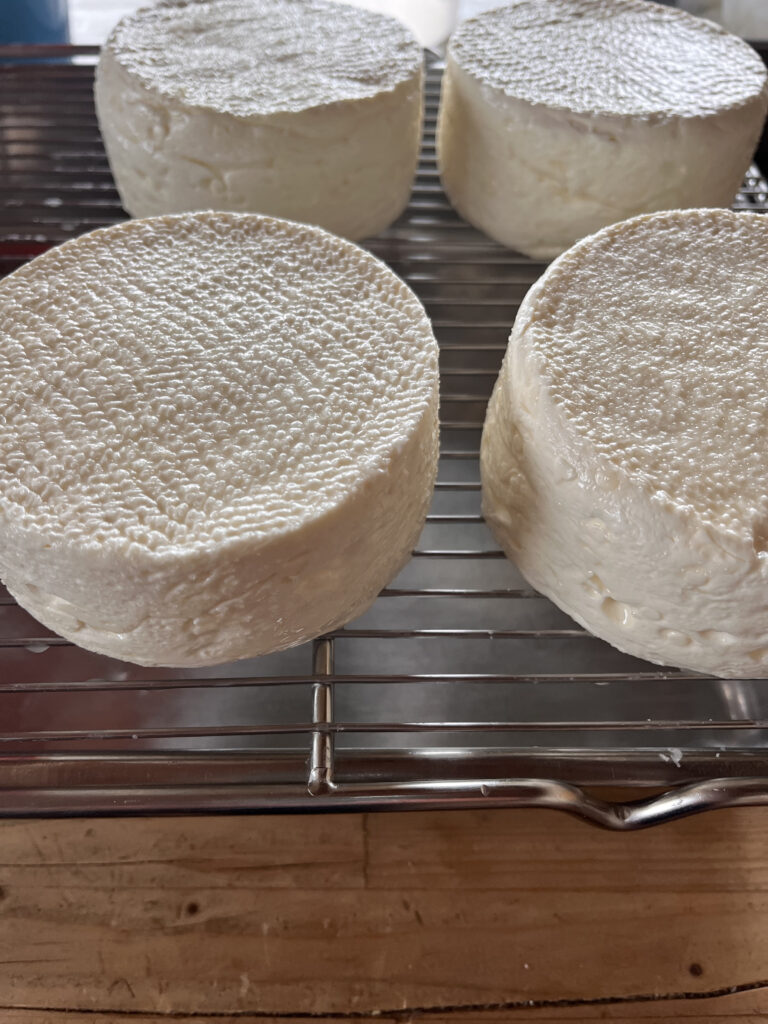
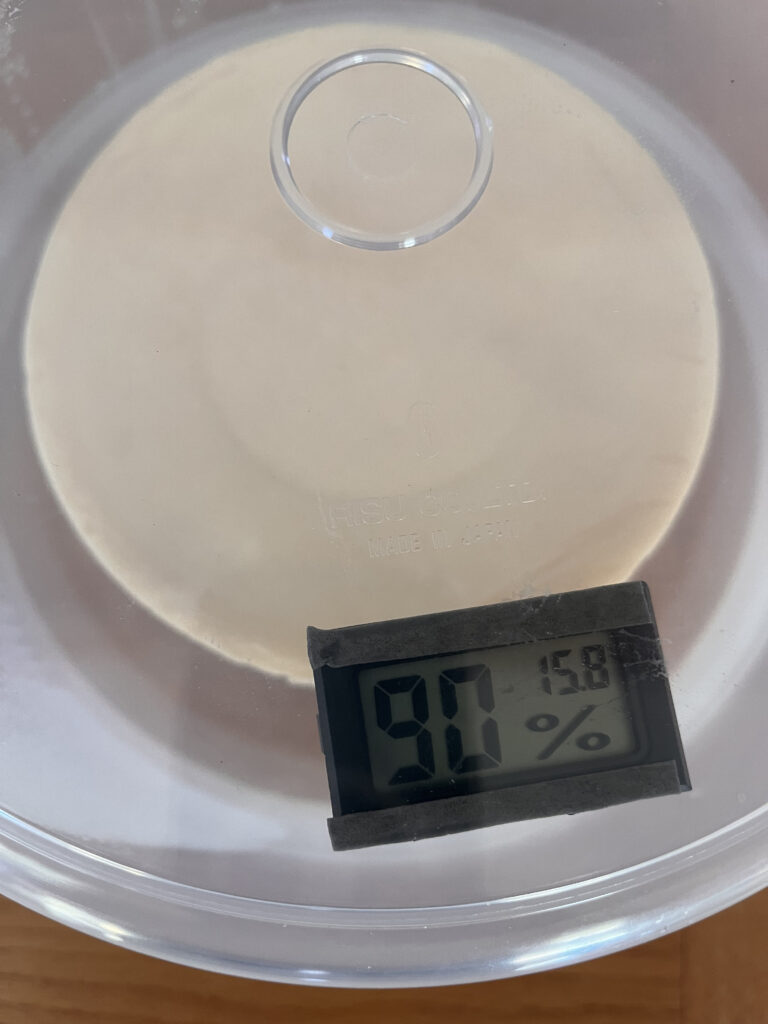
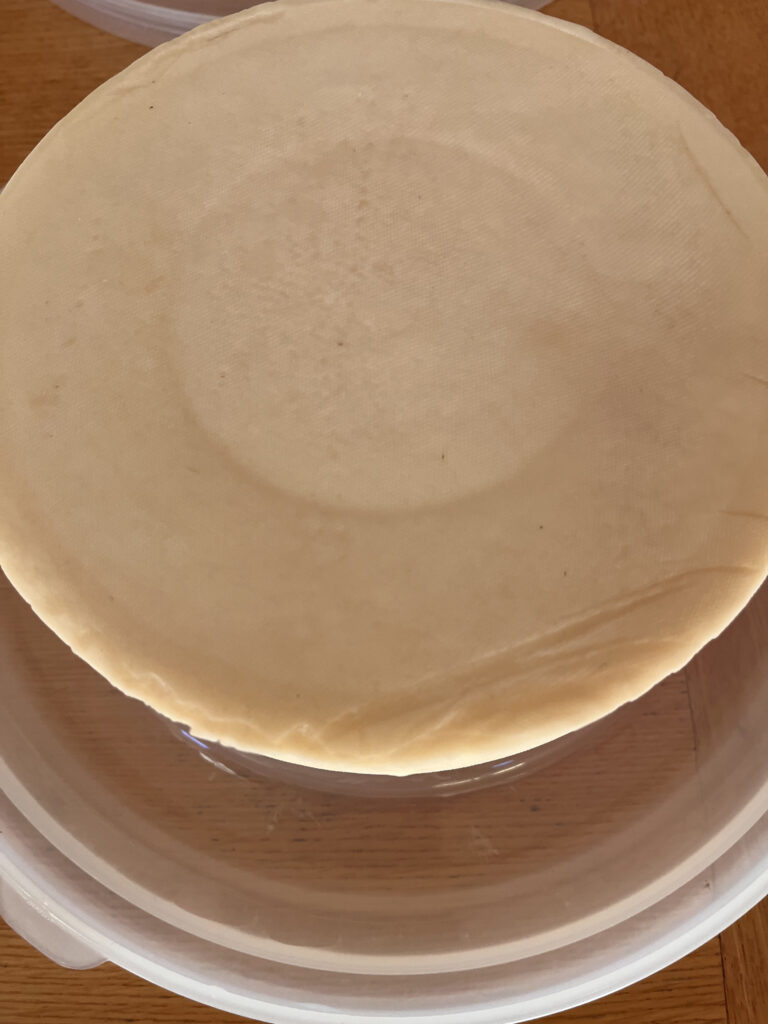
Finished salting Camembert cheese. Overall, 3.34 kg of cheese was produced from 15 L of raw milk. After the salt is acclimated and air-drying is completed, the first stage of ripening begins. The first stage of ripening is done by turning a large Tupperware from a 100 yen store upside down, placing the cheese on the lid, and covering it with the body of the Tupperware. To keep the humidity at 90-95%, a teacup filled with hot water is also placed, and the tupperware is placed in a wine cellar.
Secondary aging of Camembert and Brie cheeses. The cheeses are wrapped in paraffin paper, placed in a box and aged in the refrigerator for 3 to 4 weeks.
I would like to make a soft cheese called Fiore Rosso when the aging room becomes available. The recipe is as follows We will use thistle rennet, which is not normally used for cheese making.
Homemade Camembert cheese, 3 days of primary ripening and the whole thing is now covered in a wisp of white mold.It seems to be doing well. It will be wrapped in paraffin paper for secondary aging in 7 to 9 days.
After surface drying has been completed, it is placed in a case to begin aging at 88% humidity and 12°C temperature. I am looking forward to seeing how soon the white mold will appear. The plan is to start seeing it in a week, and the temporary aging will be finished in about 2 weeks.
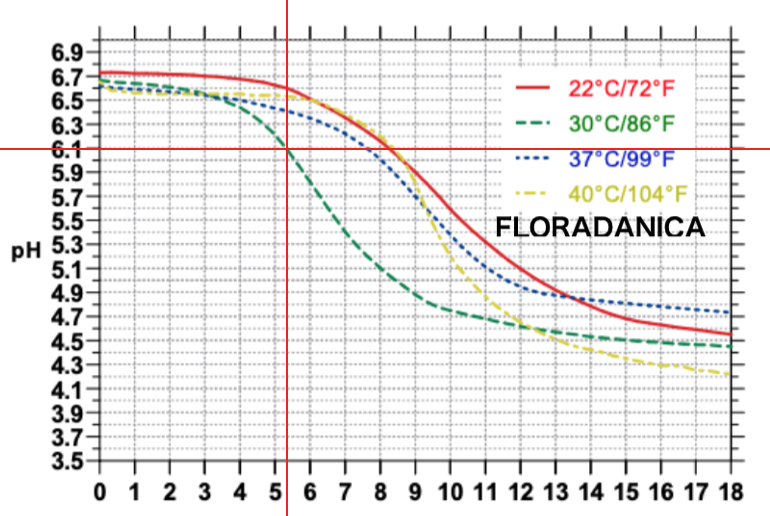
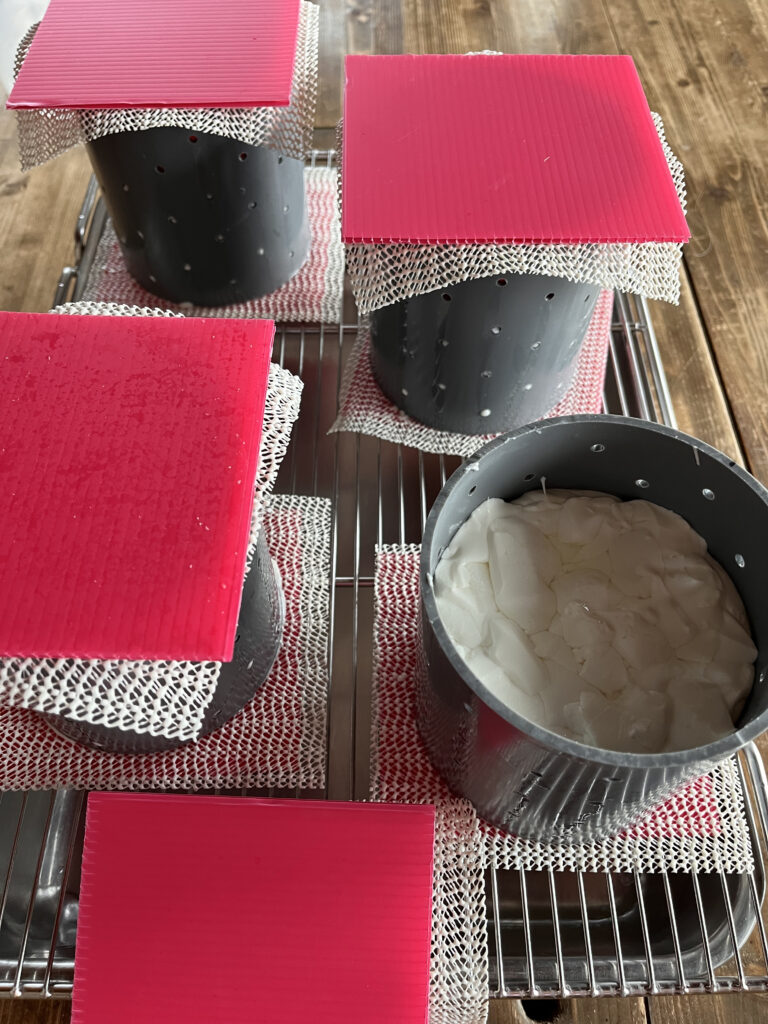
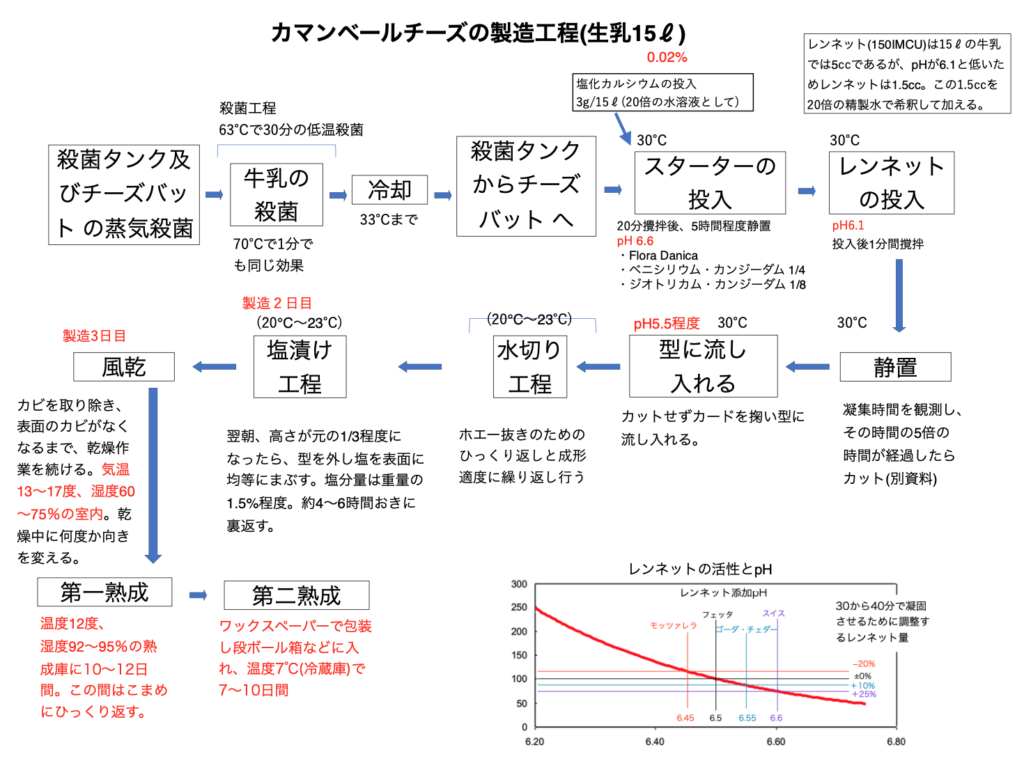
I got raw milk yesterday and started making camembert this morning. I am working according to the recipe. Rennet input is pH 6.1, rennet usage is 1/3 of normal, and card cutting is done at 5 times the agglomeration time. After pouring into the molds, they were turned over every 3 hours and salted on the morning of the 22nd. From now on, they will be turned over every 4 hours and surface dried tomorrow morning.
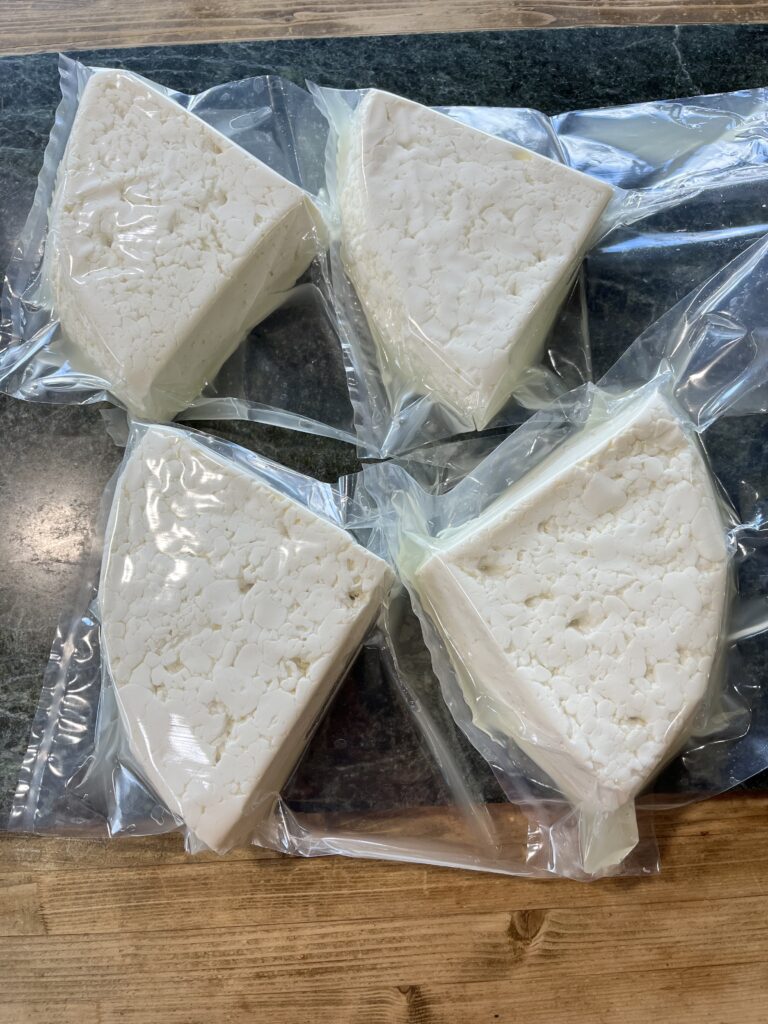
We made cheddar cheese, cream cheese and whey ricotta cheese. The cheddar is plain, black pepper and wine. It will be vacuum packed and aged for 3 months.
I will soon be making Camembert and Brie cheese. Since this is my first time making these cheeses, I have researched various resources, created recipes, and prepared containers and molds (handmade) for high humidity aging and preservation. I don’t expect to get it right the first time, but I would like to try making it and UPDATE the recipe. All I have to do is to make it. Let’s challenge!
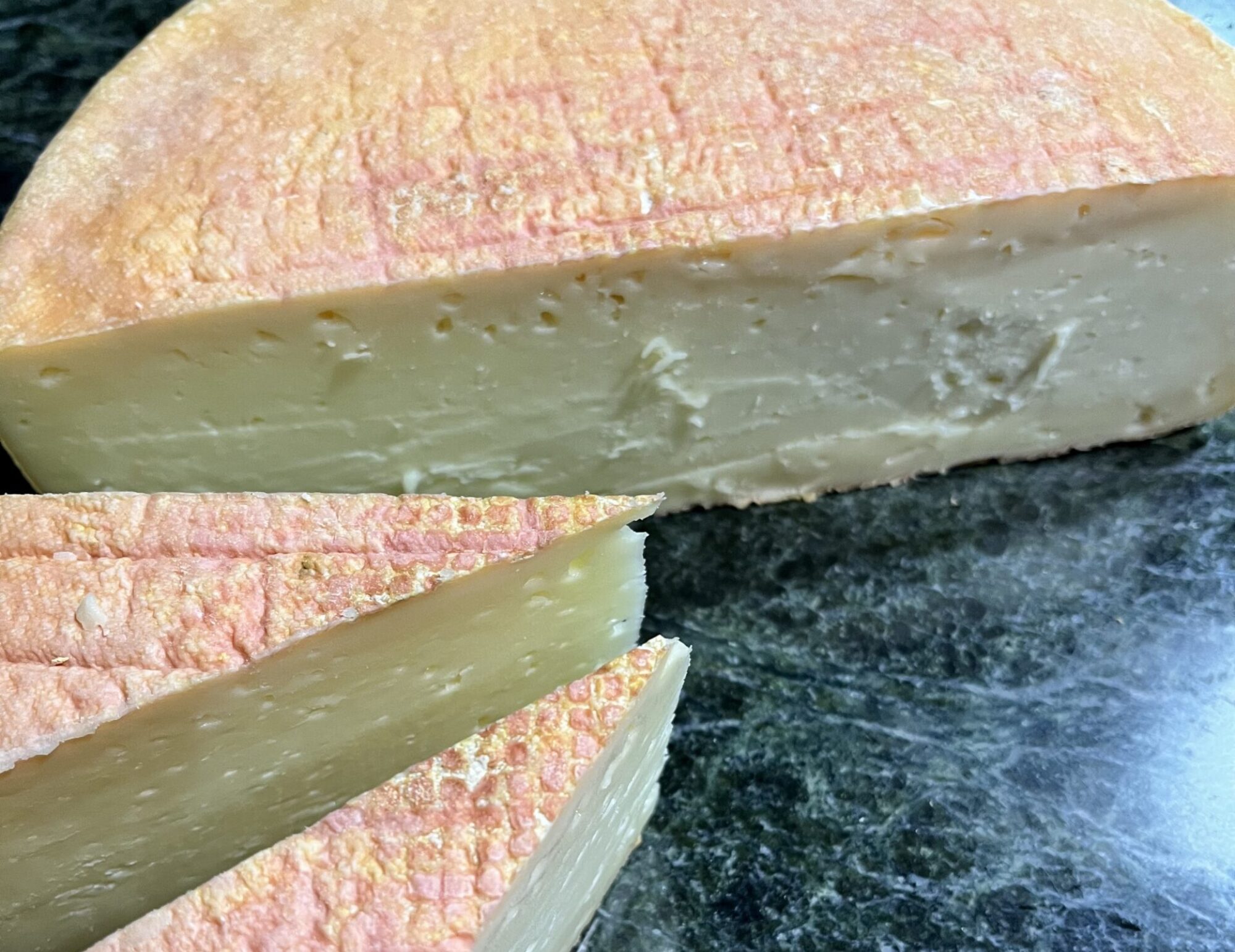
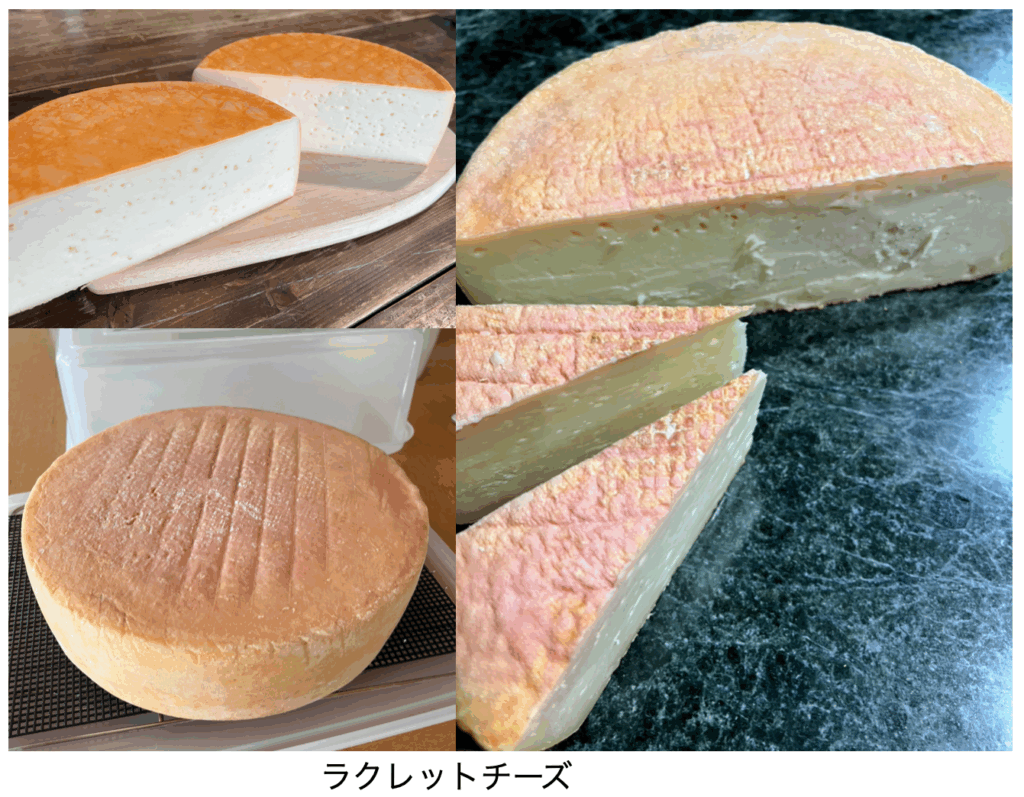
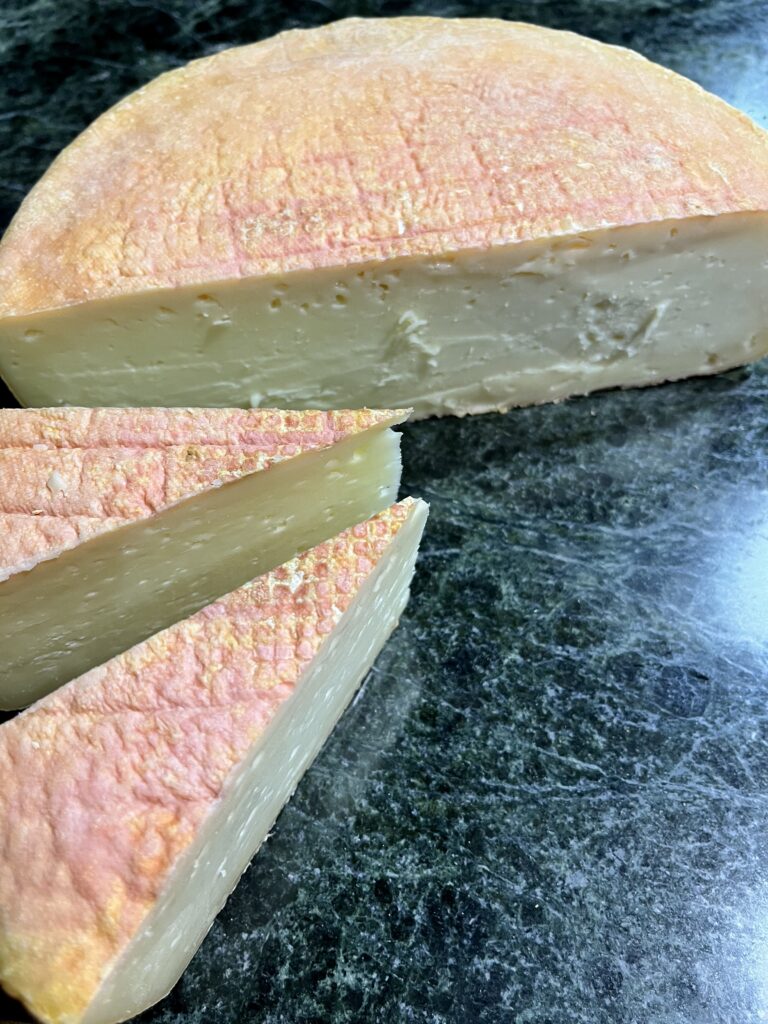
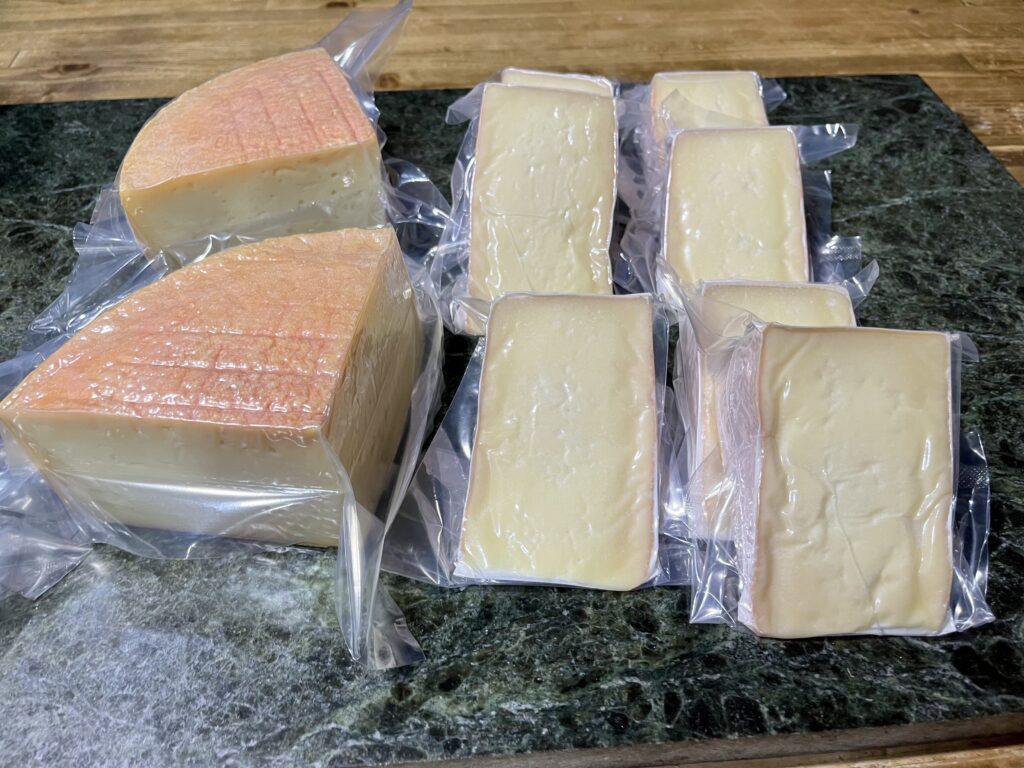
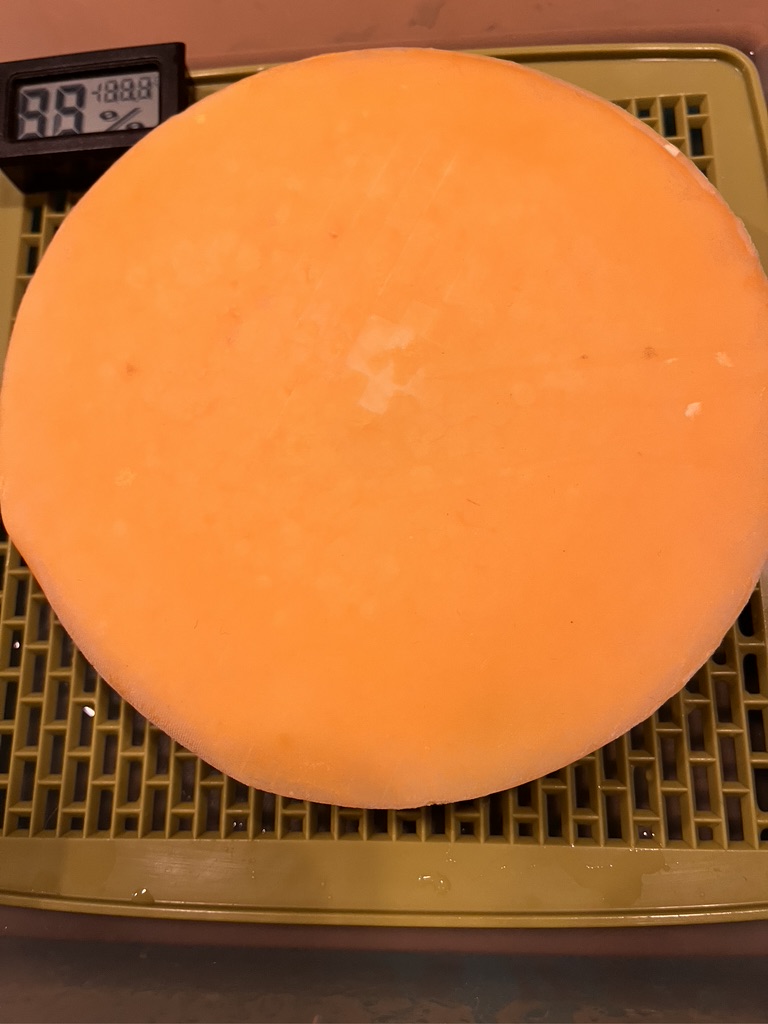
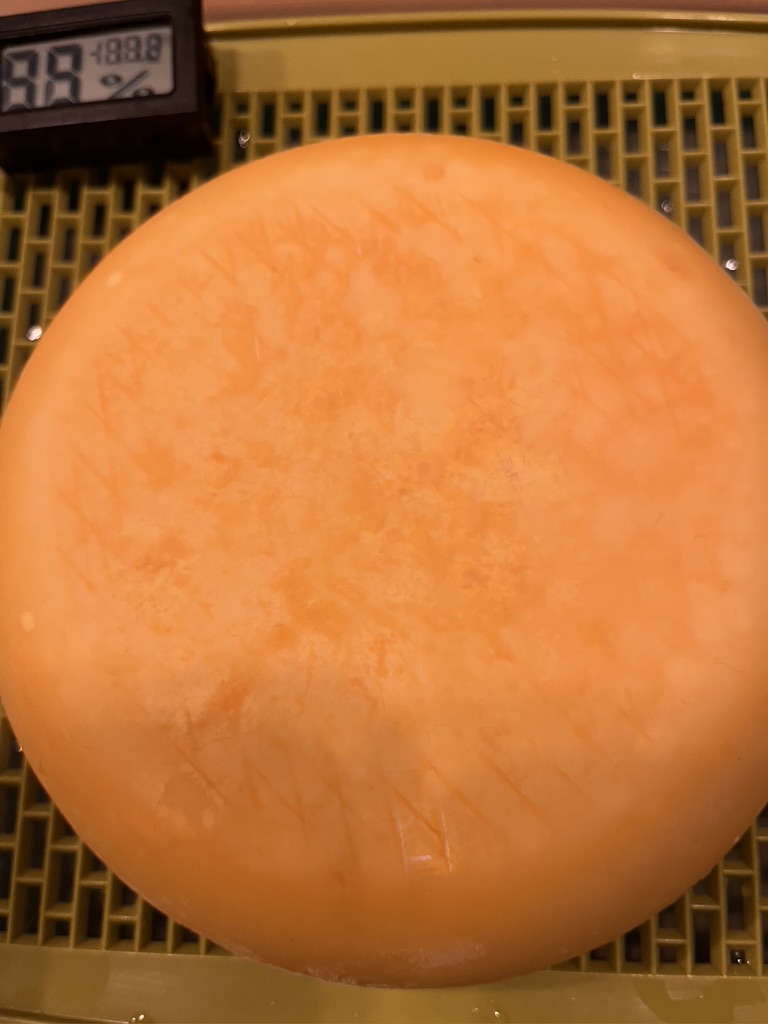
The little raclette cheese we made on February 2 has turned a beautiful orange color. I am looking forward to melting it and eating it on top of potatoes.
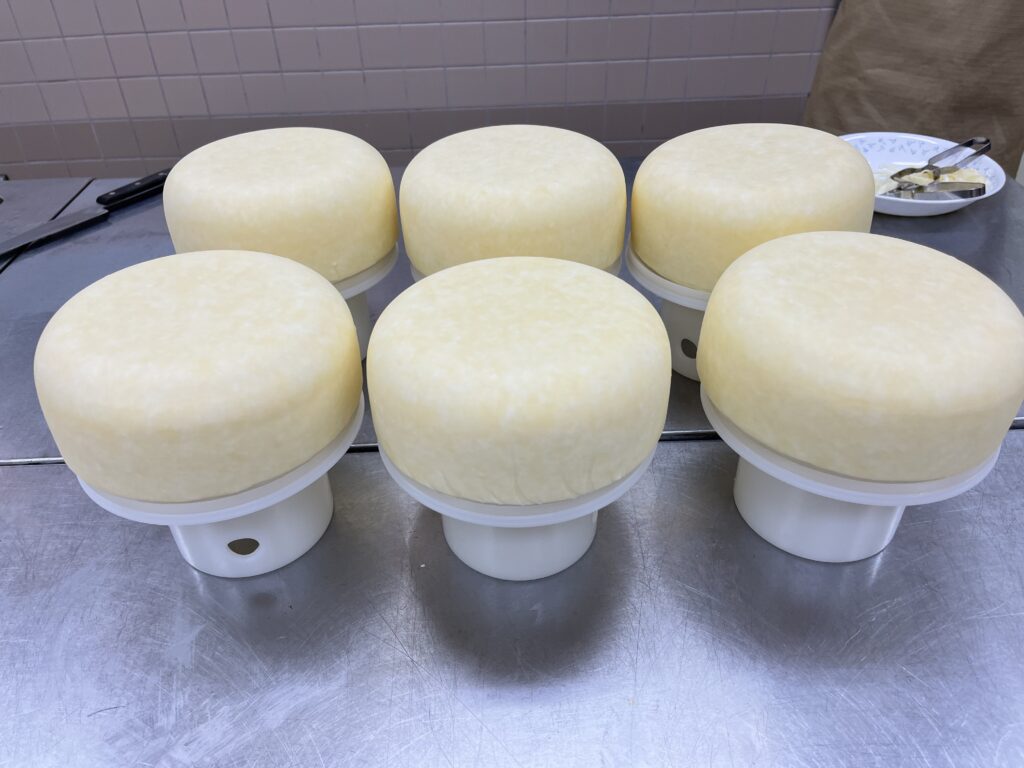
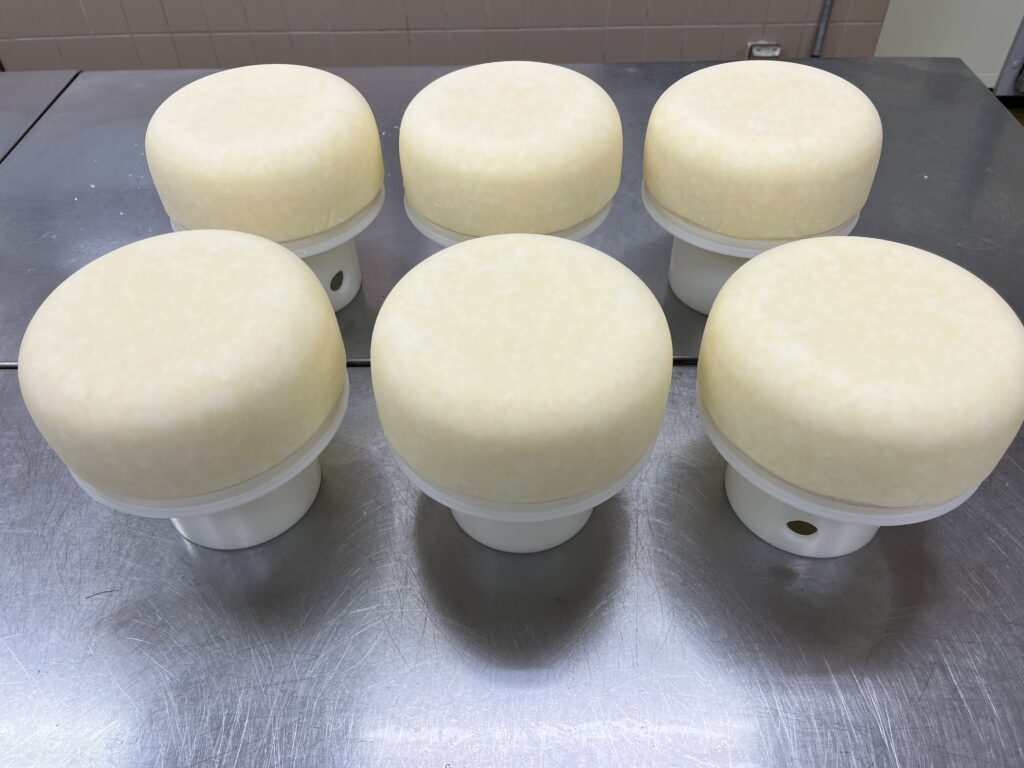
On the 9th and 10th, we will be making cheese. From this time on, we decided to make three types of cheese in one cheese making session: cream cheese, target cheese (Gouda, Cheddar, Parmigiano), and whey ricotta. This time, 2.6 kg of cream cheese was made from a 5.6 L cream layer, 6 Gouda cheeses weighing about 1.9 kg and 2-3 kg of whey ricotta.
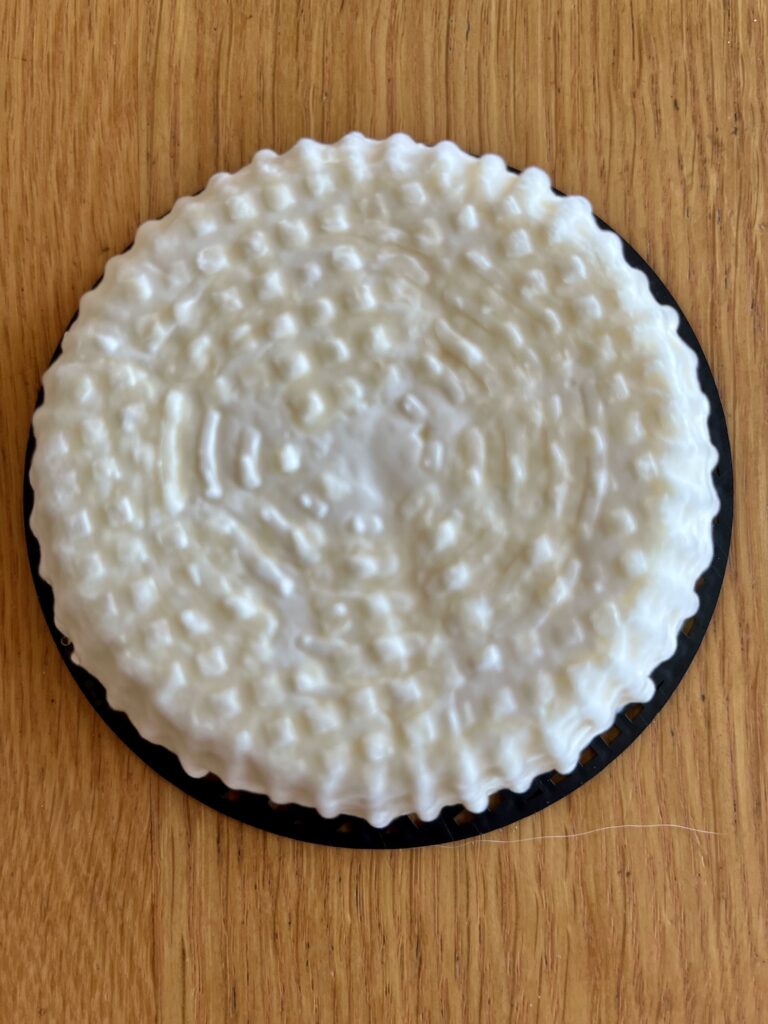
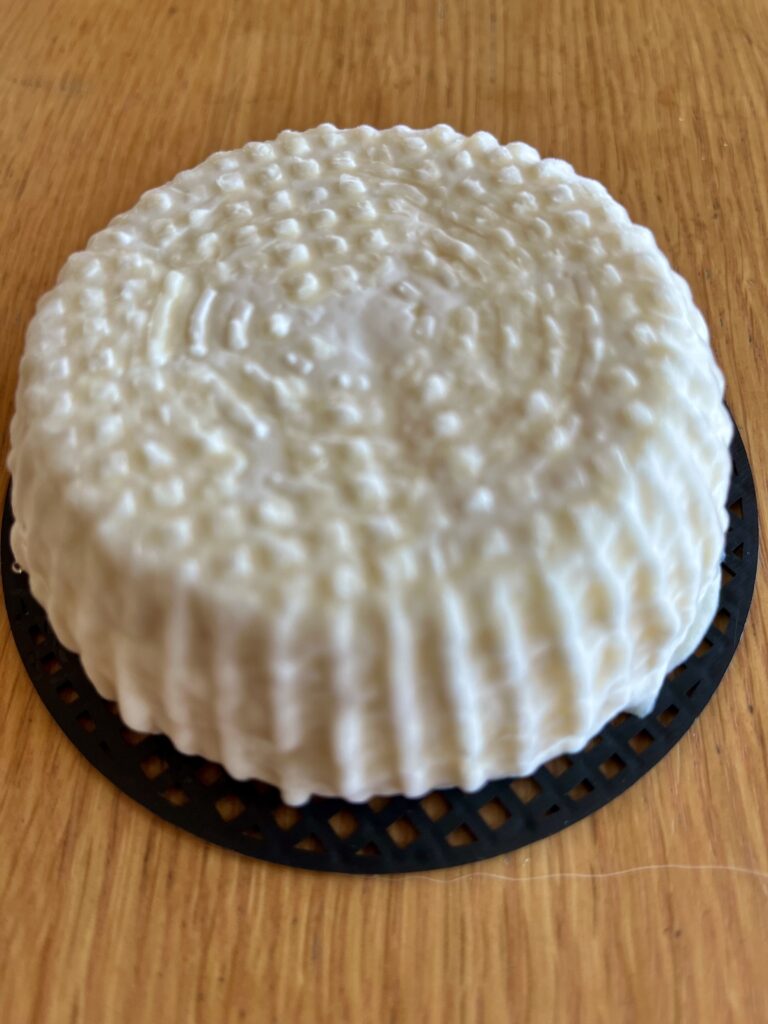
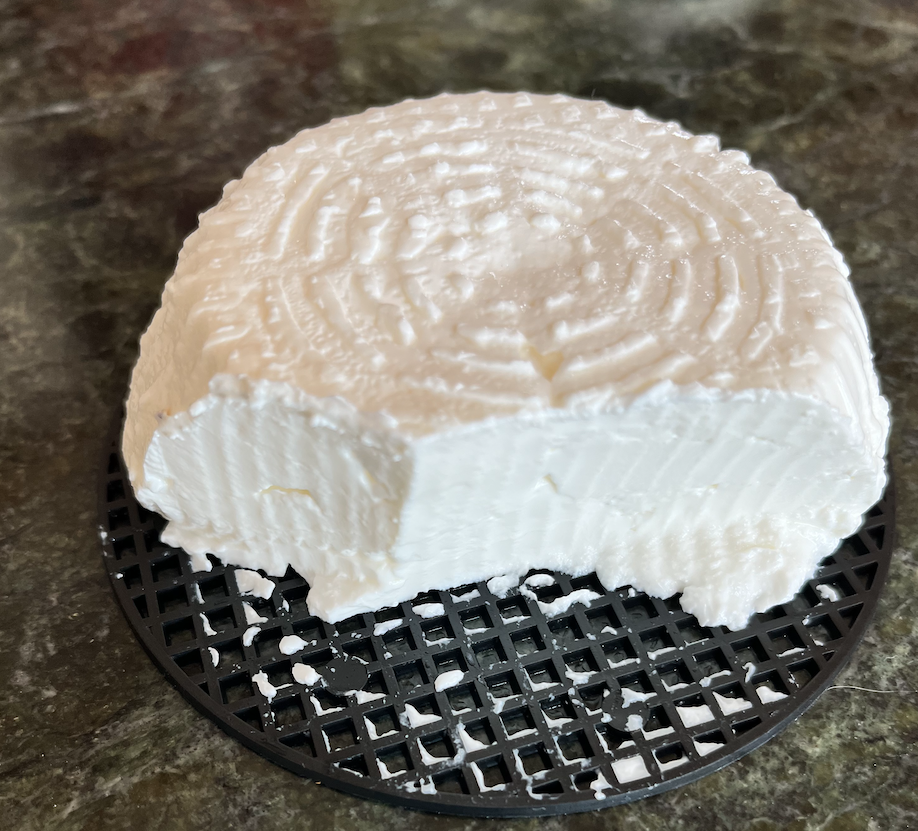
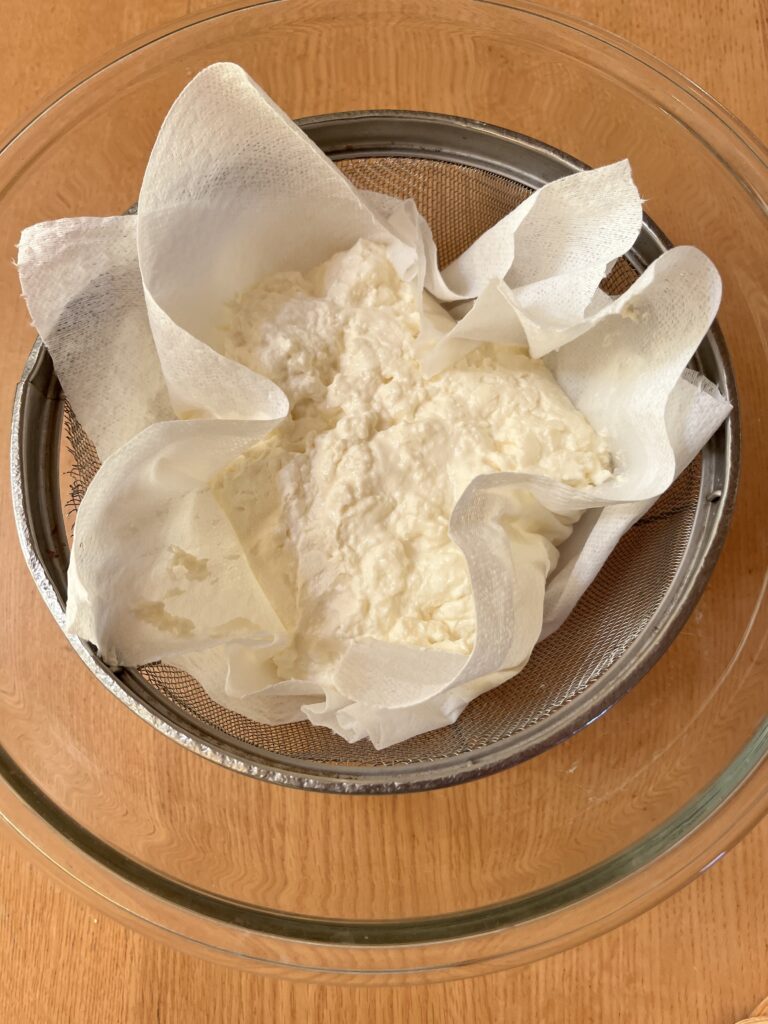
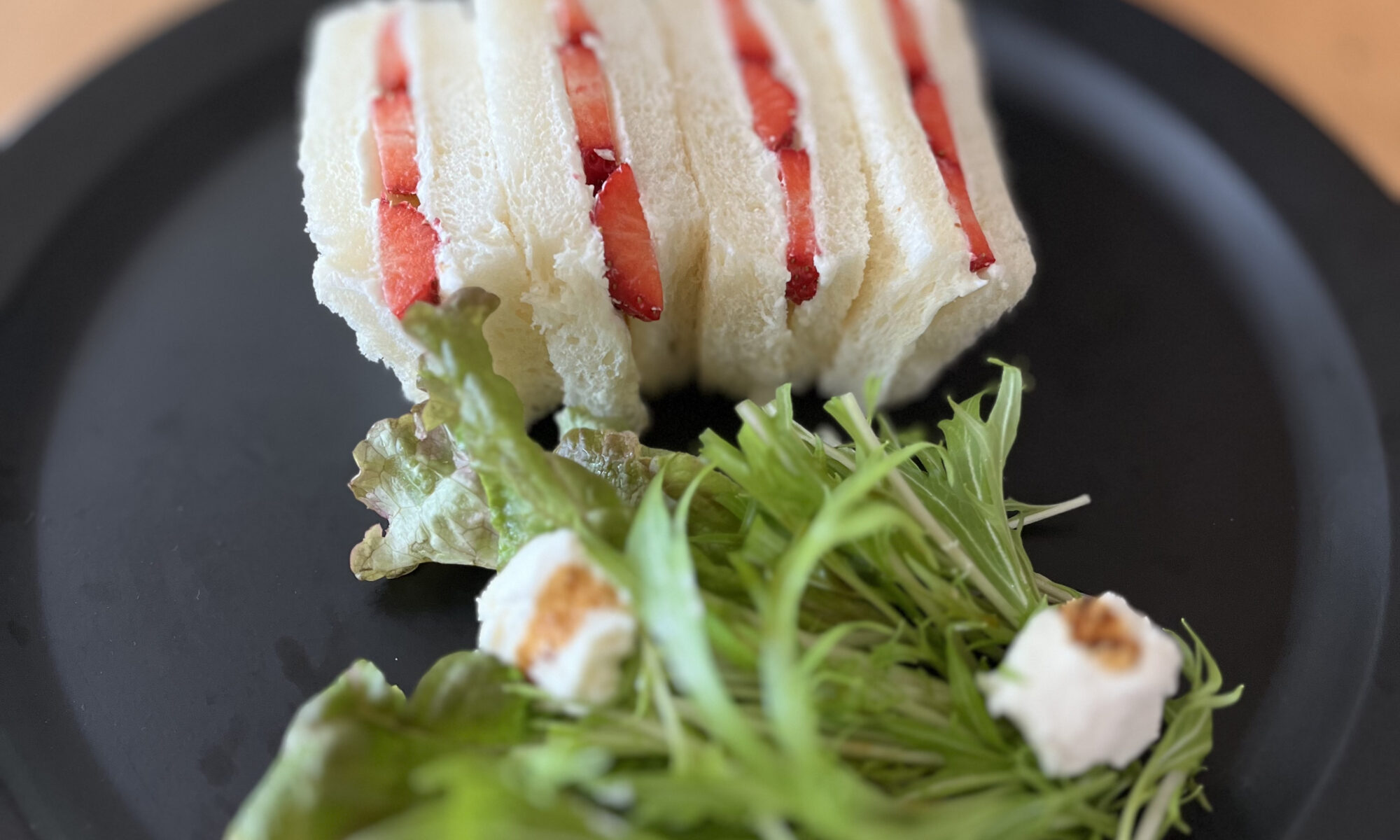
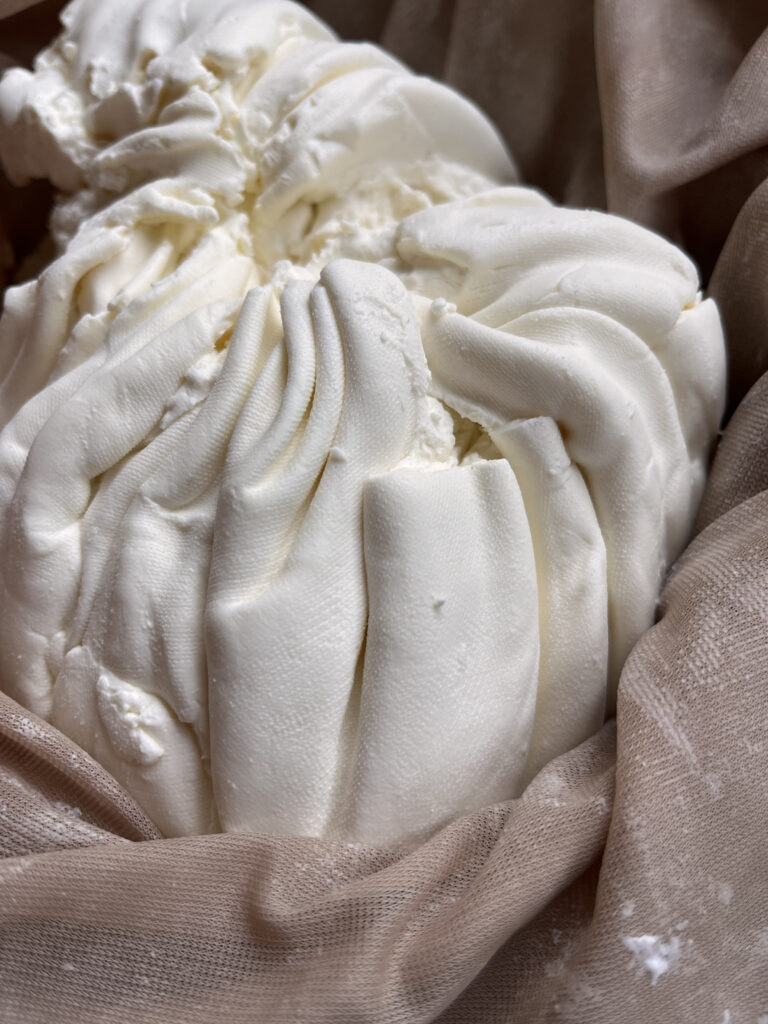
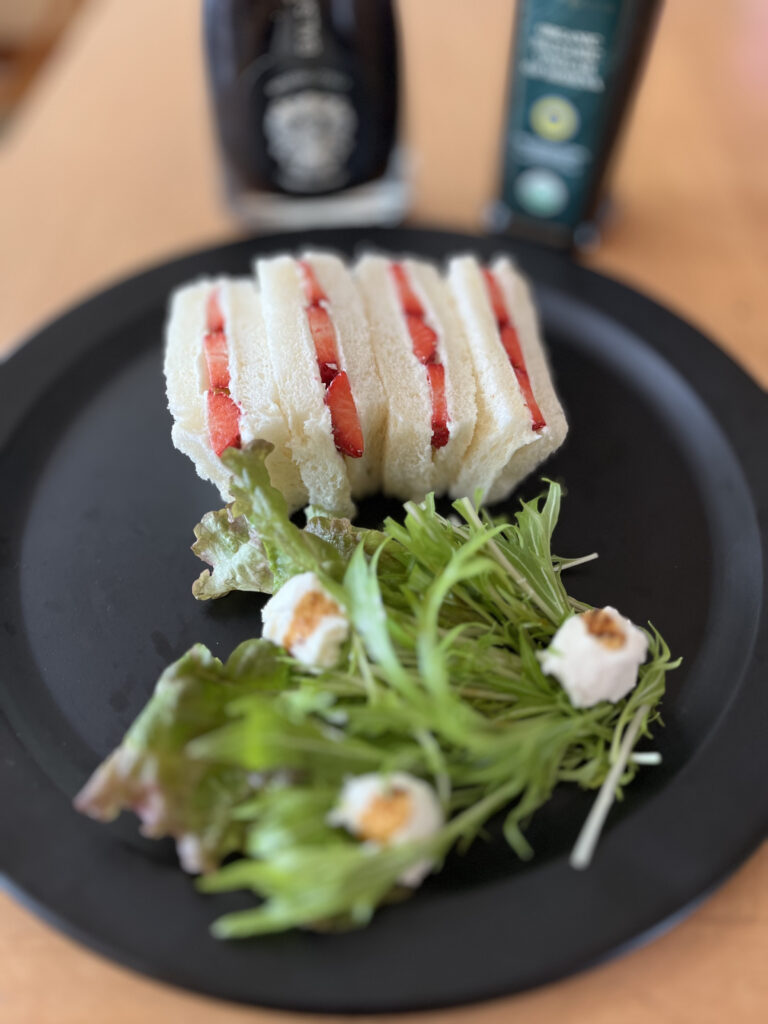
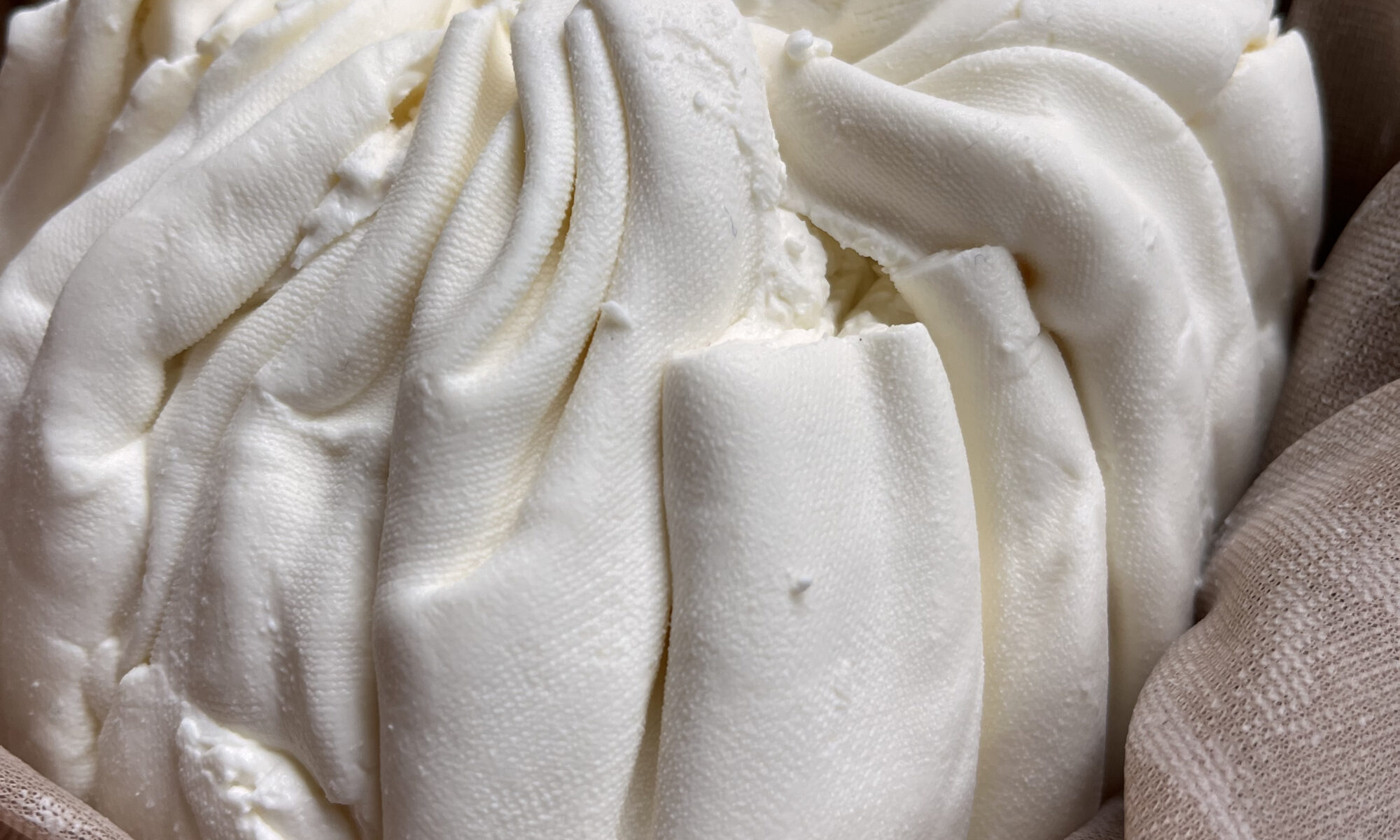
Approximately 2.4 kg of cream cheese was produced from a 5 L cream layer. We immediately mixed the cream cheese with condensed milk and made fruit sandwiches.
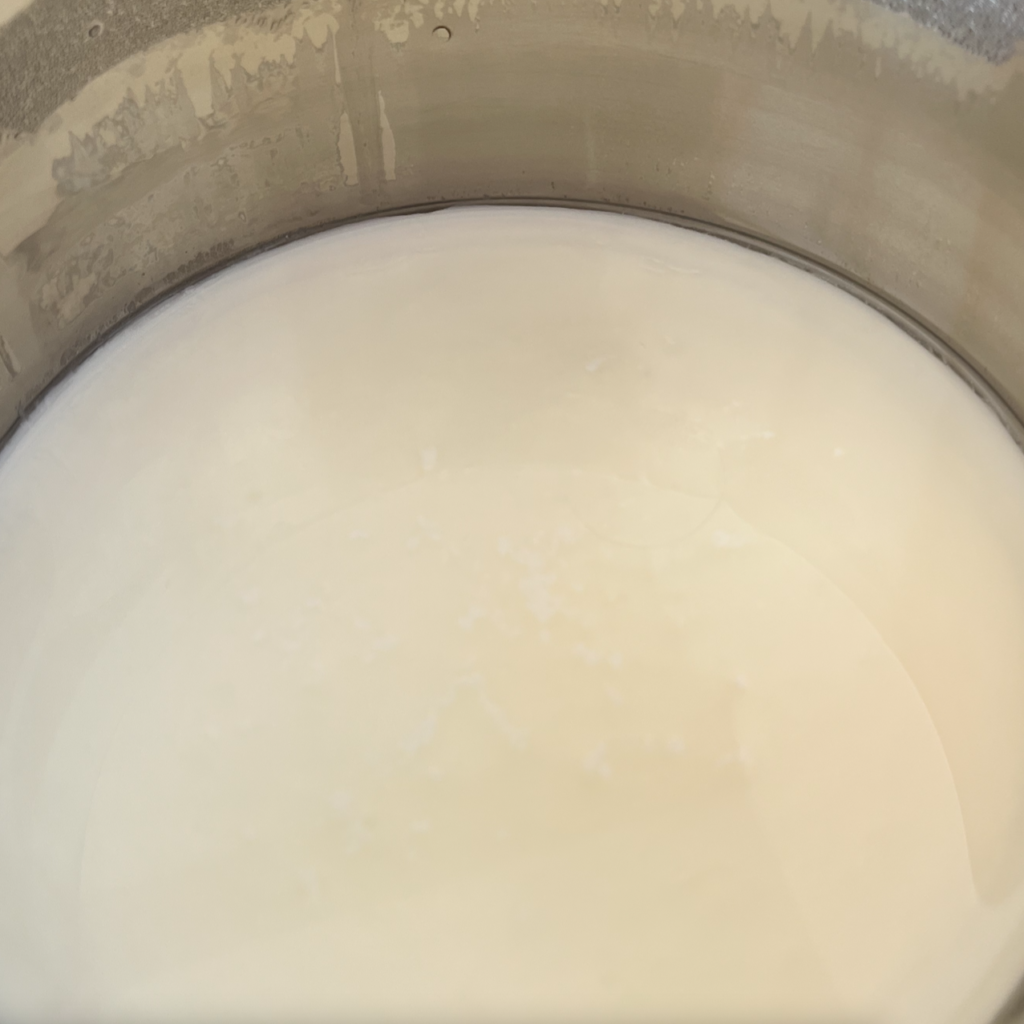
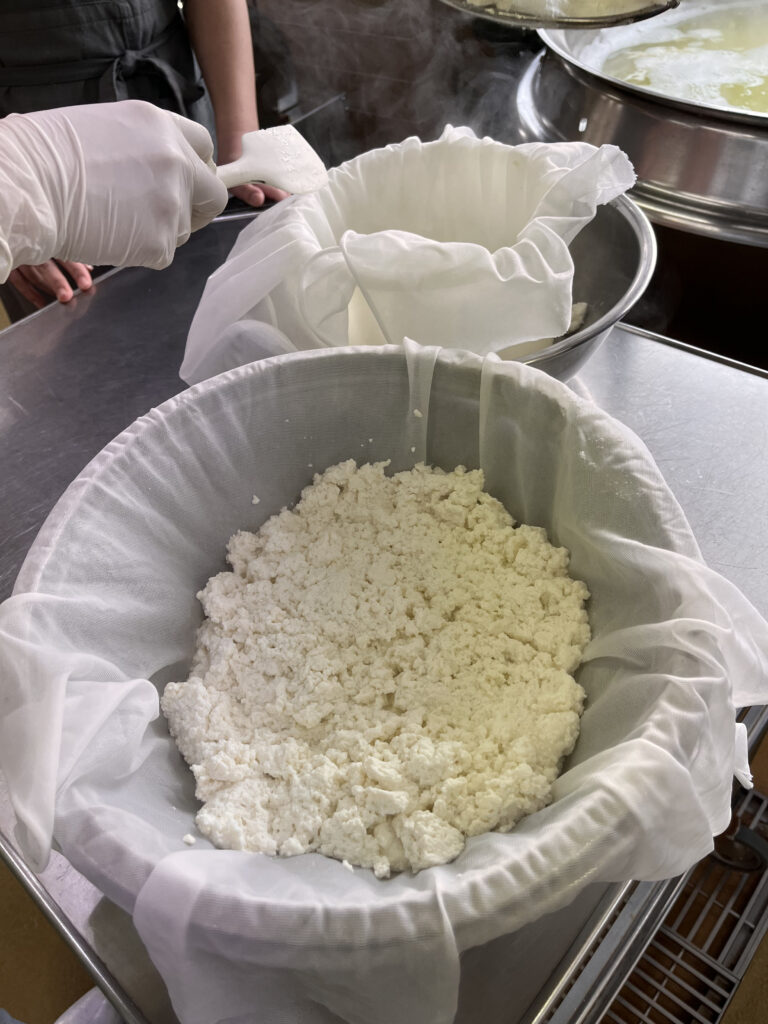
For this cream cheese, the pH was lowered to 6.4 when rennet was added in order to reduce the calcium content and make the cheese smoother in the mouth. Because the pH was lowered, the amount of rennet used was halved from the normal amount. We thought that draining would take a considerable amount of time, but it took only 12-15 hours.
From now on when I make cheese, I will prepare the raw milk the day before and on the day of, I will use the cream layer to make three types of cheese: cream cheese, purpose-made cheese, and whey ricotta cheese.
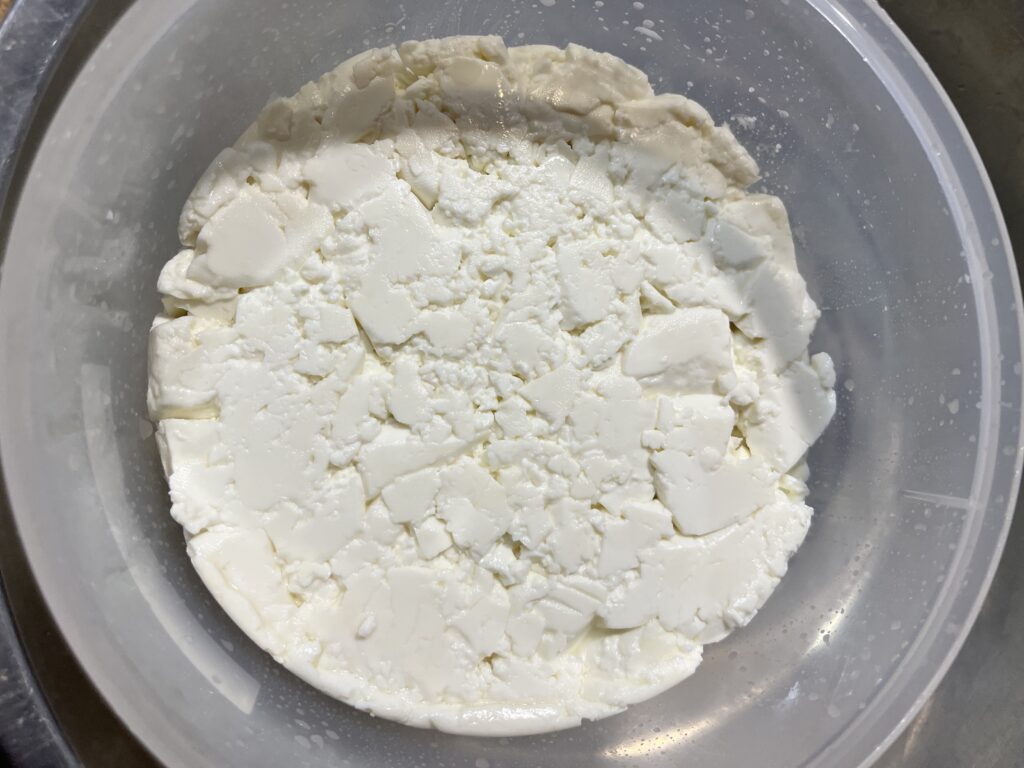
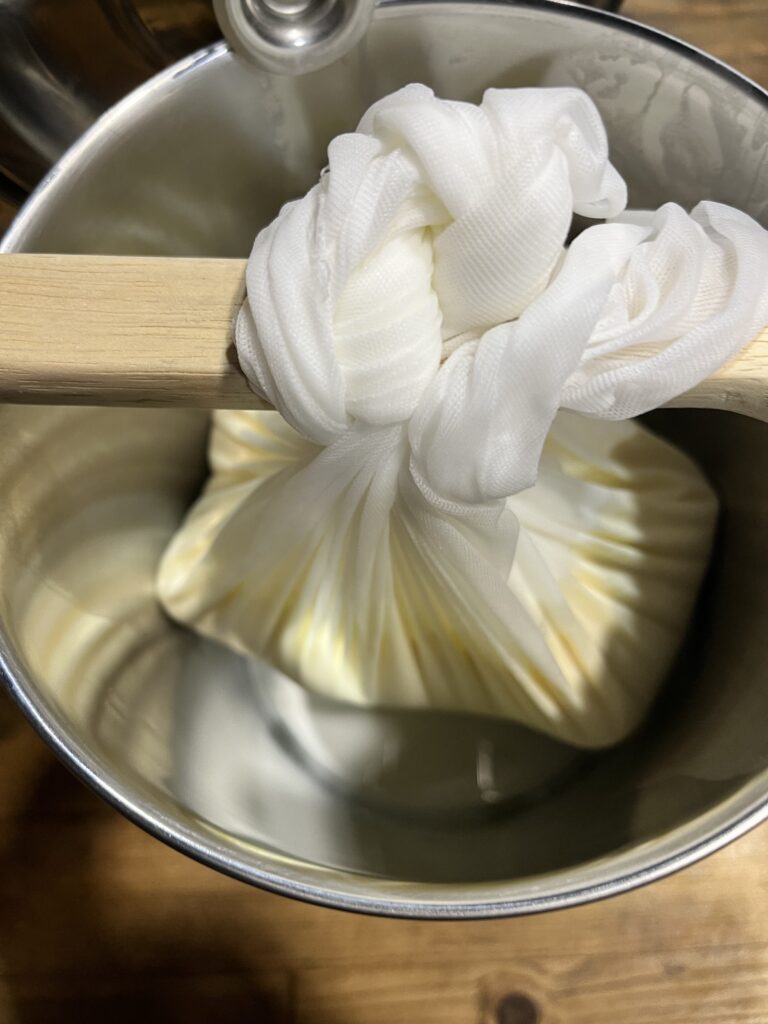
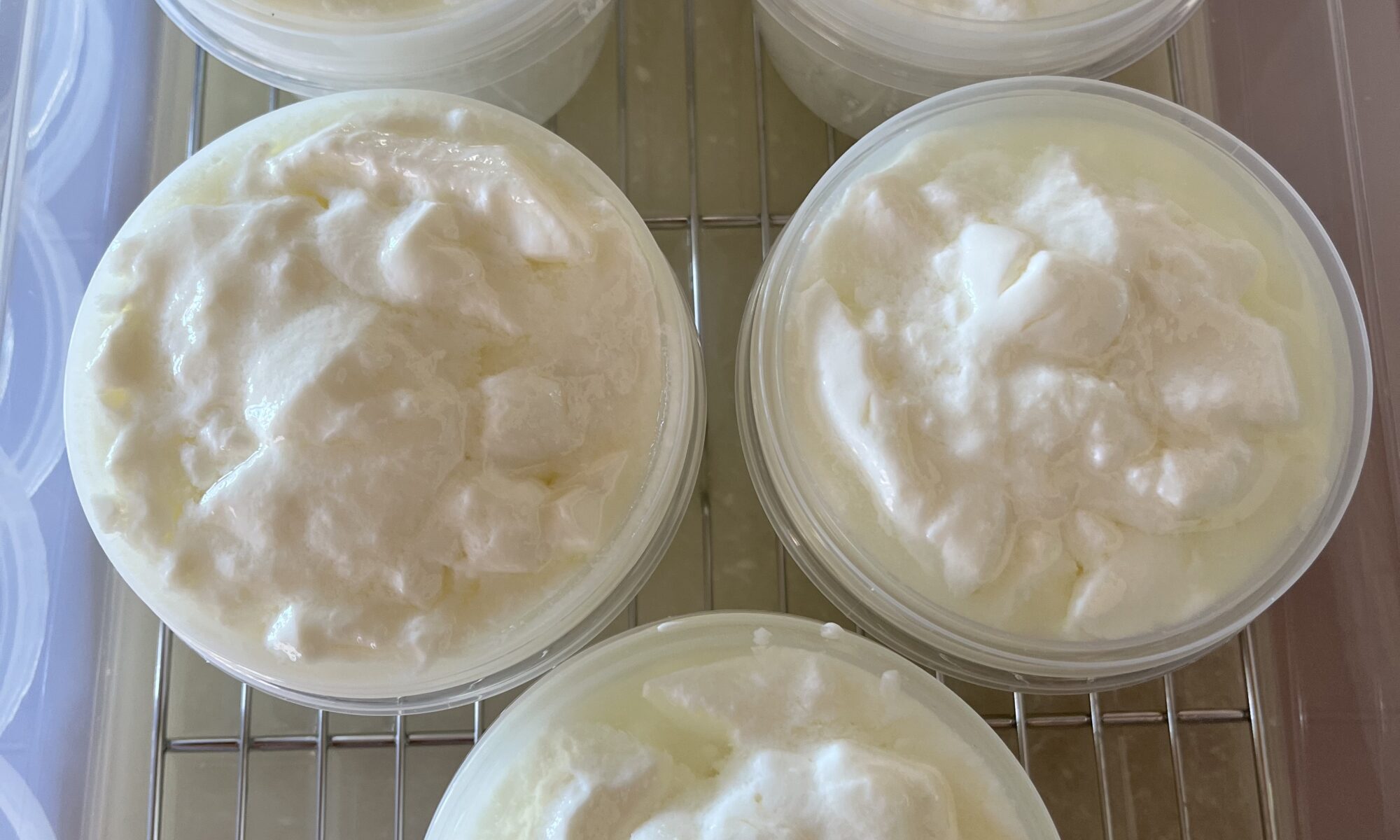
Cream cheese is being made using 5 liters of yesterday’s cream layer of raw milk for Gouda cheese. Lactobacillus acidophilus can be used with yogurt, but this time freeze-dried lactobacillus acidophilus was used. Currently, it is being drained. I think that the draining is scheduled to be finished on the 27th.
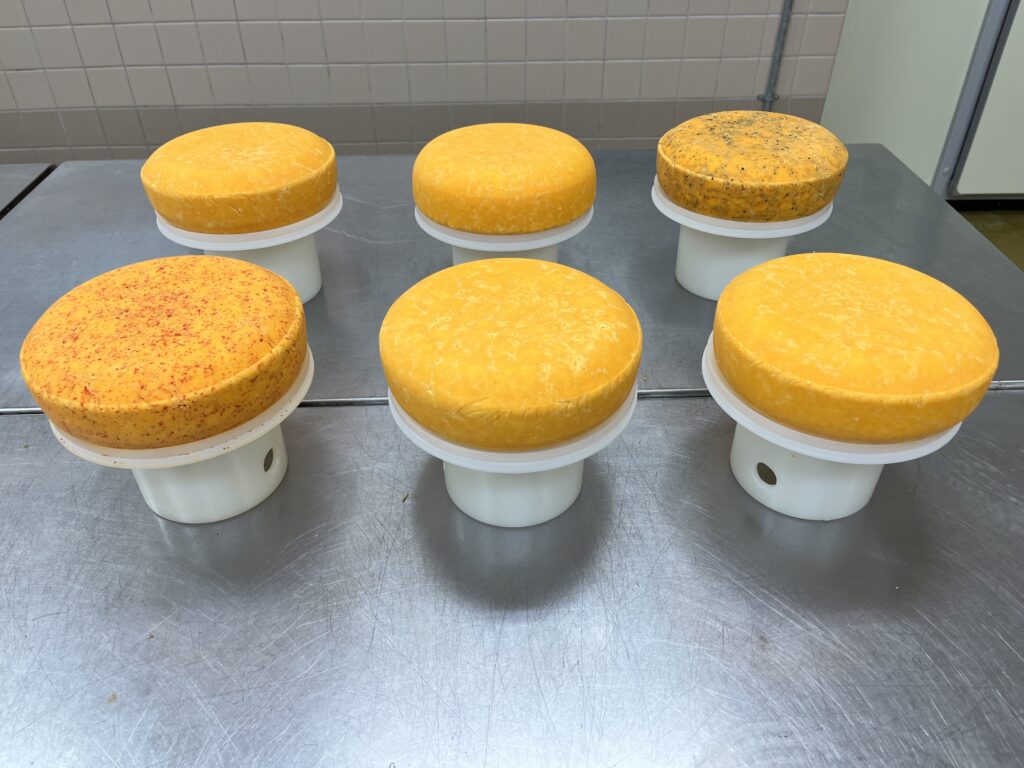
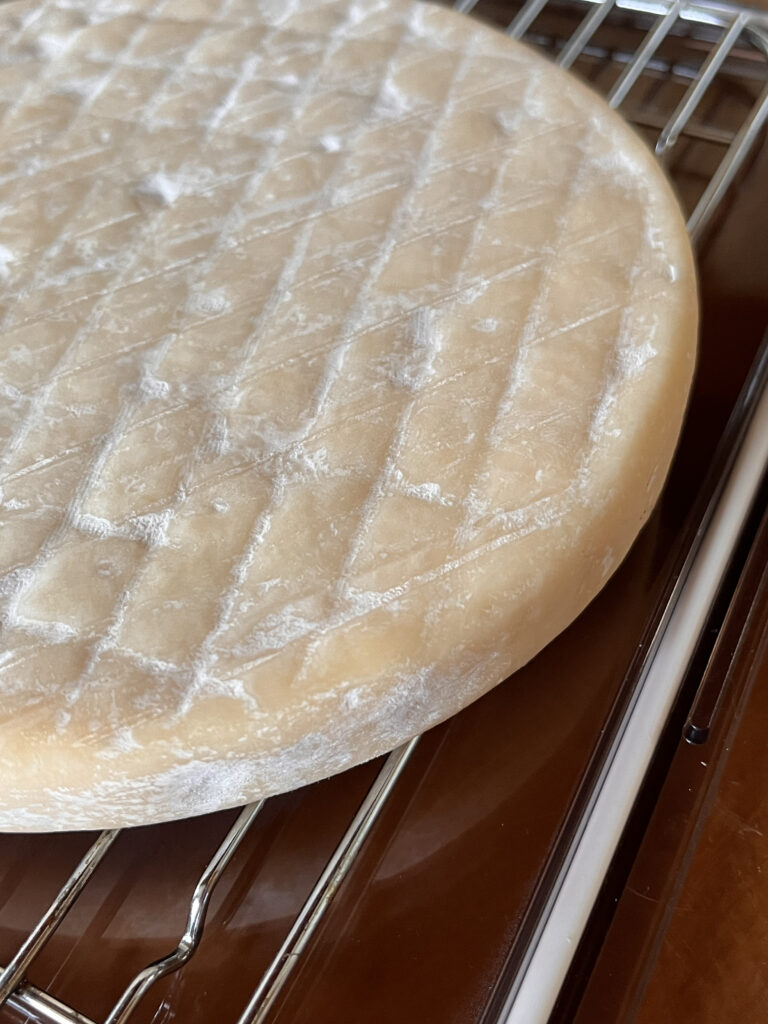
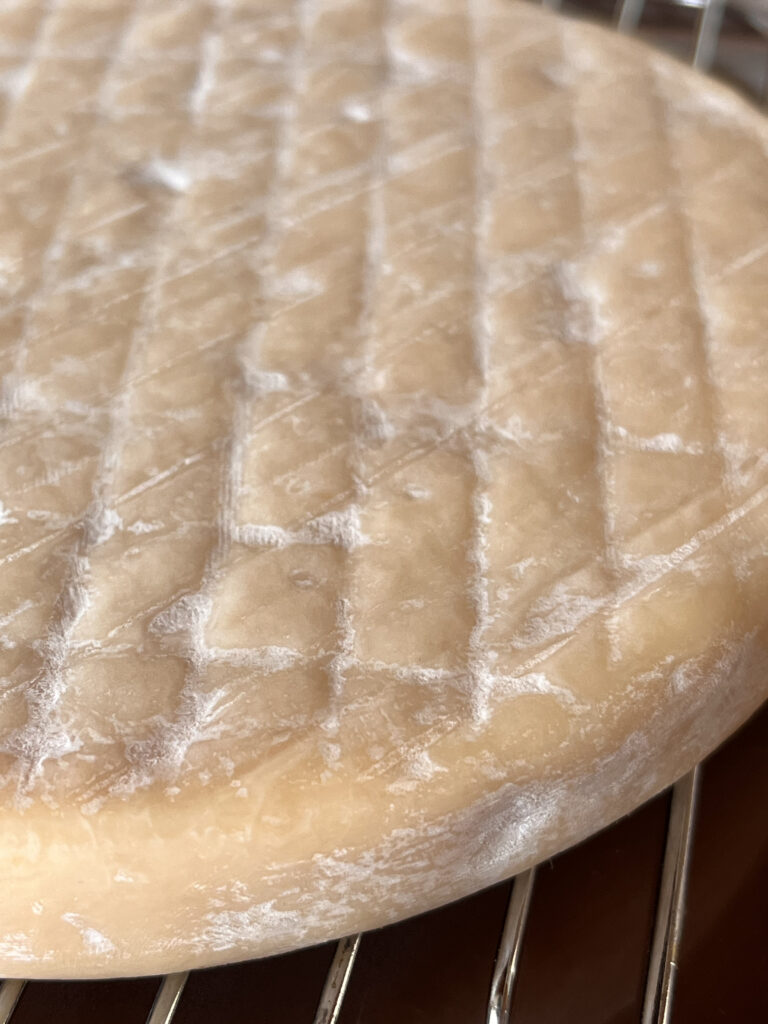
The raclette cheese I made 3 weeks ago is turning a light orange color. From now on I will change to twice a week instead of wiping it with salt water every day.
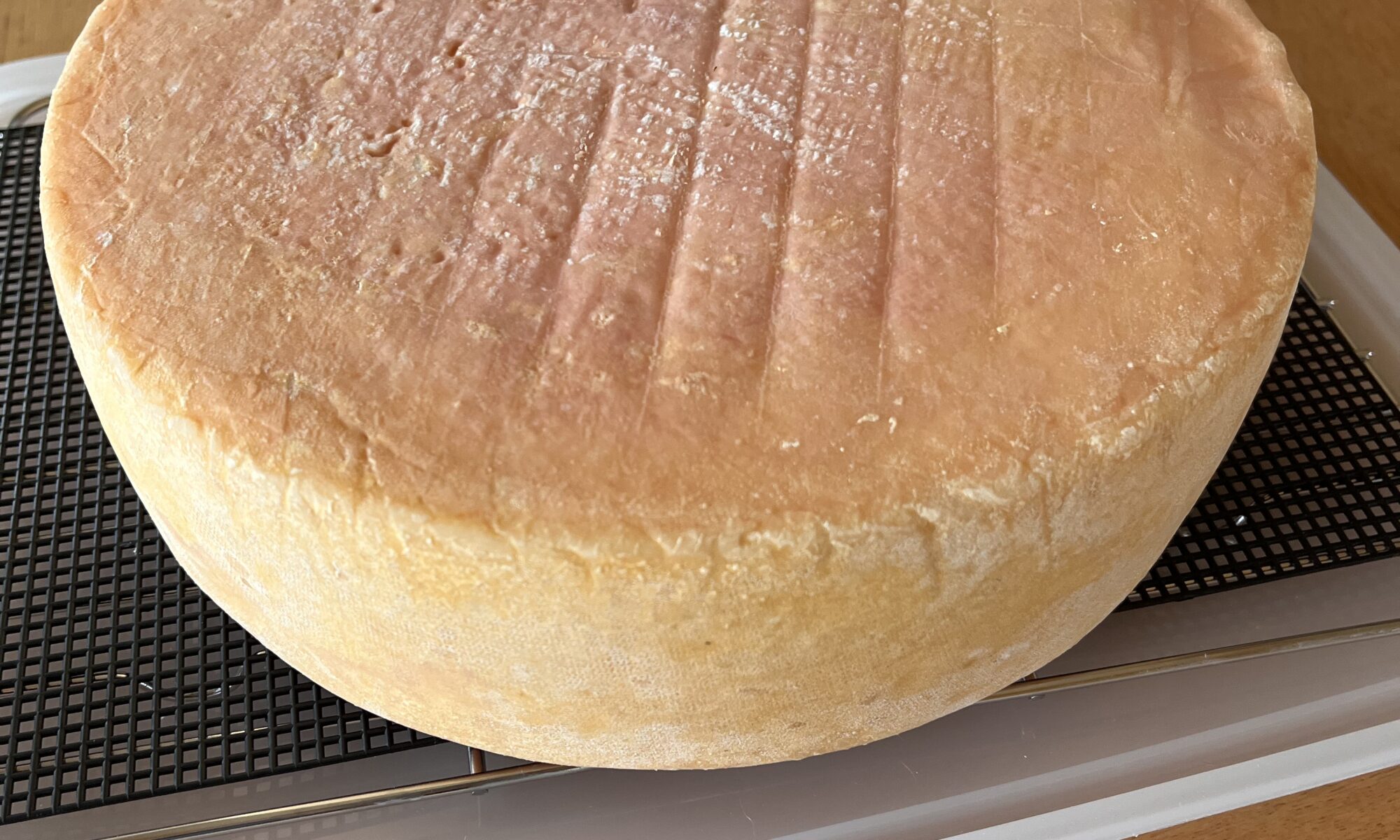
Eleven days after making the raclette cheese, the surface dried out and was stored in a large Tupperware for a week at a temperature of about 13 degrees Celsius and a humidity of over 90%. Once daily, I wipe the surface and sides with salt water. When the surface is dry, he turns it over and does the same thing.
The surface has changed little by little. I am looking forward to seeing how it will change in the future.
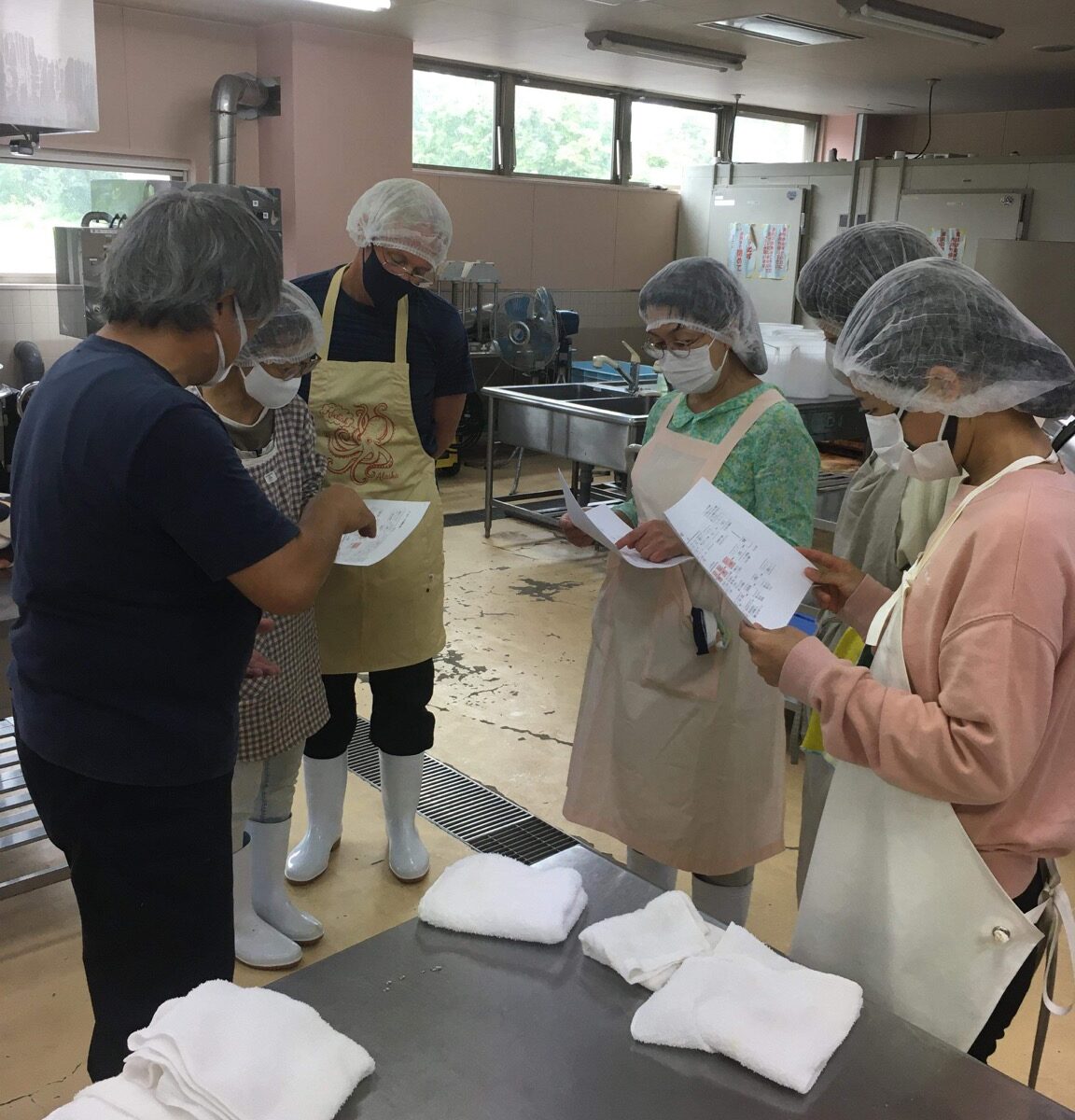
Cheese making will be held at Sarabetsu Village Furusato Kan on the following dates. We are sorry, but we are not accepting applications for participation or observation. February 10 and 11: Parmigiano style cheese February 21 and 22: Gouda cheese February 24th and 25th: Gouda cheese March 5th and 6th: Parmigiano-style cheese March 9th and 10th – Gouda cheese March 16th and 17th: Cheddar chees On each of these days, 100 liters of raw milk will be used to make six 2-kilogram portions of cheese. We will introduce the production on our blog.
I made raclette cheese and whey ricotta cheese. I am looking forward to seeing how the color of the rind changes during the aging process. The recipe used is as follows.
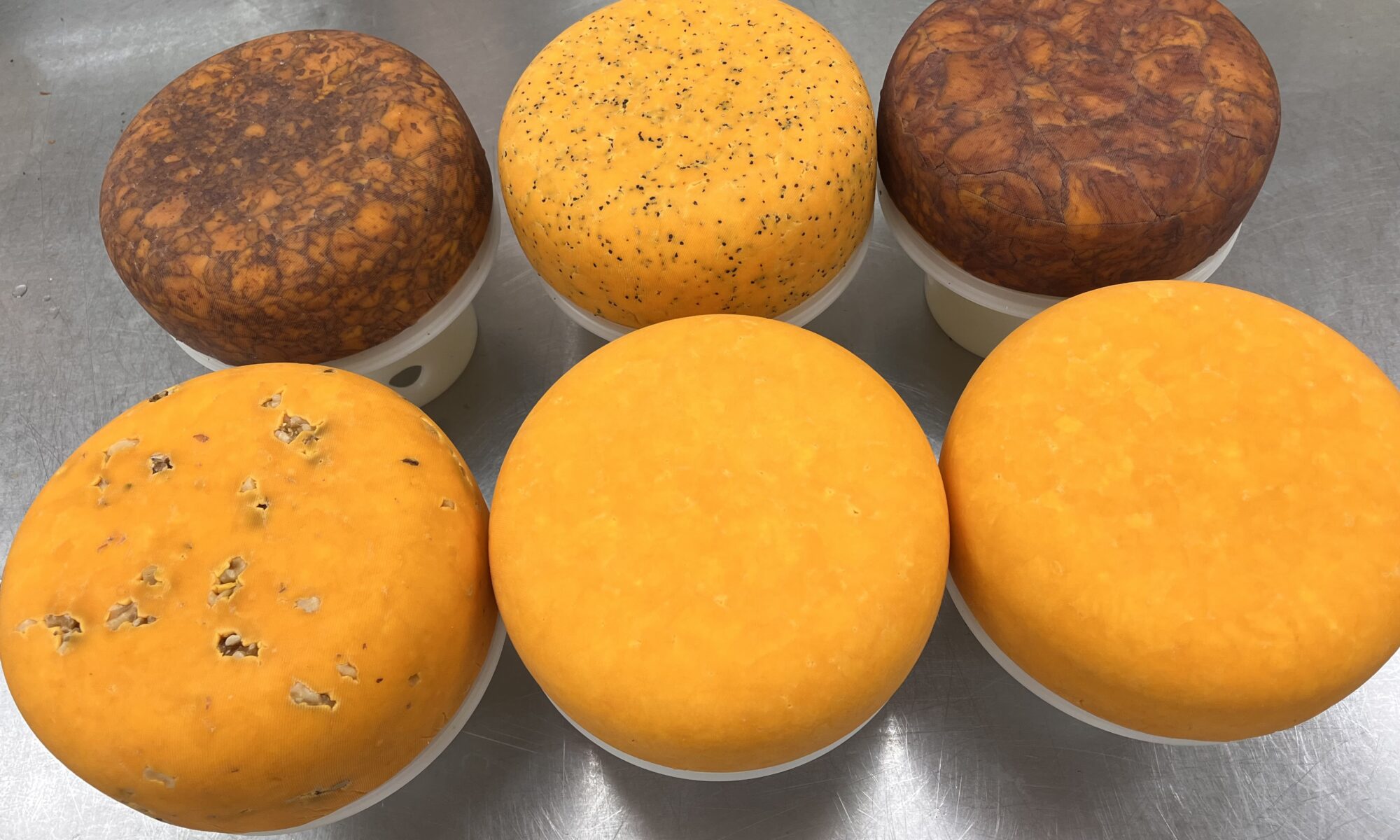
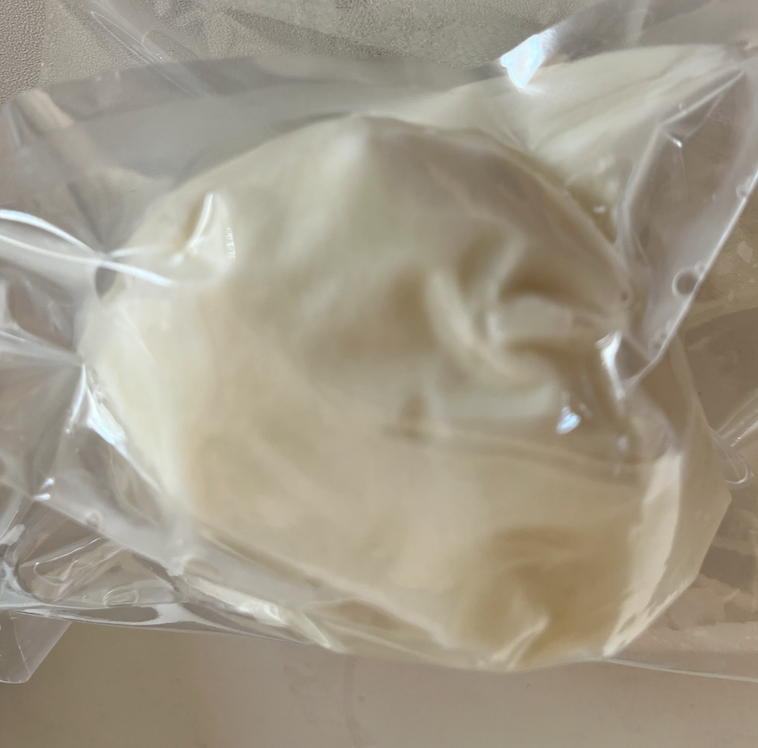
We made cheese for three consecutive days: parmigiano style cheese on the 23rd, string cheese on the 24th, and gouda cheese on the 25th. As a by-product, a large amount of whey ricotta cheese was also made each time. String cheese is vacuum-packed on the 30th after it has been rehydrated in the refrigerator. The Parmigiano and Gouda cheeses will be salted, surface dried, and aged in the cellar for one to two months before being vacuum-packed and refrigerated. The Parmigiano-style cheese will be aged for one year and the Gouda for three months. The Gouda this time is made with black pepper and one with chili pepper.
On January 25, I will be making Parmigiano-style hard cheese with my friends at the “Hometown Hall”. After production, we plan to age it for one year. Our recipe is as follows.
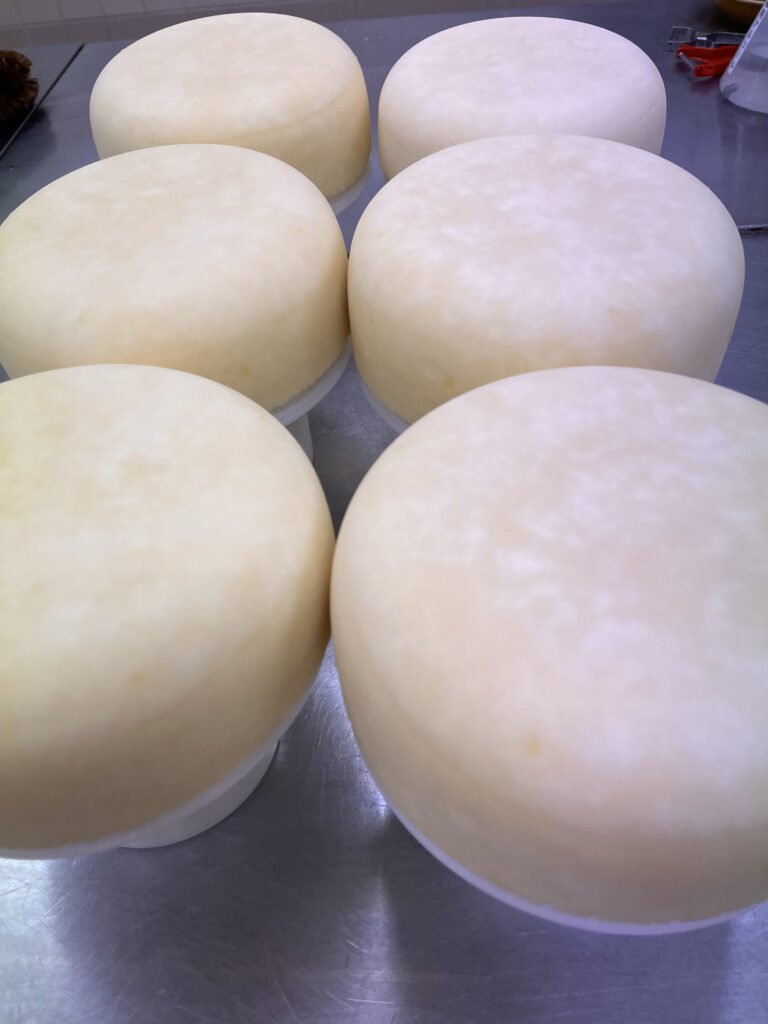
Lactic acid bacteria contained in raw milk were cultured to make bulk starter, which was used to make Gouda cheese.Although we do not know the type of lactic acid bacteria contained in the milk, the lactic acid fermentation and acidification speed are comparable to those of the lactic acid bacteria we usually use. However, we do not know what kind of enzymes the cultured lactic acid bacteria have, so we will have to wait and see about the aroma and taste that will come out during the aging process. This time, about 1.9 kg of card was produced from 15 L of raw milk.
Raw milk contains lactic acid bacteria that are present in the environment of that farm. Raw milk is made from cow blood through mammary gland cells and is basically sterile. However, lactic acid bacteria contained in grass and bedding straw adhere to the udder and are mixed with raw milk during milking. These lactic acid bacteria strongly reflect the environment and seasons on the farm. Therefore, we planned to cultivate the lactobacilli in raw milk and use raw milk from the same dairy farm to make cheese unique to the farm.
We made Bacon Gouda cheese and Whey ricotta cheese. We will use some of the raw milk we used to make Gouda cheese by culturing the lactic acid bacteria contained in the raw milk.
The method is as follows,
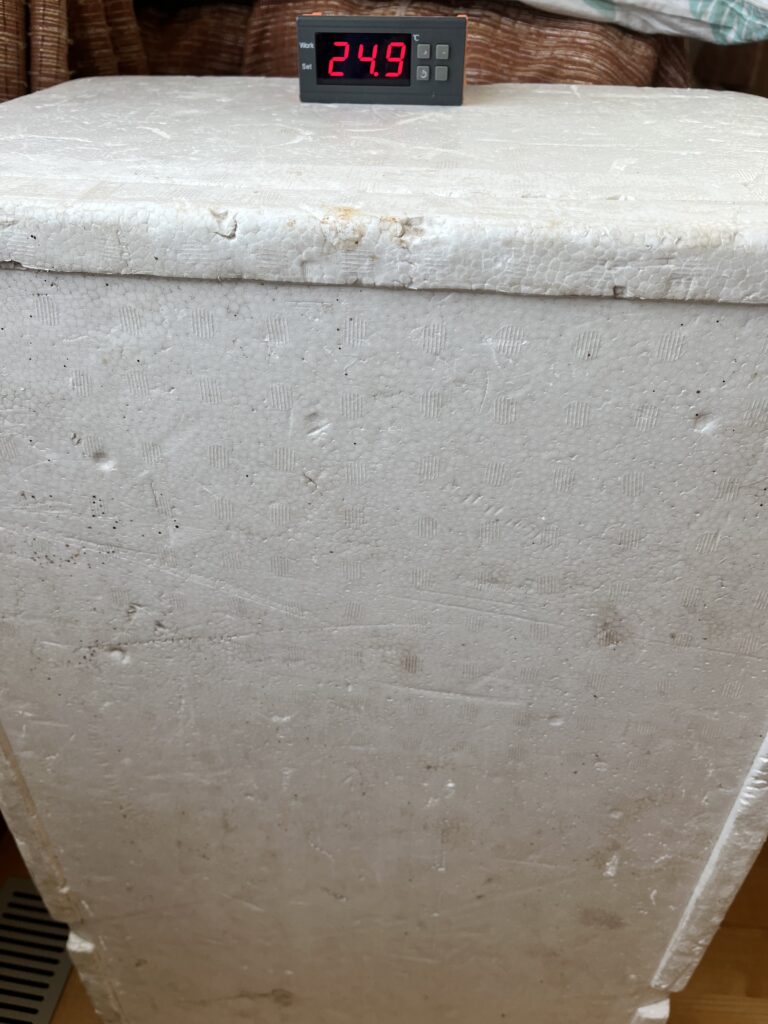
1. Leave 300 cc of raw milk at a temperature of 24°C for 1 day, remove the cream layer floating on the surface, and leave it at the same temperature for about 3 days to make a kind of yogurt.
2. Add glucose to 50 cc of nonfat milk, add 10 cc of the yogurt made in step 1, and incubate at 24°C for 24 hours.
3. Add glucose to 50 cc of nonfat milk, add 10 cc of the yogurt made in step 2, and incubate at 24°C for 24 hours.
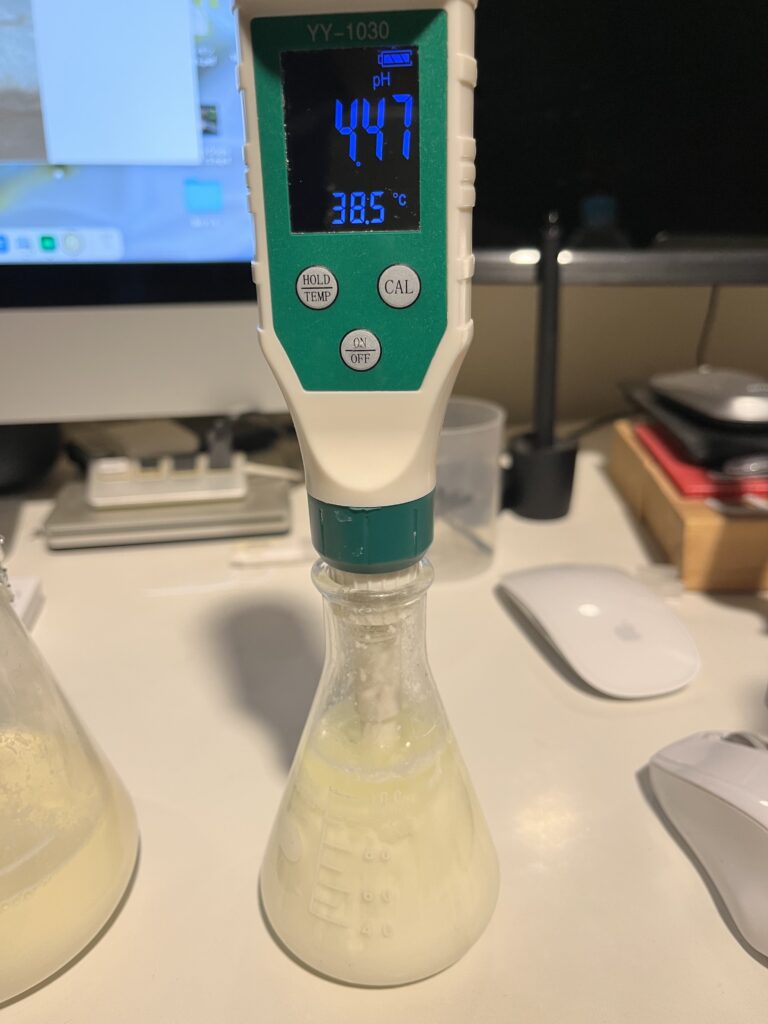
4. When it is confirmed that the resulting yogurt has a pH of 4.7 or less, add 240 cc of nonfat milk and glucose, add 60 cc of the resulting yogurt, and incubate at 24°C for 18 to 24 hours to confirm that the pH of the yogurt is 4.7 or less. This completes the bulk starter according to the farm environment where the raw milk was produced.
5. Make Gouda cheese by adding 300 cc of bulk starter to 15 L of raw milk.
Raw milk itself is made from cow blood through mammary gland cells and is basically sterile and contains no lactic acid bacteria.
Raw milk contains lactic acid bacteria because the lactic acid bacteria contained in grass and bedding straw in pastures adhere to the cow’s udder and enter the raw milk during milking. Therefore, the quality of the pasture and rearing environment determines the type and number of lactic acid bacteria contained in the raw milk.
My friends and I will be making Gouda cheese on November 21 and 22. We will make 6 Gouda cheeses of about 2 kg with 100 liters of milk. ・The lactic acid bacteria is 10U of Christian Hansen’s CHN-11. ・Calcium chloride is used at 0.02% of the milk volume. ・Use 16.6 mℓ of rennet with a strength of 300 IMCU/mℓ. ・pH was 6.55 when rennet was added. ・The pH at the time of pre-pressing was 6.35. ・The time from feeding the lactic acid bacteria to filling the mold is scheduled to be 180 to 210 minutes.
The production scenery will be announced at a later date.
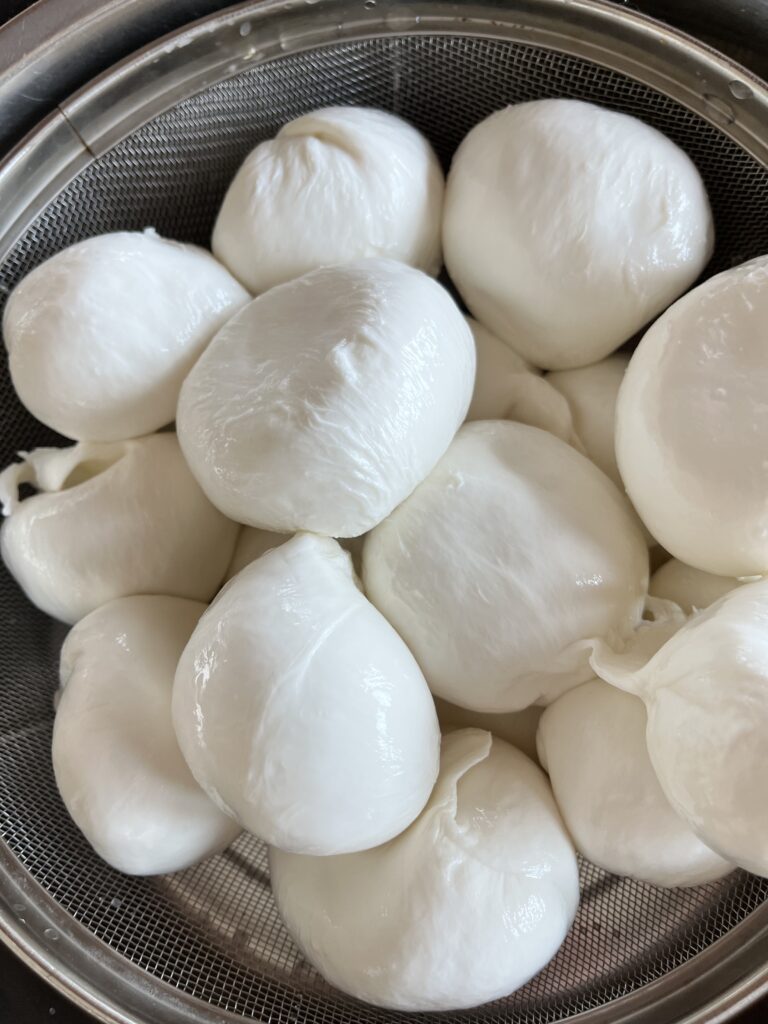
Today I made mozzarella cheese. The milk used was 15 liters of raw milk.
In other countries, pasteurized milk is sold in gallon bottles (4.5 L), which makes it easy to make cheese at home, but in Japan, pasteurized milk of this size is not sold, and we have to share raw milk from dairy farms and pasteurize it ourselves.
This time, in addition to mozzarella, we also made whey ricotta. Mozzarella whey has a low pH, so we used a pH adjuster to adjust the pH to 6.5. The result is creamy and can be mixed with jam or honey. The video shows the pasteurization process, etc.
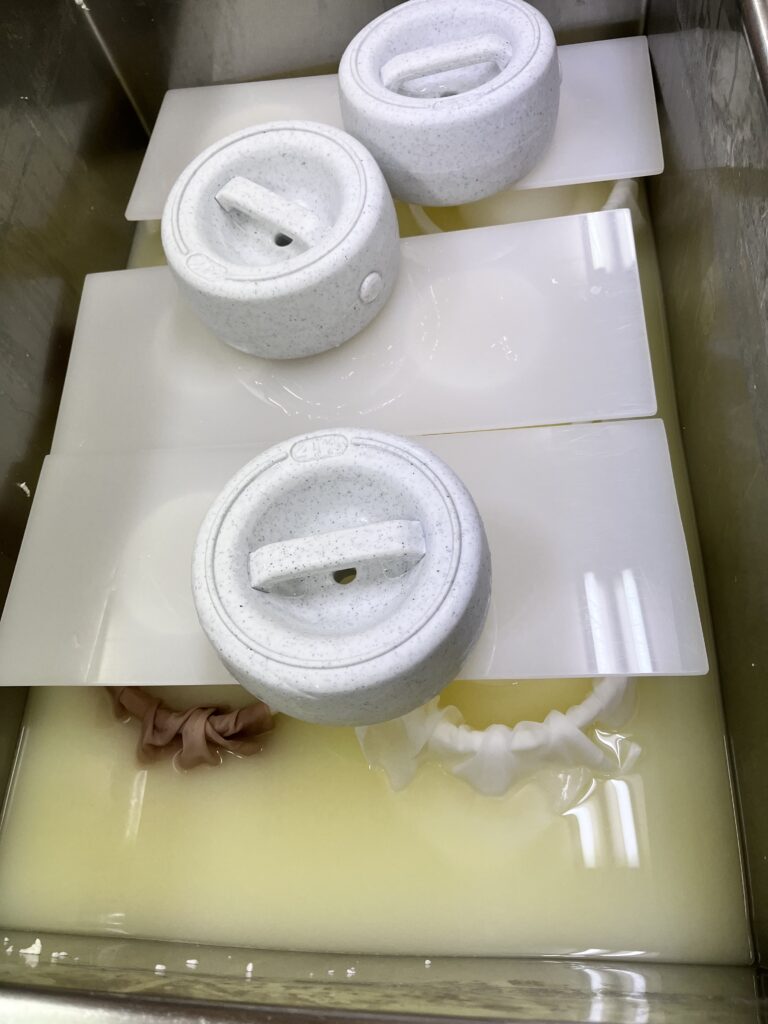
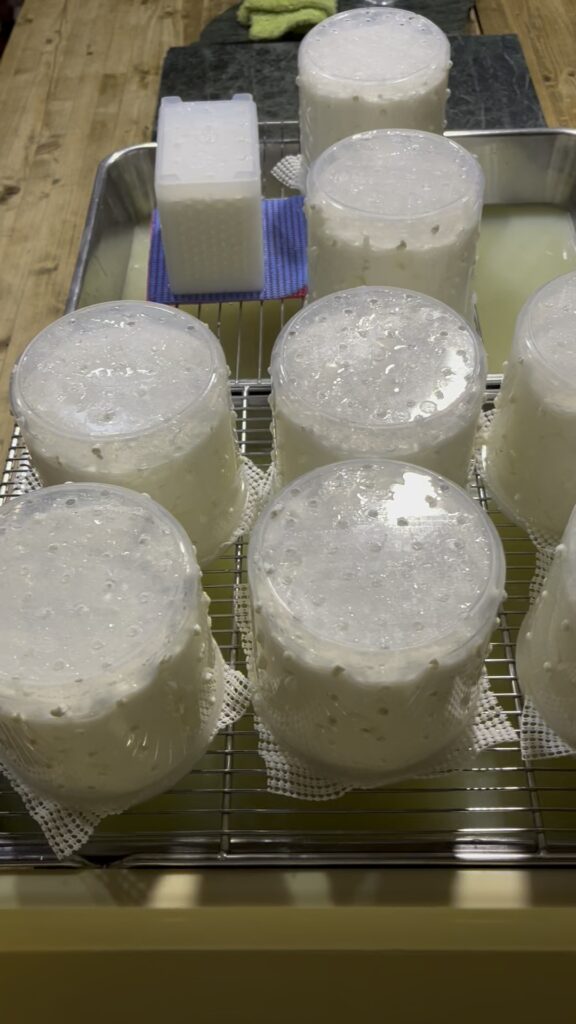
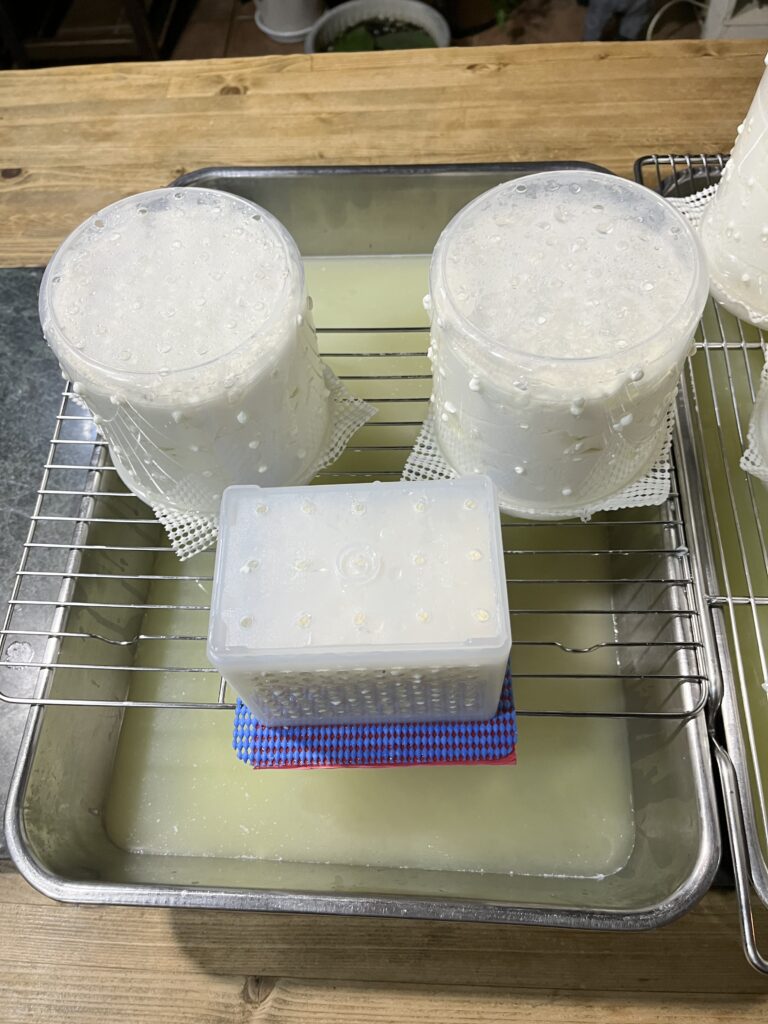
Yesterday (11/3), we made Gouda cheese at the renovated cheese processing facility at Sarabetsu Village Furusato Kan. It was the first cheese making after the facility was put into operation, and although there were a few accidents, such as batteries for the thermometer and precision scale being out of order and the platform scale being sent for repair, we were able to make cheese according to the recipe. We are now salting the cheese in plastic bags as shown in the photo. Our method of salting is to sprinkle 1.5 to 1.7 % of the weight of the cheese with salt and turn it upside down for 3 days to achieve the desired salt concentration.
After the harvest work in the field today, we had the participants compare the taste of the cheese to see if the type of salt used would change the taste of the cheese. The three types of salt used were (1) refined salt, (2) Ako salt, and (3) rock salt, and the cheese was ripened for two and a half months. Fifteen participants were asked to taste them in order starting from (1) and raise their hands to indicate which salt tasted better. The result was five each from (1) to (3). Those who chose (2) and (3) rated the saltiness as more salty later, rather than immediately after eating. Those who chose (1) also rated the saltiness as gentle.
The components of the salt used are shown in the table.
Today’s results show that there is no change in the taste of cheese no matter which salt is used, and that there is a time difference in the perception of salty taste depending on the mineral components in the salt used. The salt equivalent of (1) was the highest, but the mineral component was the lowest, resulting in a flatter and gentler salty taste. From the above, we learned that the taste of cheese does not change depending on the salt used, and we would like to use refined salt next time. Also, if you are careful about taking in too much salt, it is a good idea to choose salt with a high mineral content.
このことを理解するための資料として「原料と製品のパフォーマンスにおける乳由来たんぱく質の役割を理解する」という「Think USA Dairy」のテクニカルレポートを見つけました。(Googleで資料名を検索すると最初に出てきます。)また以前のブログにも掲載した「ChemMatters | DECEMBER 2017/JANUARY 2018 9 」 にある酸性化とチーズ製造についての資料も併せて見ることで理解に役立つと思います。
In cheese production, it is said that the acidification rate and time from the addition of starter to the time when the card is pulled from the whey and molded, as well as the pH at the time when the card is pulled from the whey and molded, determine the basic structure of the cheese.
To understand this, we found a technical report from “Think USA Dairy” (https://www.thinkusadairy.org ‘ C3- Using Dairy). It would also be helpful to view the material on acidification and cheese production in “ChemMatters | DECEMBER 2017/JANUARY 2018 9 “, which was also posted in a previous blog, to help understand this topic.
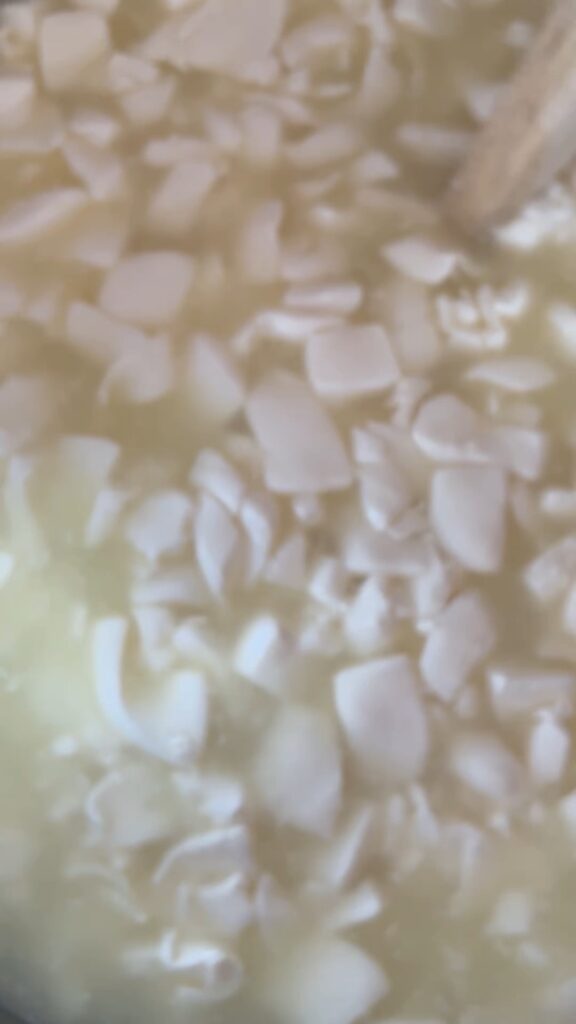
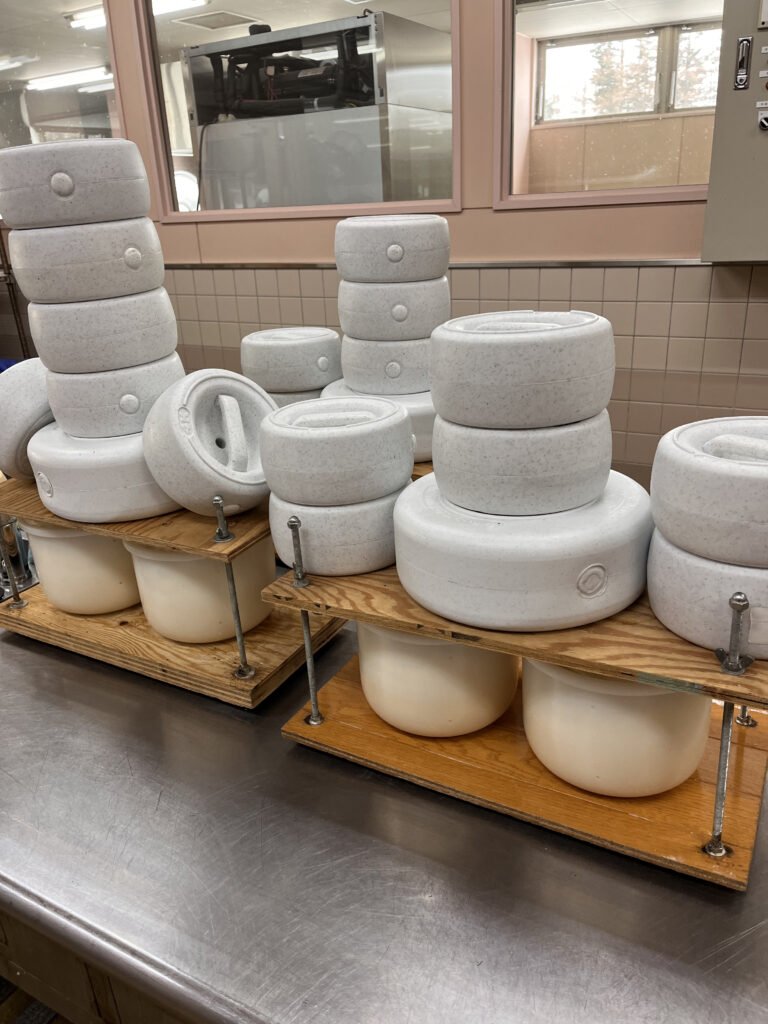
Since we had bamboo and wood, we purchased stainless steel wire and rods to create a wire cutter (horizontal cut) to cut cheese curds. The left wire spacing is 2 cm for mozzarella and the right wire spacing is 1 cm for semi-hard cheese. The vertical cutting is done with a knife. For hard cheese, cut with a whisk. We created this product in the belief that it would make the moisture content of the cut card as uniform as possible and reduce the moisture bias of the green cheese.
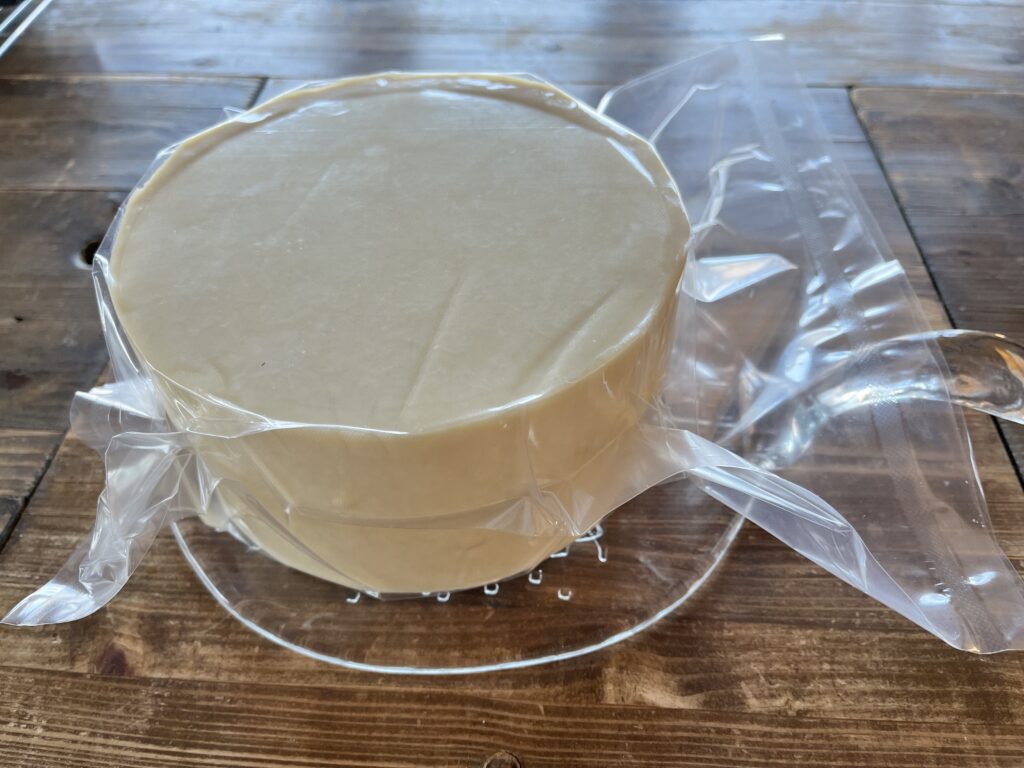
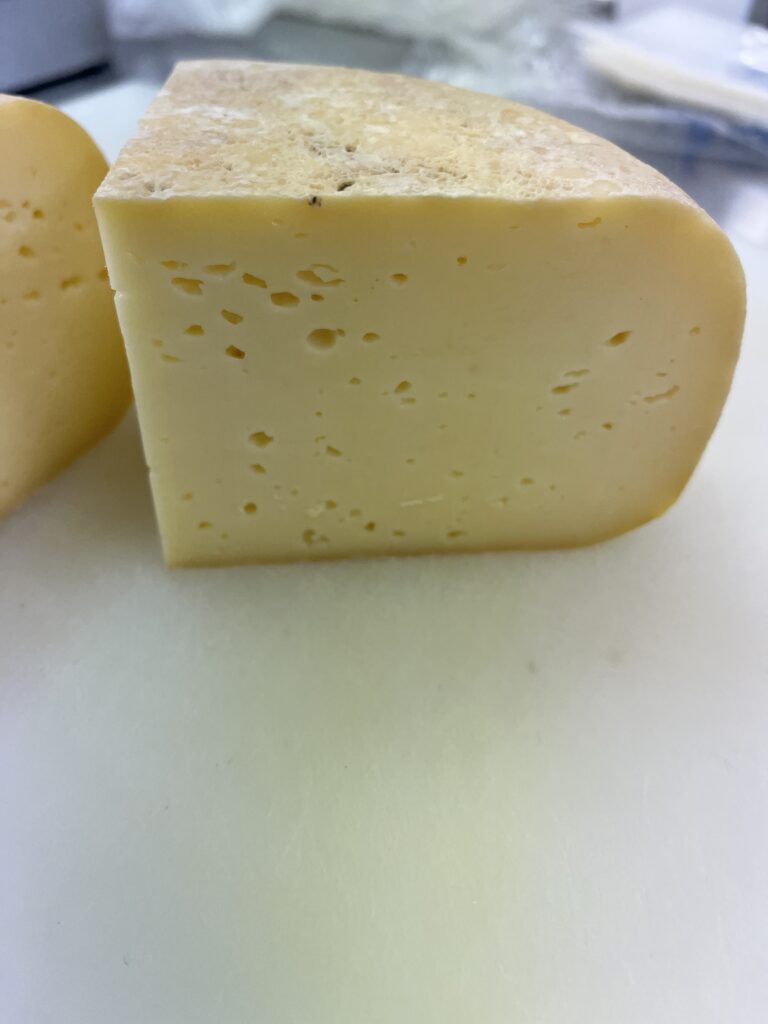
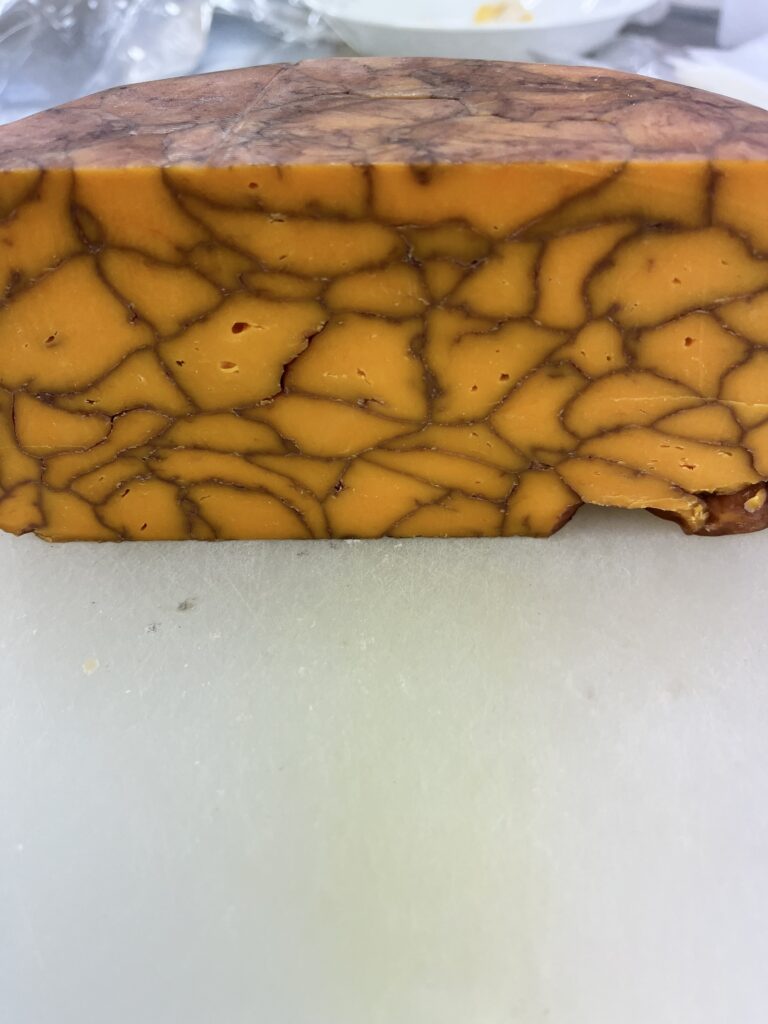
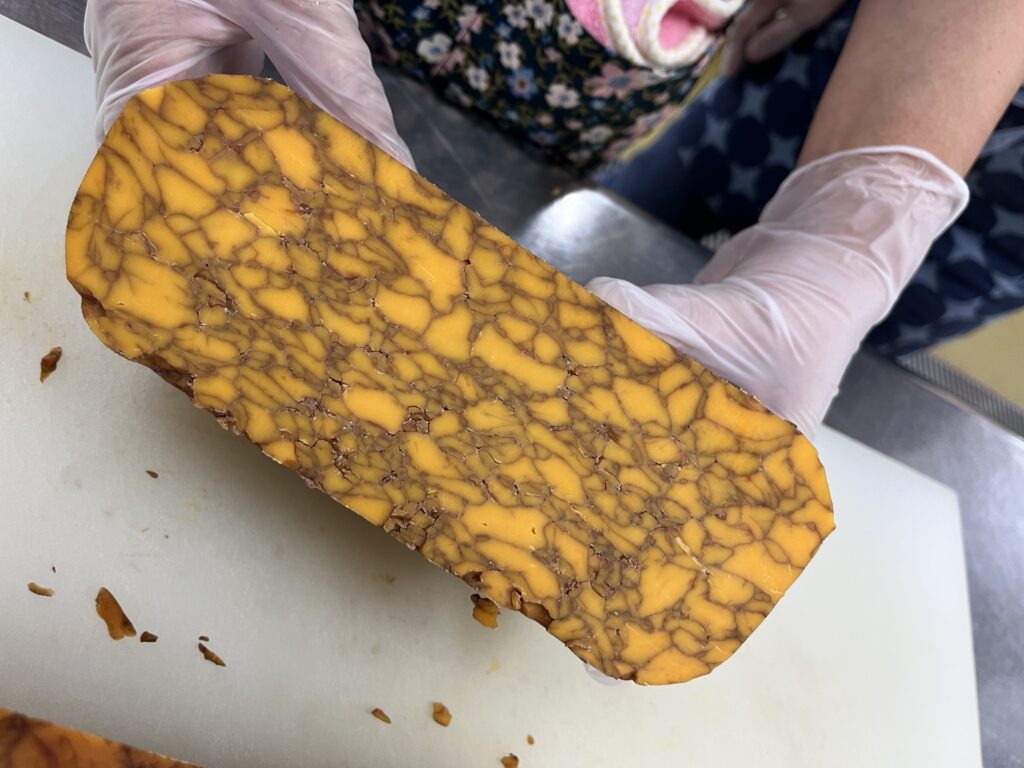
Gouda cheese made in January, started to puff up (butyric acid fermentation) after one month of aging, so I vacuum-packed it and stored it in the refrigerator (about 7 or 8 degrees Celsius). After 6 months had passed, I cut the cheese and found that many gas holes had formed. Since it was stored in the refrigerator, the activity of butyric acid bacteria was suppressed and there was almost no fermentation smell. When I tried to eat it, I found it to be a delicious cheese with a lot of flavor components. Since it did not look good, I made shredded cheese and used it for toast and pizza. When you make Gouda cheese and the cheese swells up after butyric acid fermentation, do not throw it away but vacuum-pack it and store it in the refrigerator for at least six months before eating.
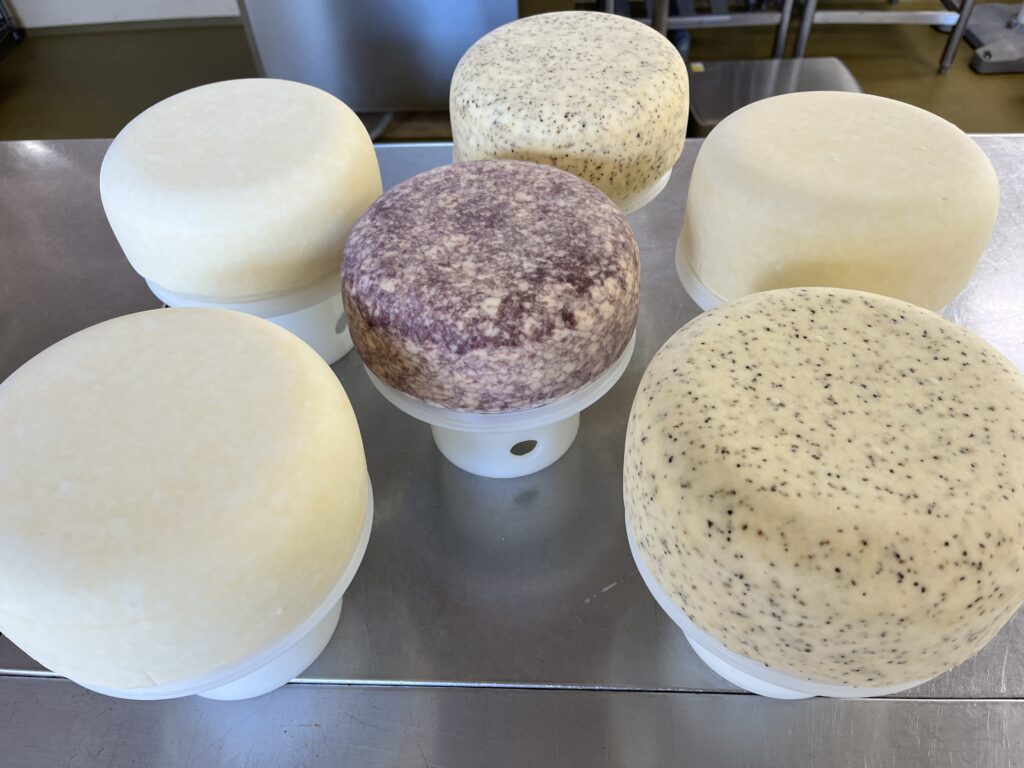
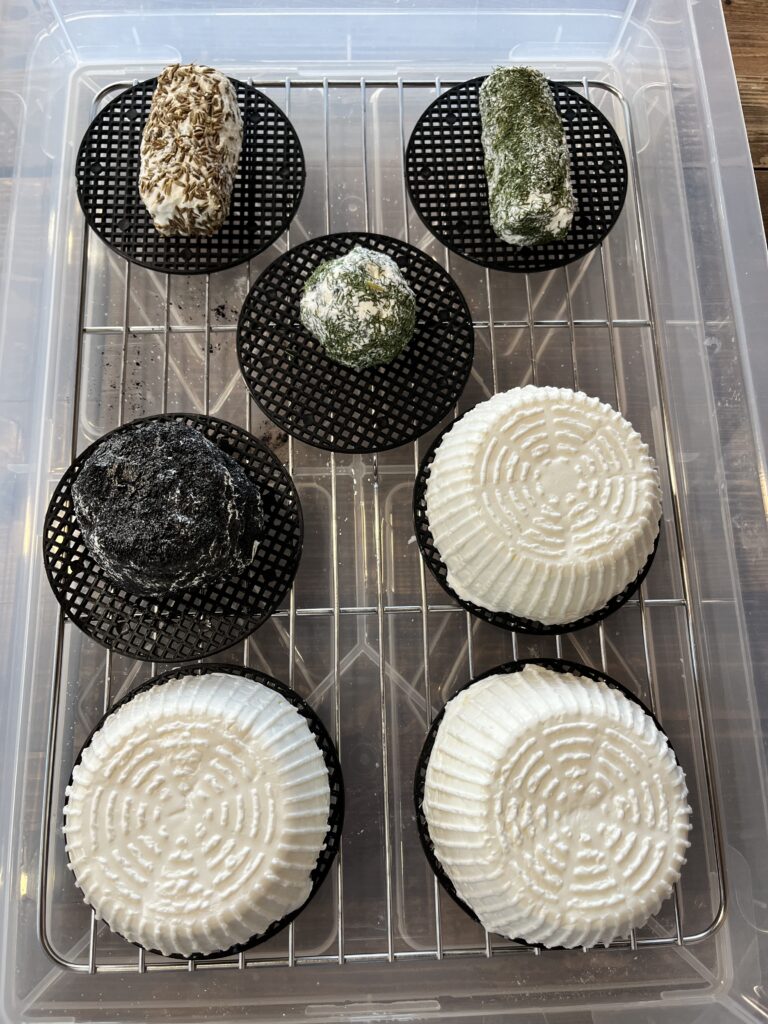
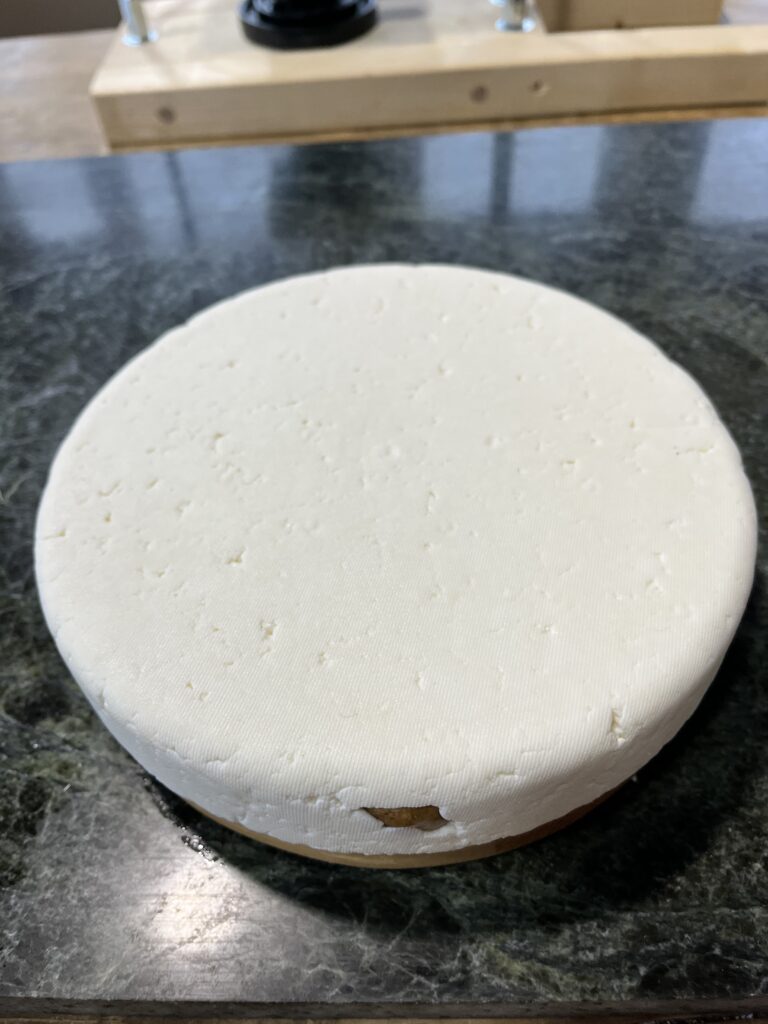
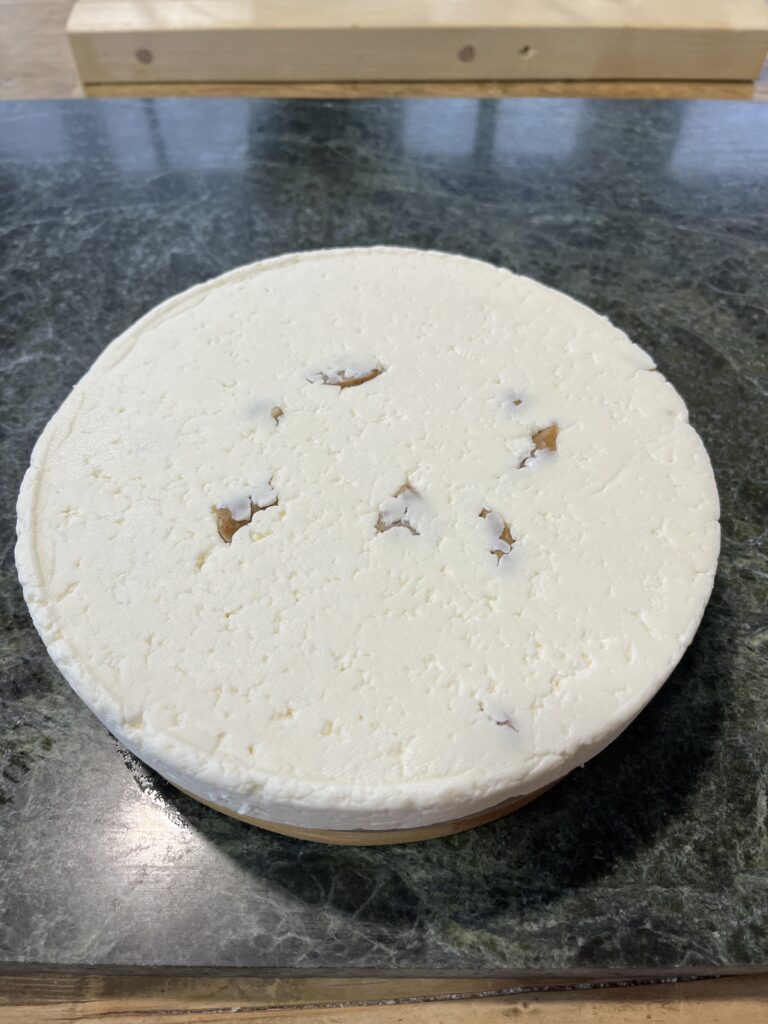
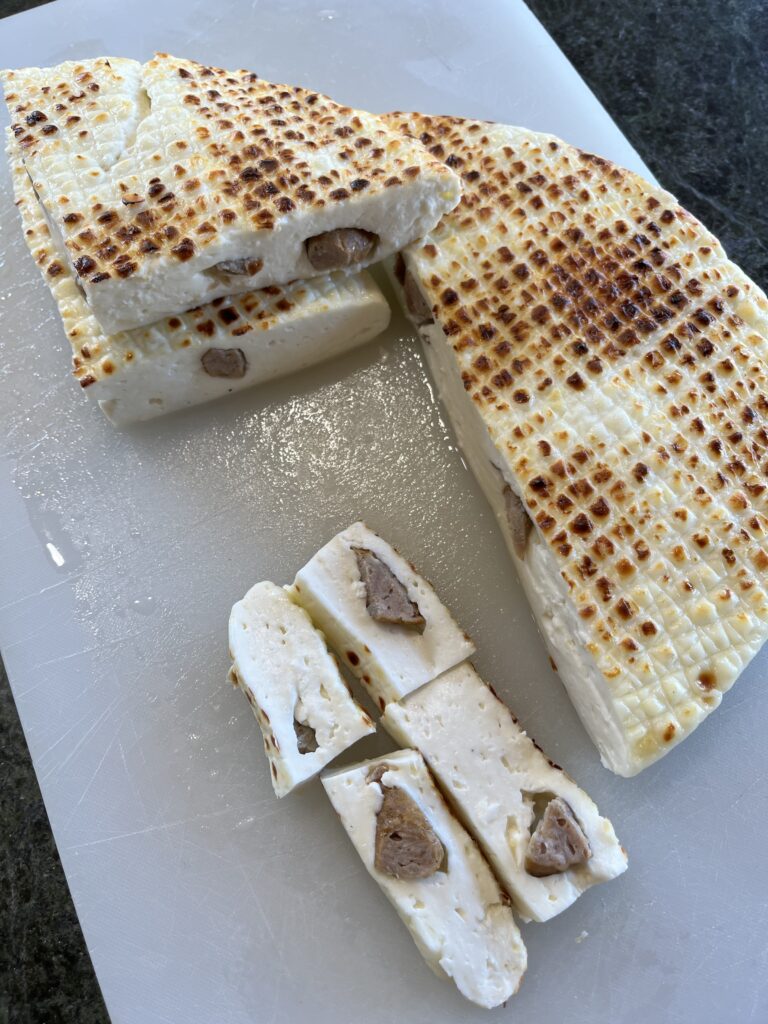
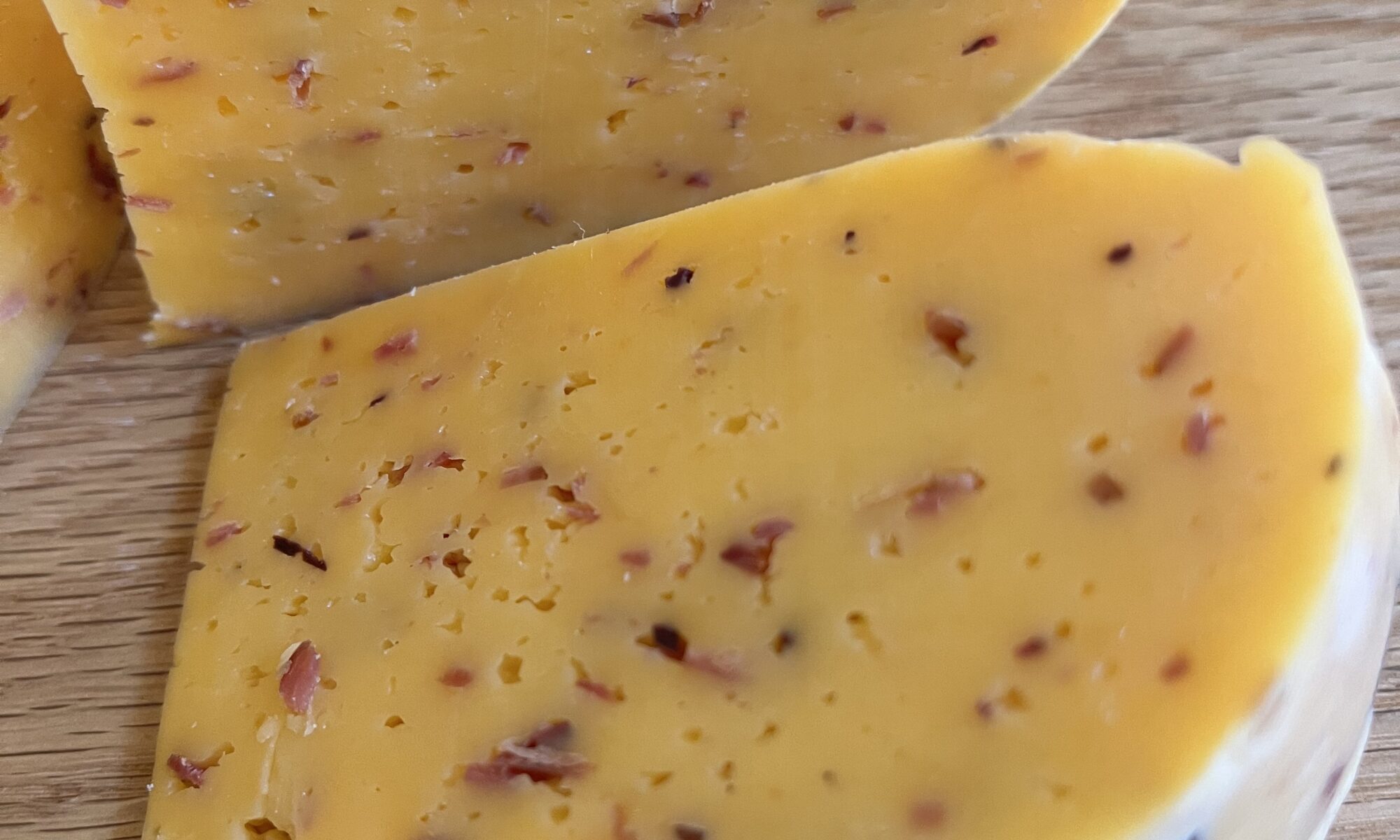
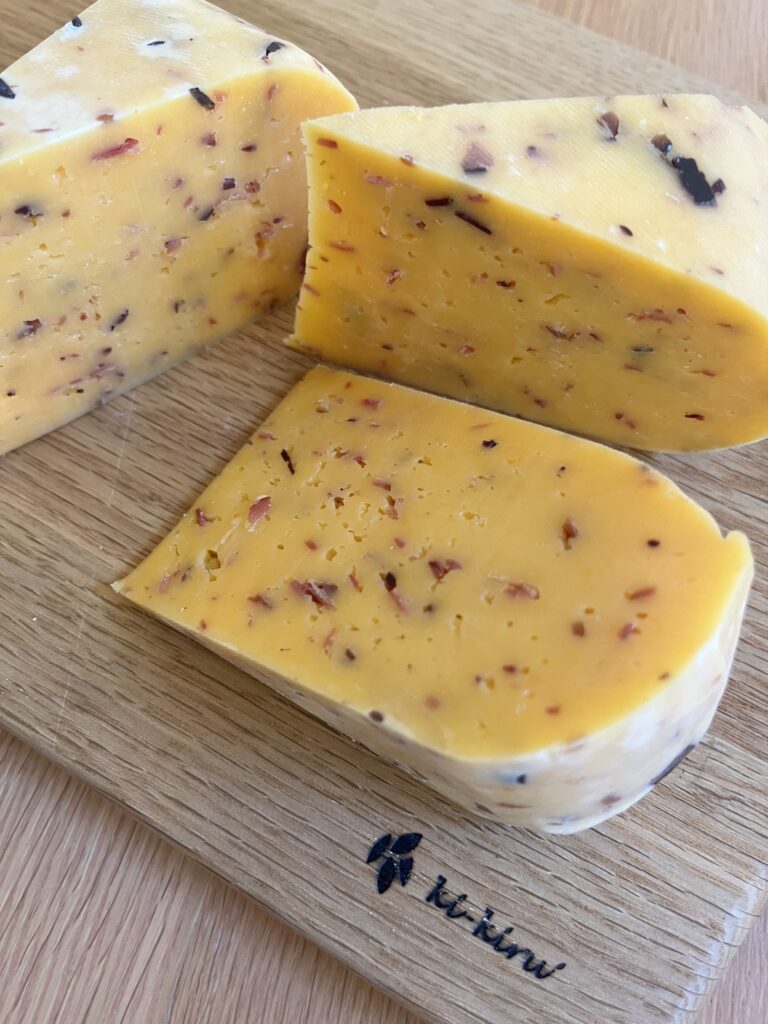
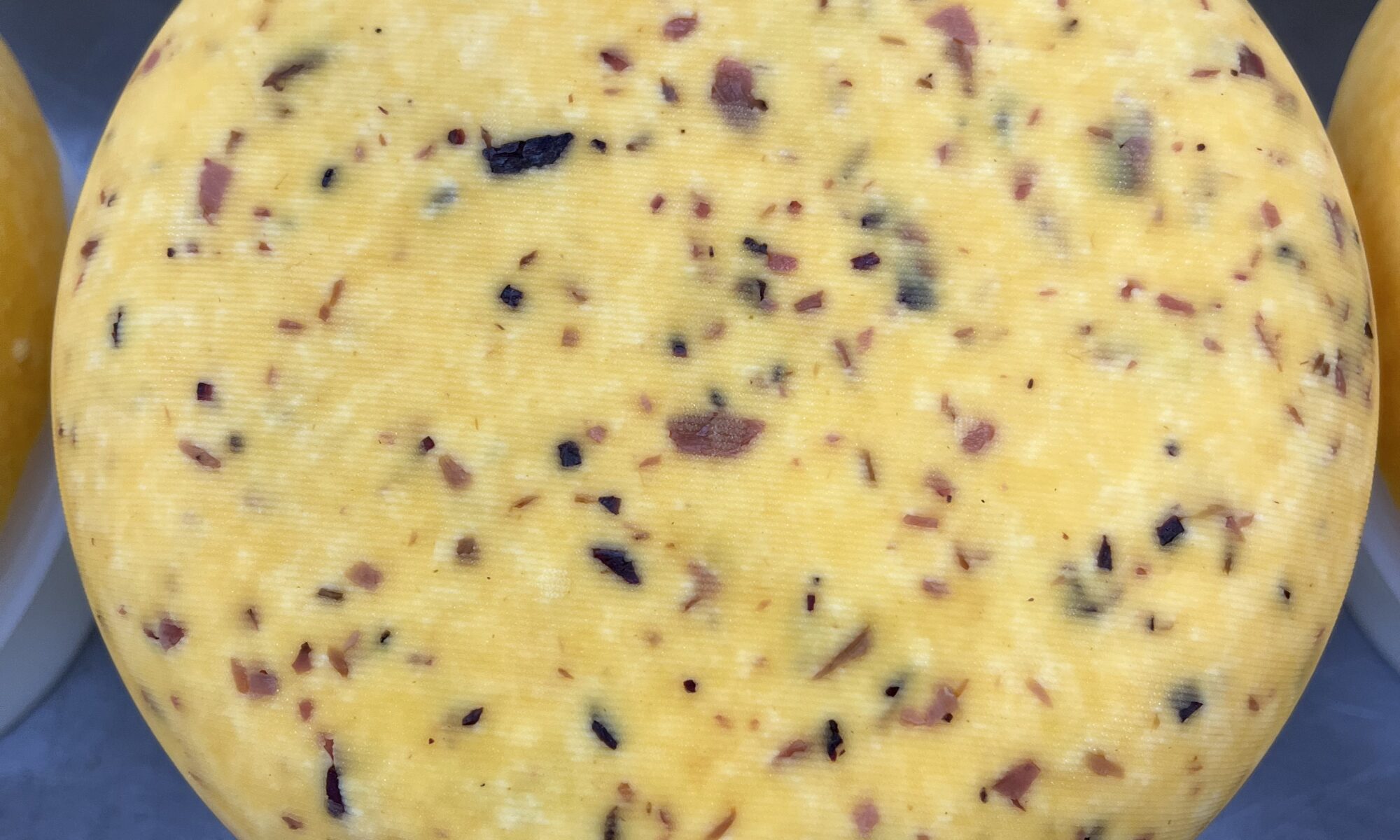
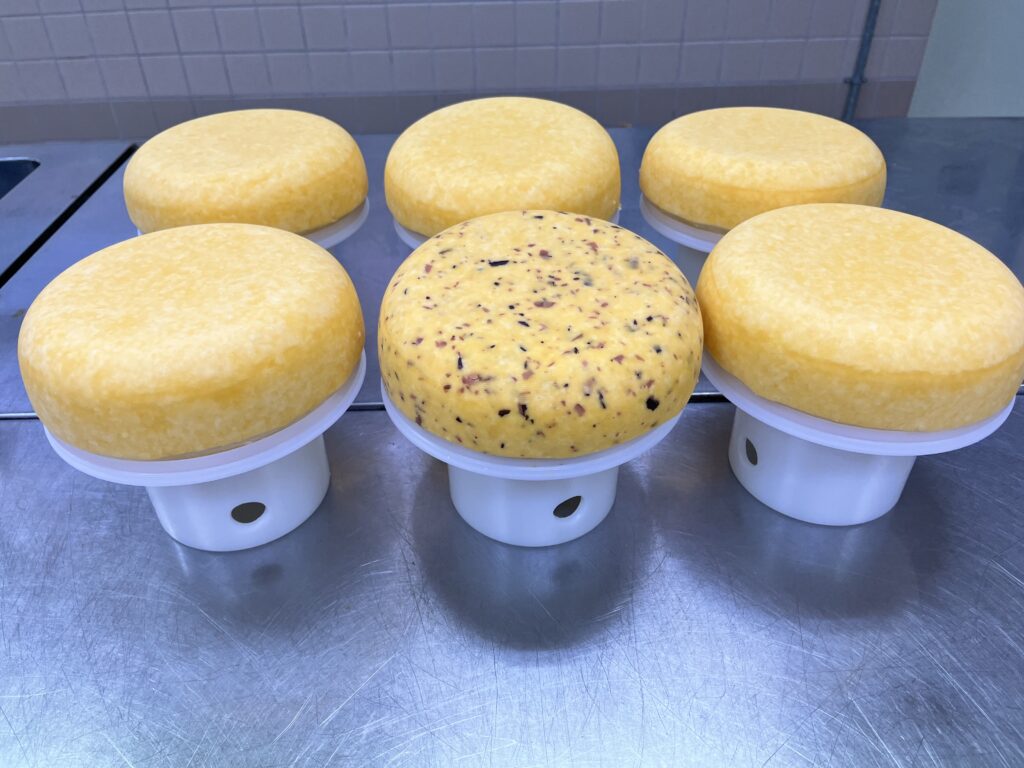
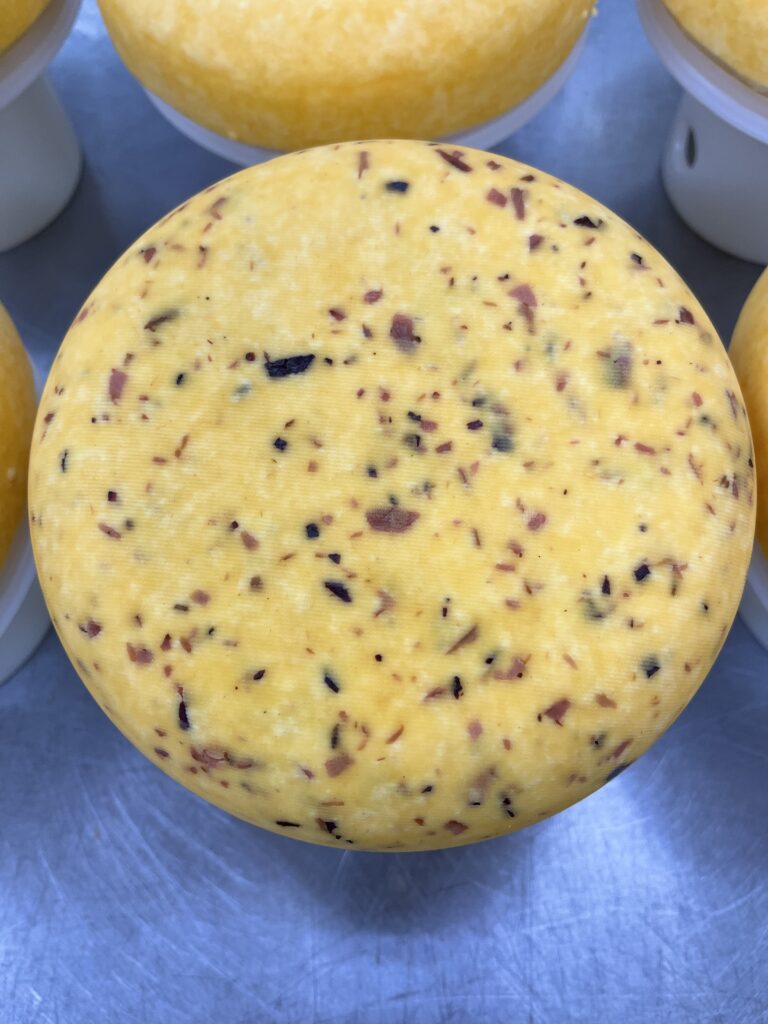
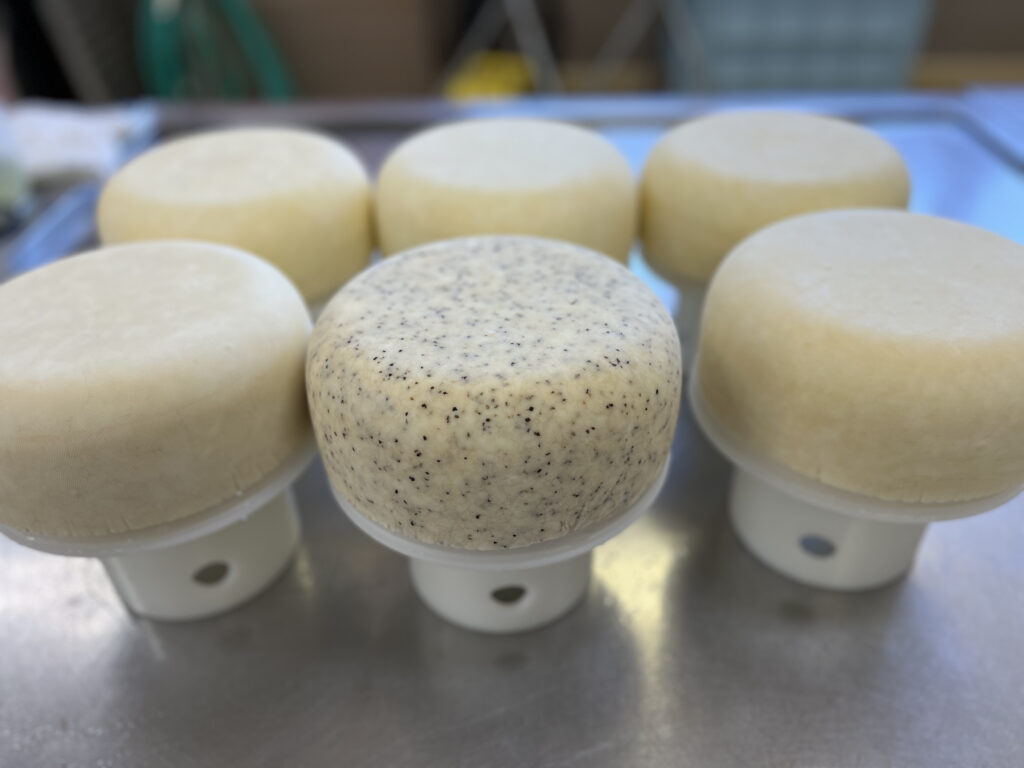
I made 4 dessert cheeses. They are bacon, wine, dried fruit, walnuts and oranges. The surface is dried and vacuum packed and will be on the table in 3 months.
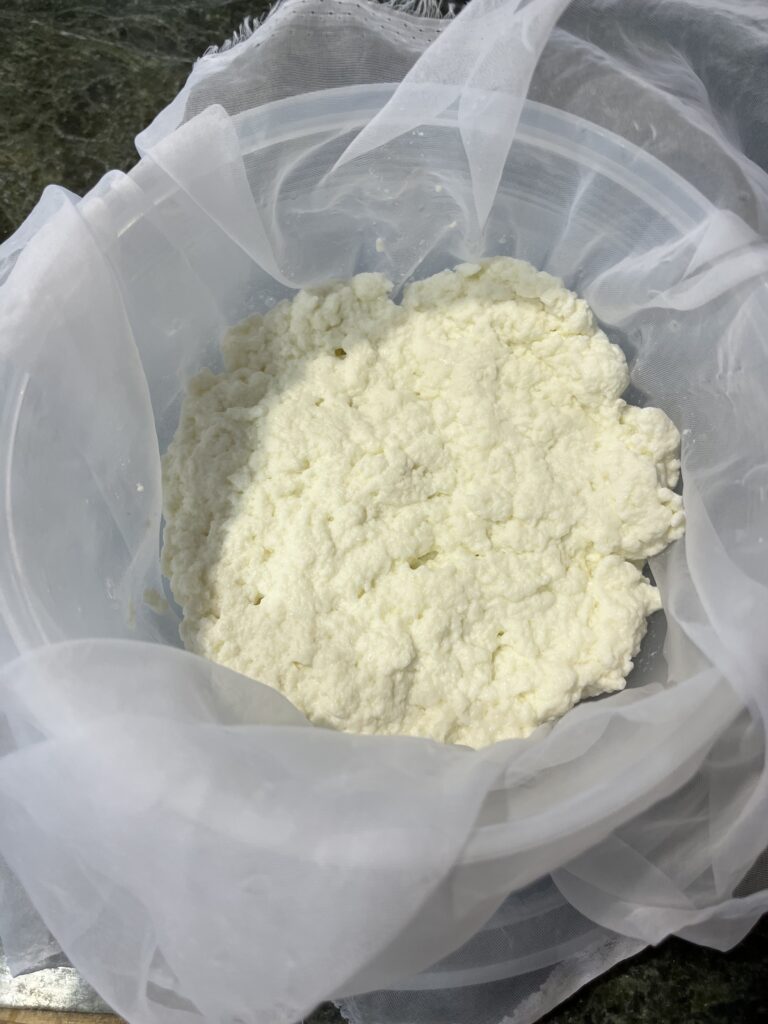
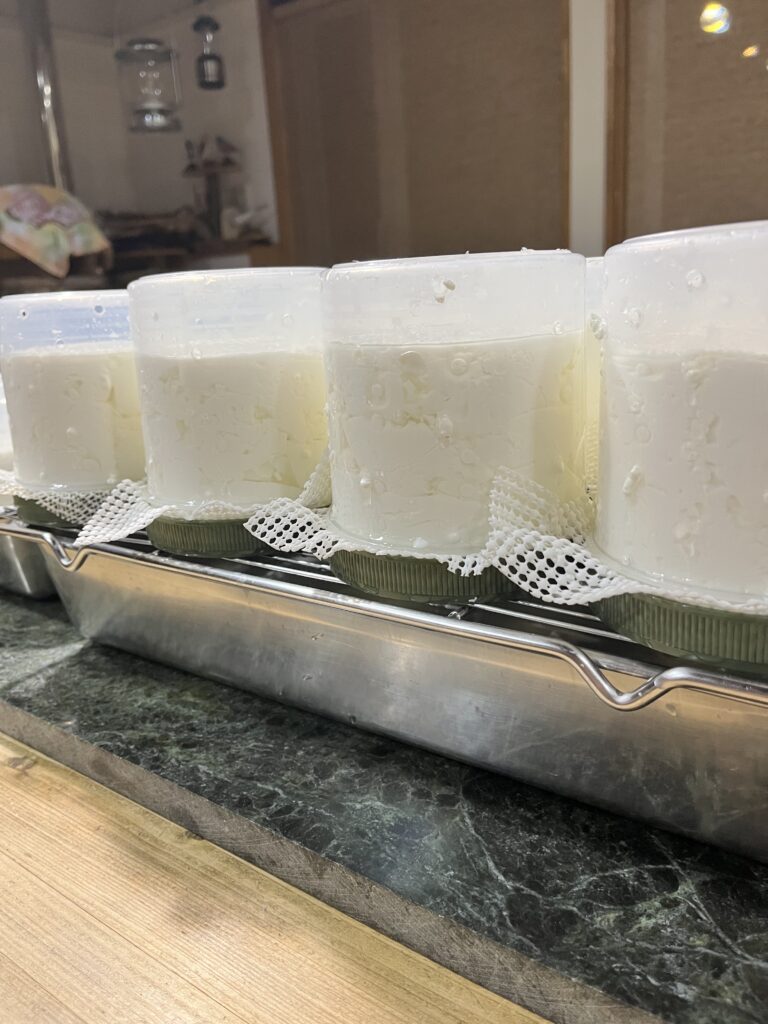
Molds are expensive, so cases from 100 yen stores are processed and used. In this case, we used a draining net from a 100 yen store instead of cheesecloth. It fits the case perfectly and is disposable.
This time ・15 liters of raw milk ・Lactobacillus CHN-19 was used. ・Colored a little with annatto ・Bacon is homemade and crisped in bacon oil before use. ・Dried fruits are sterilized by steam. ・Walnuts are roasted and orange zest is sterilized with liqueur.
The food processing room at Sarabetsu Village Furusato Kan, which is used by the Cheese Study Group for cheese making, will be out of service from August through the end of October due to renovation work. The renovation work will include updating the flooring and equipment, and the environment will be improved. During the construction period, we will not be able to conduct any activities as a research group, but will be making cheese prototypes privately at home. The prototypes will be posted on the blog.
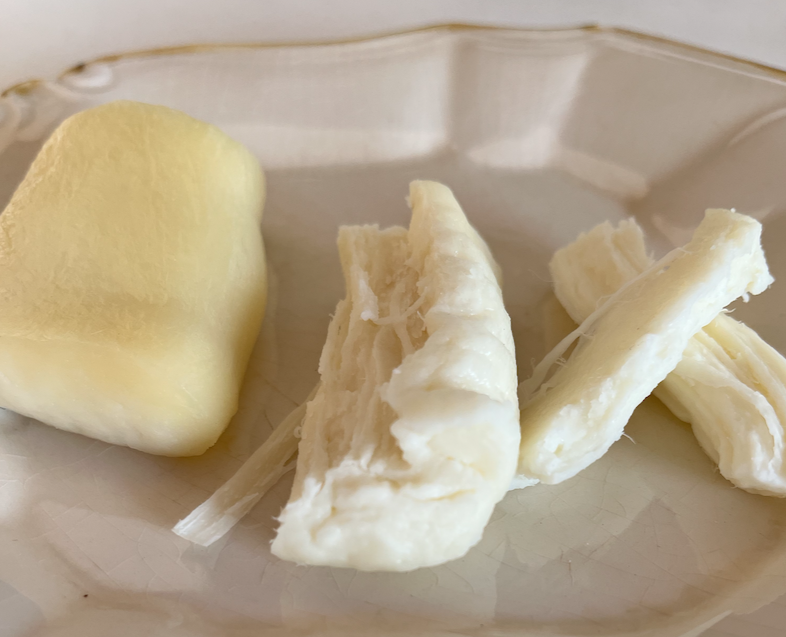
we made string cheese yesterday. The outline is as follows. ・Six participants and 100 liters of milk. ・Lactic acid bacteria was Christian Hansen’s TCC-3. ・The pH was 6.45 when rennet was added. ・The time from adding rennet to curdling was 11 minutes. ・The time from adding rennet to cutting was 33minutes. ・Cards were cut into 1 cm squares to speed up the whey discharge. ・The pH of the card was reduced to 5.3 by matting before processing into string cheese. This time, the cheese had a low moisture content and was a little firmer, with clearly visible fibers.
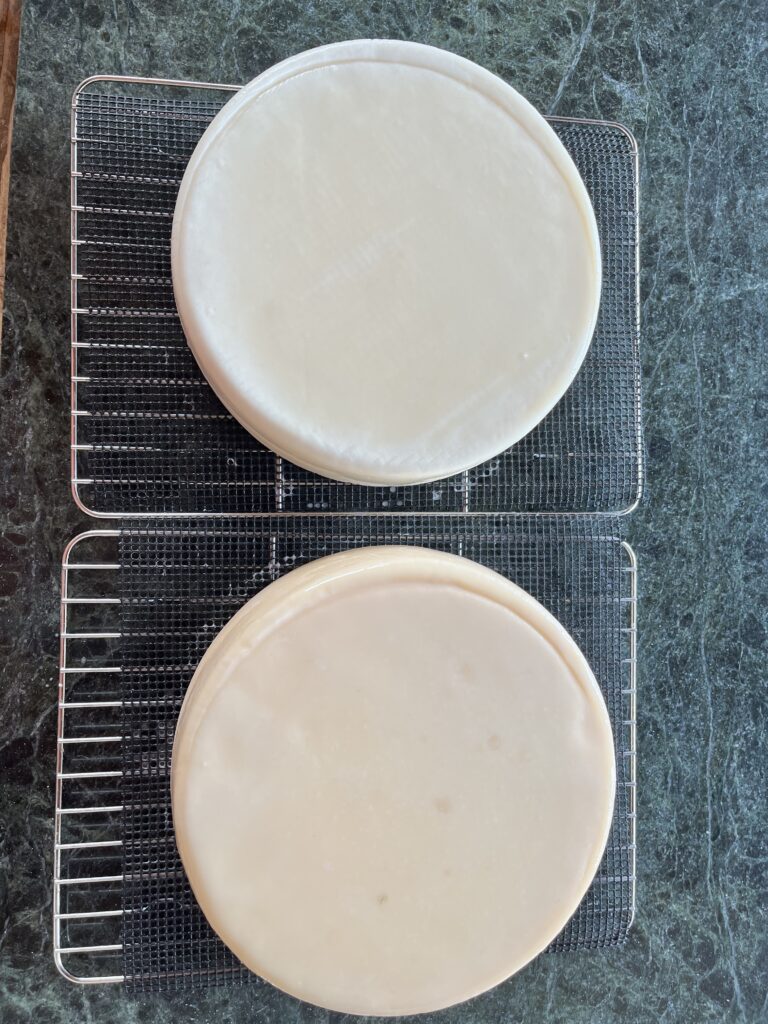
The salting process for the Gouda cheese I made yesterday is as follows: Instead of soaking the cheese in saturated brine, we directly rub salt with a salt content of approximately 1.5% to 1.8% onto the cheese and let it rest for about 3 to 4 days. Since we produced four small Gouda cheeses this time, we salted them using three different types of salt. I am looking forward to seeing how the taste and aroma changes with each salt after 3 months.
Today, I made Gouda cheese using my homemade cheese-making equipment. I used 15 liters of milk. I sterilized all the utensils and pasteurized the milk at a low temperature. I used a type of lactic acid bacteria called CHN-19, which does not produce gas holes. Despite being prepared, I was a bit flustered since it was my first time making cheese at home. My homemade mixer was able to rotate, but the blades were small, so I couldn’t stir the mixture as effectively as I wanted. In the end, I resorted to manual stirring. I ended up with four small Gouda cheeses.
Tomorrow, I plan to salt them using refined salt, Akou’s natural salt, and rock salt (Alpen Salz), and after surface drying, I will vacuum-pack them. I’m looking forward to seeing how the different salts will affect the taste and aroma.
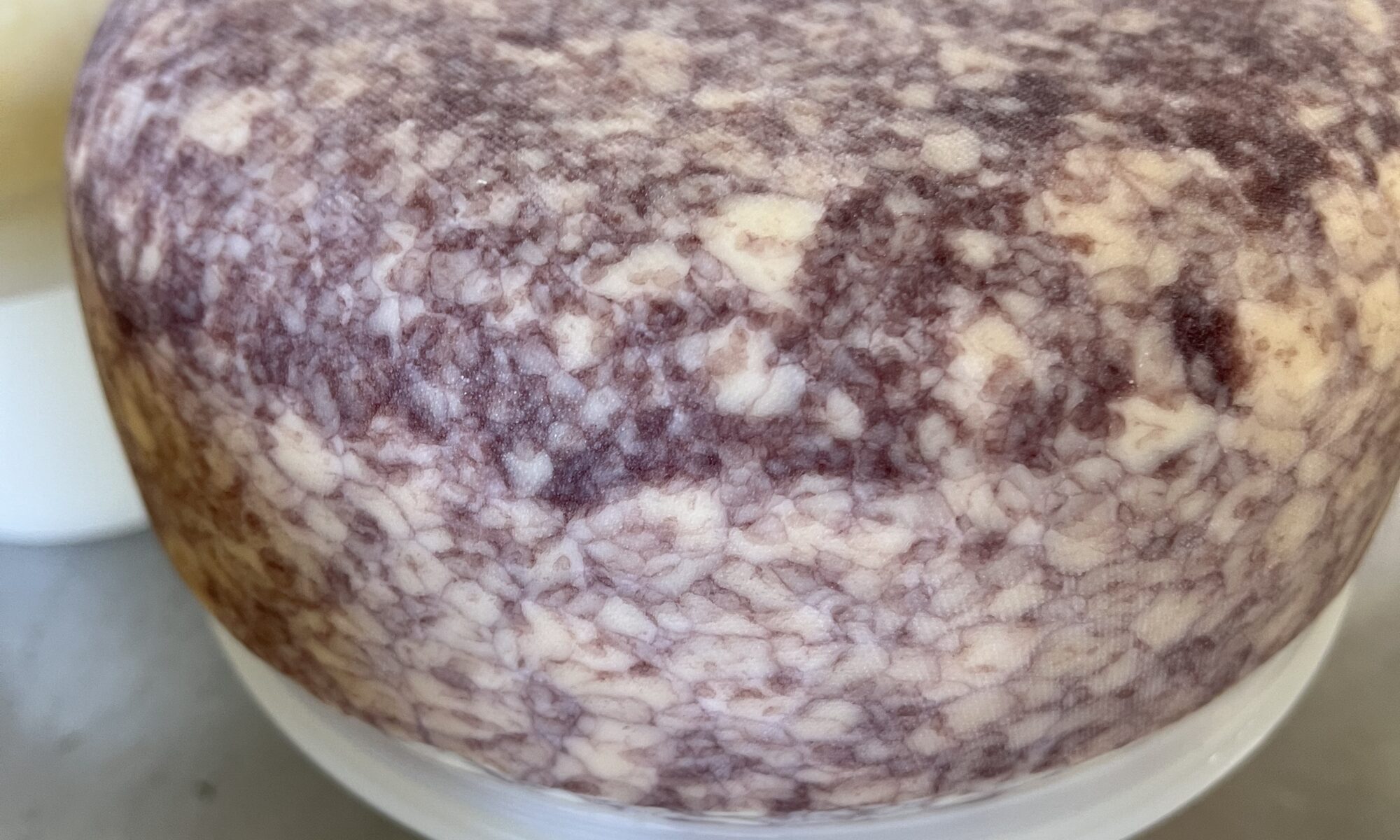
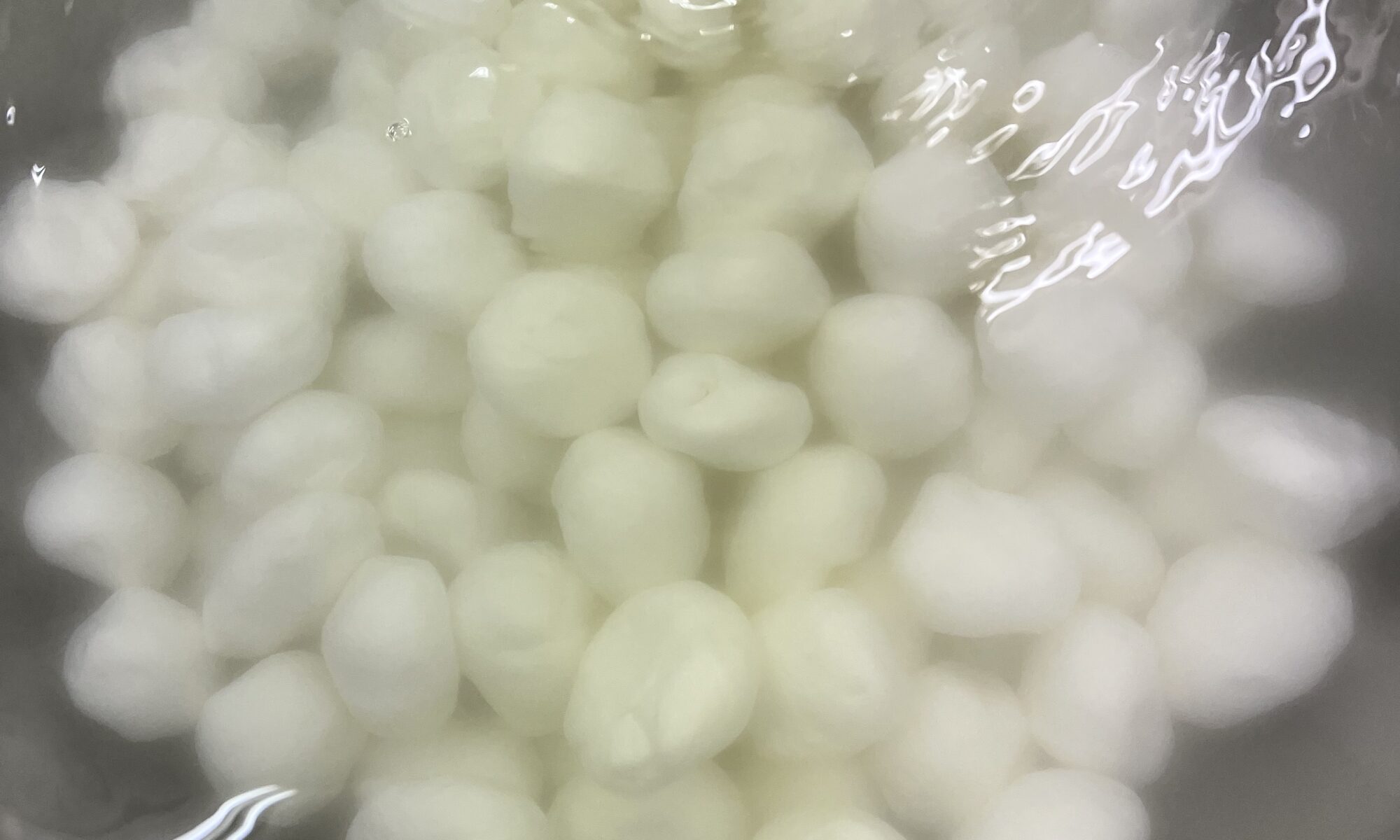
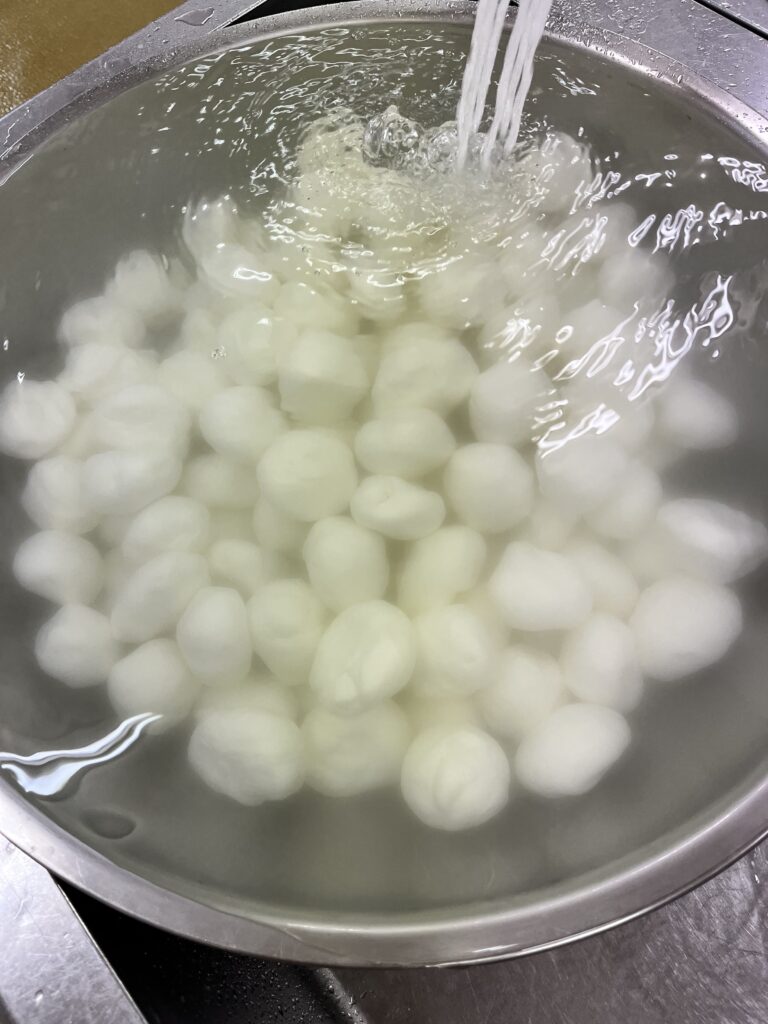
Yesterday, seven members of the weekend team and I made Mozzarella cheese. This time, we incorporated finely chopped Nara pickles into the Mozzarella dough, rolled it into balls, and covered them with Mozzarella dough to create a cheese resembling mochi. Some of the members were not fond of Nara pickles, but they found the final product delicious. Since both Nara pickles and Mozzarella cheese are fermented foods, they complement each other well. The photo shows the Nara pickle-filled cheese used in a Caprese salad. Fruits go well with Caprese, don’t they?
When my friends and I make mozzarella cheese, we usually use 100 liters of fresh milk. First, we pasteurize the milk at low temperature and add starter culture and calcium chloride, then we wait for the pH to reach 6.45. At pH 6.45, we add rennet and determine the cutting time using the flocculation method.
Typically, the flocculation coefficient for mozzarella cheese is stated as 4 in many online sources. However, in our case, since the pH is already 6.45 when we add rennet and the acidification process is advanced, the curds tend to incorporate a significant amount of whey. Therefore, we use a coefficient of 3.
On the other hand, when making string cheese, we repeatedly stretch, fold, and knead the curds to achieve a fibrous texture. Recently, when we used the same method as mozzarella cheese to make string cheese, it turned out to be soft with a high whey content, and the fibers broke in the middle.
Therefore, for our next attempt at making string cheese, we plan to experiment with either increasing the pH at which we add rennet to around 6.5 to reduce whey incorporation into the curds, or adjusting the flocculation coefficient to 2-2.5 to enhance whey expulsion. We will determine which method produces the optimal string cheese.
In our group, instead of immersing Gouda cheese in saturated brine, we use a method of rubbing salt to achieve a salt content of 1.5% to 1.8% in the cheese. Recently, we have been asked about the potential changes in taste and aroma when using mineral-rich salt or smoked salt.
There are several reasons for salting cheese. Firstly, rubbing salt into the cheese provides surface sterilization. Salt also helps remove whey from the cheese and inhibits the growth of lactic acid bacteria and molds. Additionally, salt plays a role in increasing the presence of umami-enhancing compound sodium glutamate, contributing to the flavor of the cheese.
However, we still have limited understanding of how the mineral content in salt and other factors might influence the taste and aroma of the cheese. Therefore, we have decided to conduct a comparison.
Specifically, we will make two Gouda cheeses. One will be salted using refined salt, and the other will be salted using salt with high mineral content, primarily magnesium chloride (such as Akō’s natural salt). After salting, we will mature and store both cheeses in the same environment. Subsequently, we will conduct taste tests to discern any differences in flavor and aroma.
This cheese will be made with prototype equipment.
We are planning to make Mozzarella cheese on the 22nd, as it is the season when tomatoes, basil, and fruits are easily available. There will be 7 participants, and we have 110 liters of fresh milk. This time, we will also make Mozzarella with added Nara-zuke (Nara-style pickles). We will be using hot water for cheese processing, so we hope that the temperature does not rise.
The equipment for prototyping cheese at home is now complete.
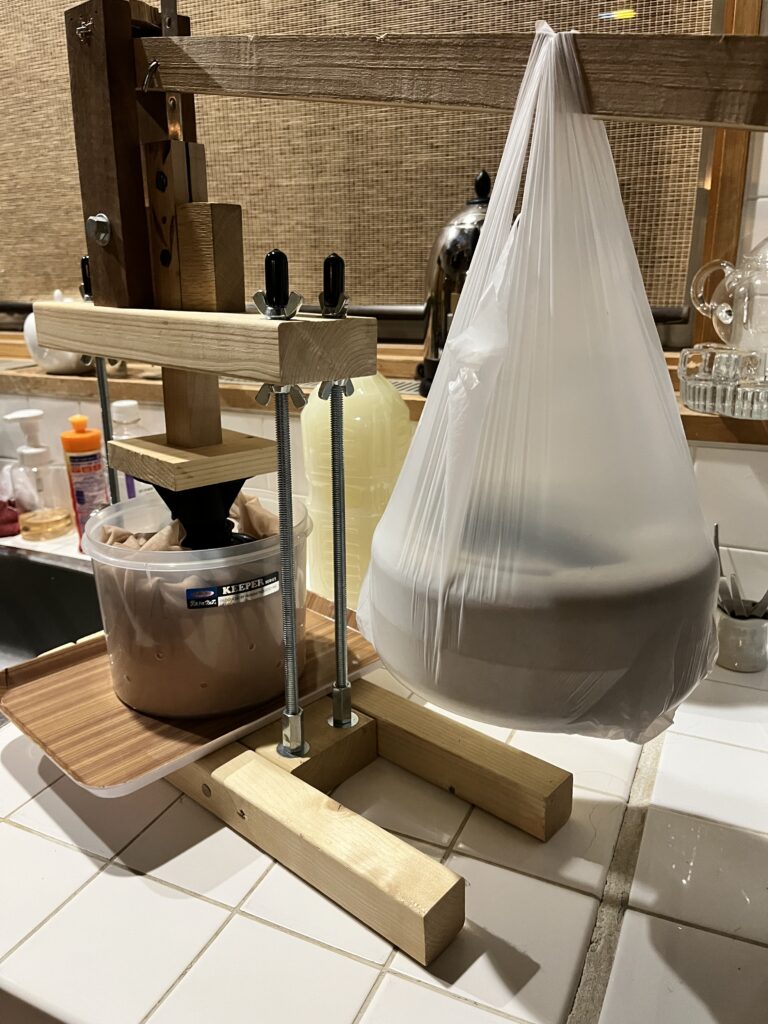
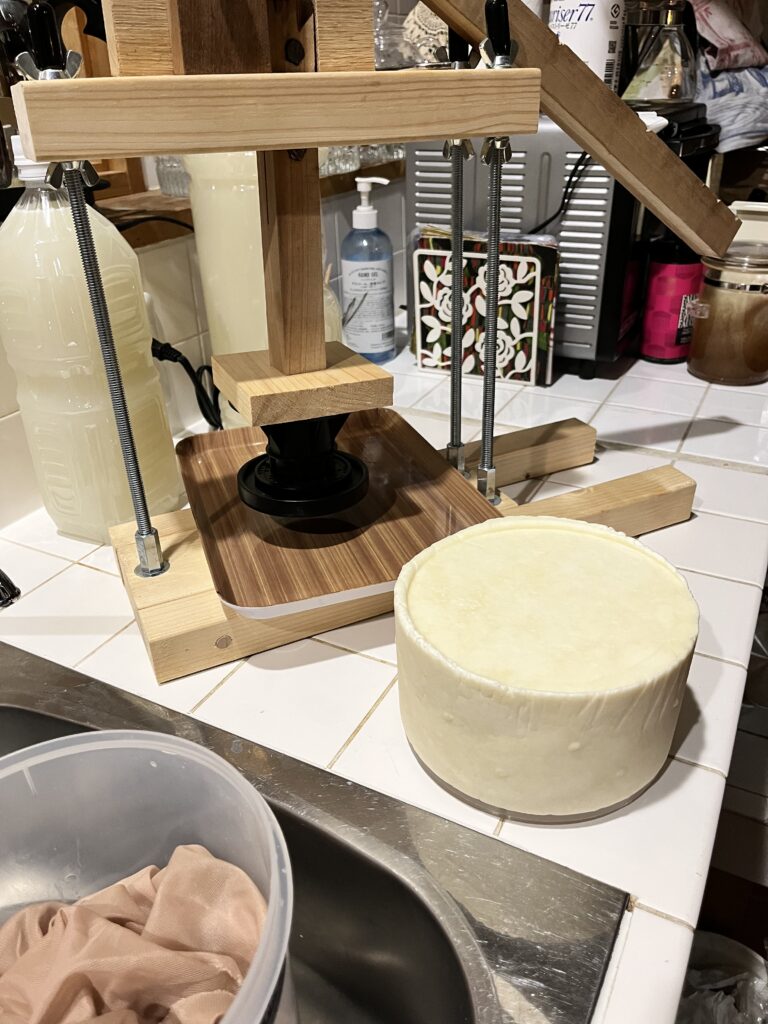
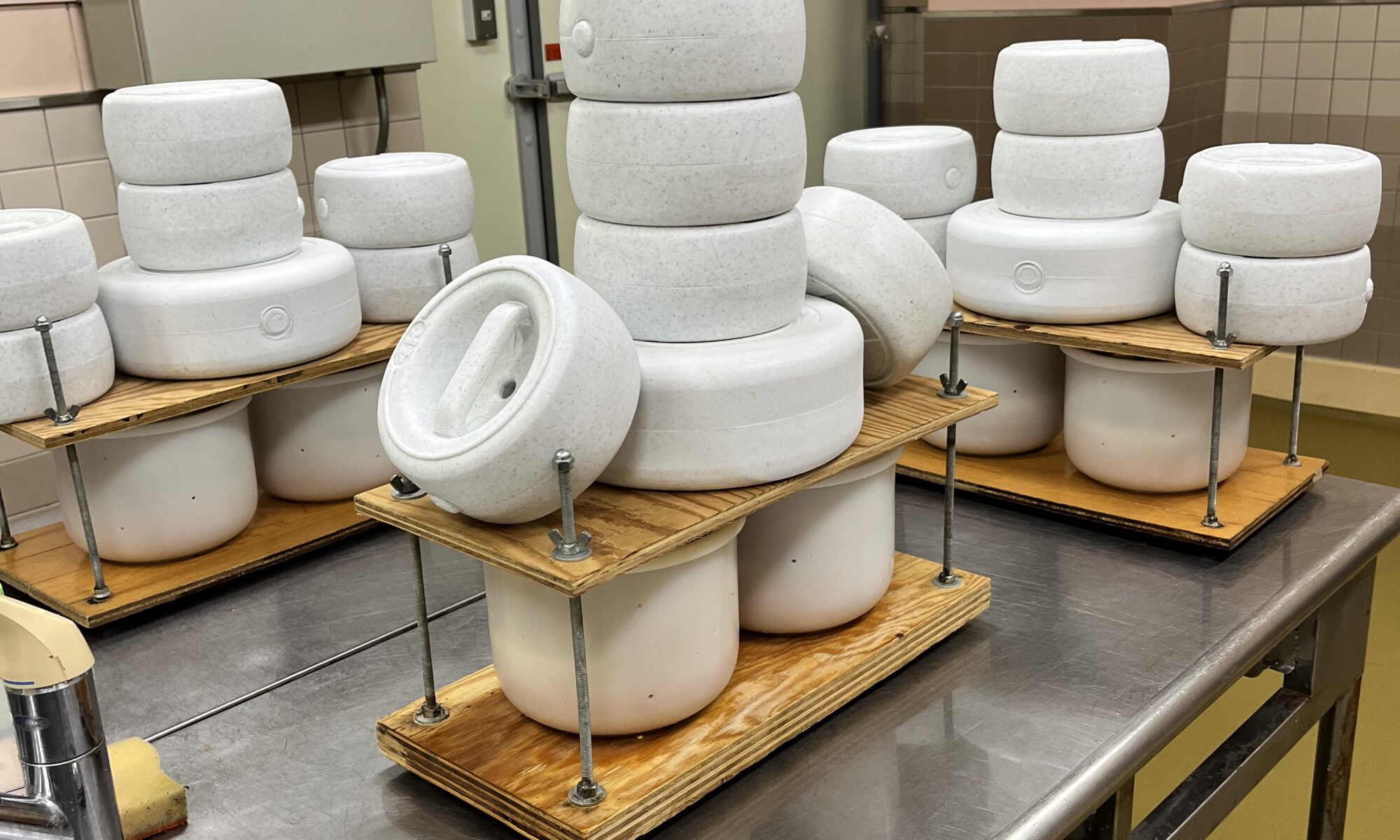
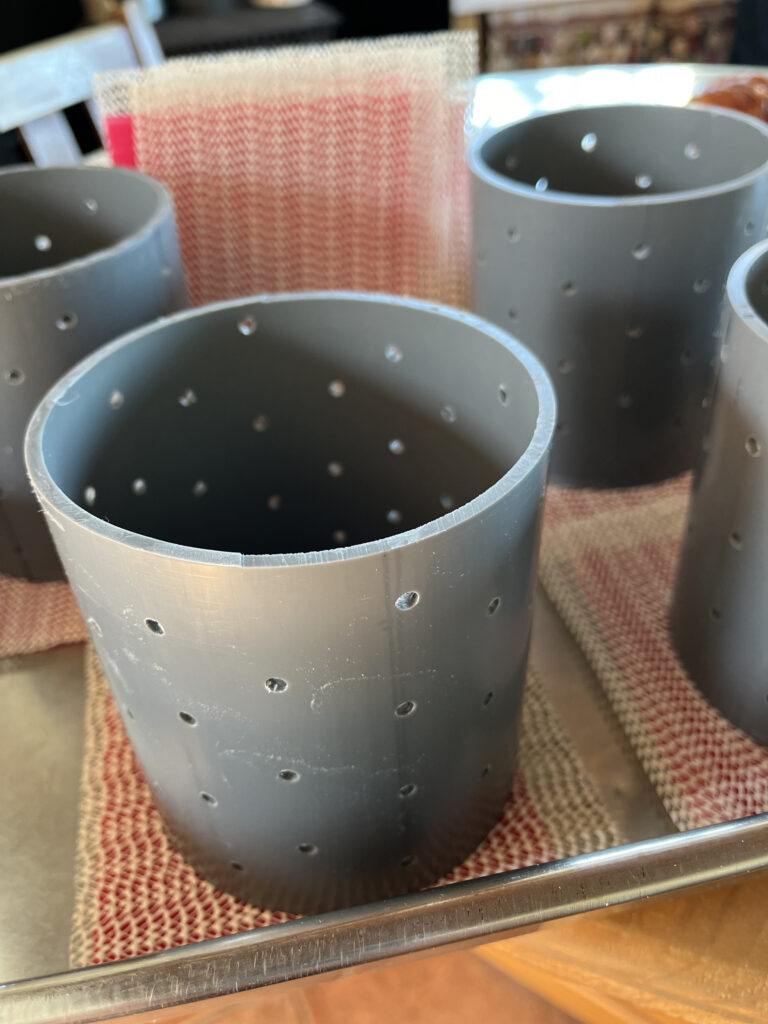
A square pickle barrel was used for the warming water tank, and a hole was made in the lid of the tub for a stainless steel skimmer for processing cheese and a hole for the cold cooker for warming. A thermometer was provided to simultaneously monitor the temperature of the water tank for heat retention and the milk. We made our own horizontal cutting wire cutter to cut the curds and will use a knife for the vertical cutting. Created a stirrer to automatically stir the card in the cooking process after cutting the curds. Prepared a colander needed to separate whey and card and extract whey. A cheese mold (mold) was made by punching holes in commercially available Tupperware. A press machine was made to press the cheese. Spoons were prepared to measure lactic acid bacteria and additives in 5 steps from 1/4 (1.25g) to 1/64 (0.078g). Pasteurization of milk will be performed using a portable gas stove at 72°C for 1 minute while stirring with a stirrer.
This is a video of string cheese production. The raw milk is 100 liters, the lactic acid bacteria used is TCC-3, the pH of rennet input is 6.4 to 6.45, and the pH to start kneading pressure is 5.3. String cheese is stretched and folded several times during kneading and pressing in order to make it fibrous, which is one of its characteristics. This time, in addition to regular-sized string cheese, a scallop-like cheese is also made. These are dried and smoked for several days.
This time we will make string cheese. The raw milk is 100 liters, the lactic acid bacteria used is TCC-3, the pH of rennet input is 6.4 to 6.45, and the pH to start kneading pressure is 5.3. String cheese is stretched and folded several times during kneading and pressing in order to make it fibrous, which is one of its characteristics. This time, in addition to regular-sized string cheese, a scallop-like cheese is also made. These are dried and smoked for several days.
( 1 ) Mozzarella cheese When I first started learning how to make mozzarella cheese, no matter how many times I made it, all I got was hard, squeaky cheese. The proper timing for kneading mozzarella was at pH 5.2, and the temperature of the card (lump of cheese) was raised to about 60°C. The cheese was stretched and shiny, but somehow it ended up hard and squeaky. Through trial and error, I learned from literature and other sources that the optimum pH for rennet is 6.2. So I came up with the idea of adding rennet at a lower pH than usual (up to 6.3). Then the rennet worked better and the pH of the card dropped faster. Of course, the work got busier, but we ended up with a delicious mozzarella cheese with a soft structure. Later, after researching various literature and resources, I found one that stated that the pH at which rennet is added should be between 6.4 and 6.45 when making mozzarella cheese. I have since used this value and no longer make hard mozzarella cheese.
( 2 ) Ricotta cheese I also make ricotta cheese using the whey from Gouda cheese. However, for some reason, the whey from mozzarella cheese could only produce ricotta cheese that was fine and cream cheese-like. I tried different temperatures and amounts of citric acid with the same results. We were unable to find detailed conditions when we searched the materials. However, I found and read a paper on the continuous production of ricotta cheese in a factory, which described the relationship between the conditions under which ricotta is obtained and citric acid. Finding this paper revealed how to make ricotta cheese from mozzarella whey. Since mozzarella whey has a low pH of about 6.1, this problem was solved by adjusting the pH to 6.4-6.5 by adding a pH adjuster (a food-level sodium carbonate solution) and reducing the amount of citric acid added to 0.15% of the whey volume. Using these conditions, ricotta cheese can now be made from mozzarella whey.
Aiken, K. The Top 10 Most Popular Pizza Toppings (Infographic). The Huffington Post, Nov 12, 2013: http://www.huffingtonpost.com/2013/11/12/ popular-pizza-toppings_n_4261085.html [accessed Sept 2017].
乳糖不耐症: 原因. Mayo Clinic, Feb 9, 2016: http://www.mayoclinic.org/diseases- conditions/lactose-intolerance/basics/causes/ con-20027906 [accessed Sept 2017].
Making Gouda cheese for the first time in a long time (May 27 and 28) We made Gouda cheese for the first time in a long time. We used 100 liters of milk and a Christian Hansen CHN-11 starter (the type that produces a small gas hole).
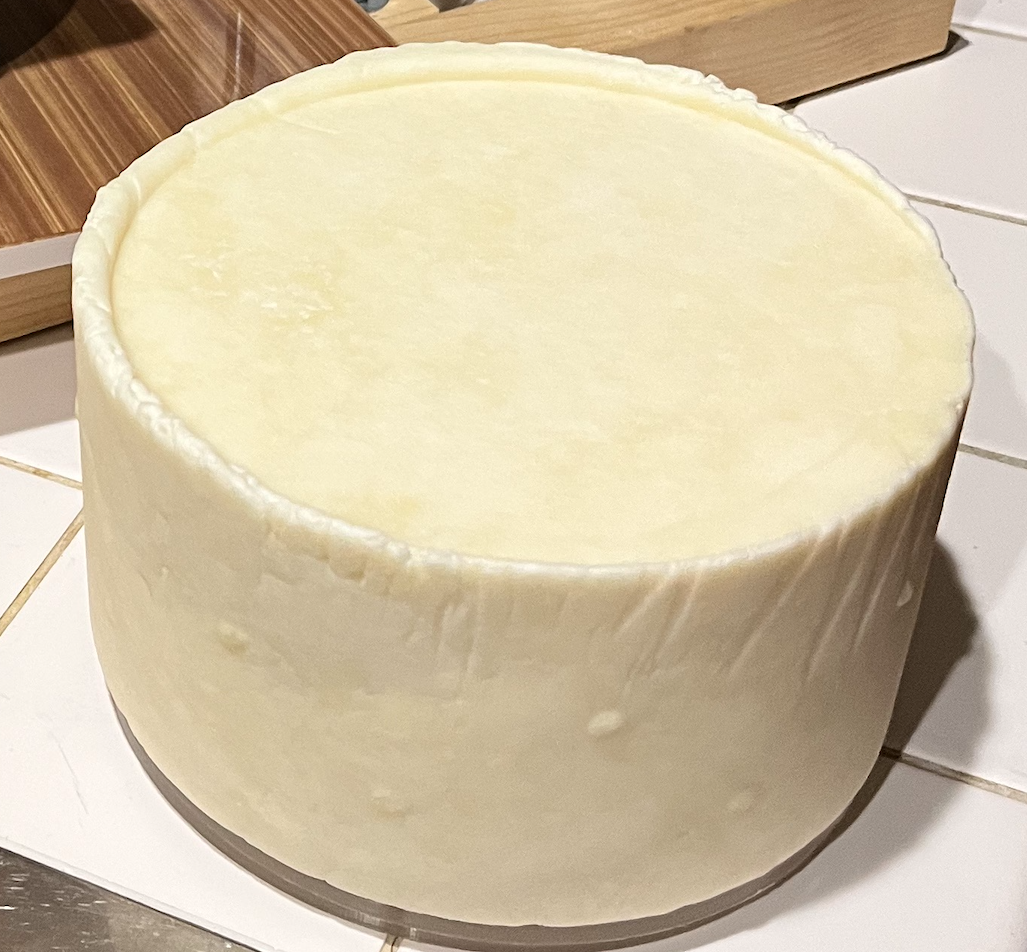
One is with black pepper, the rest are plain. This picture shows the cheese being removed from the mold and salted in the bag with 1.5-1.6% of its weight in salt. The cheese will now be placed in the vegetable compartment of the refrigerator for 3 days to allow the salt to penetrate, turning it upside down, before it is removed from the bag and allowed to mature.
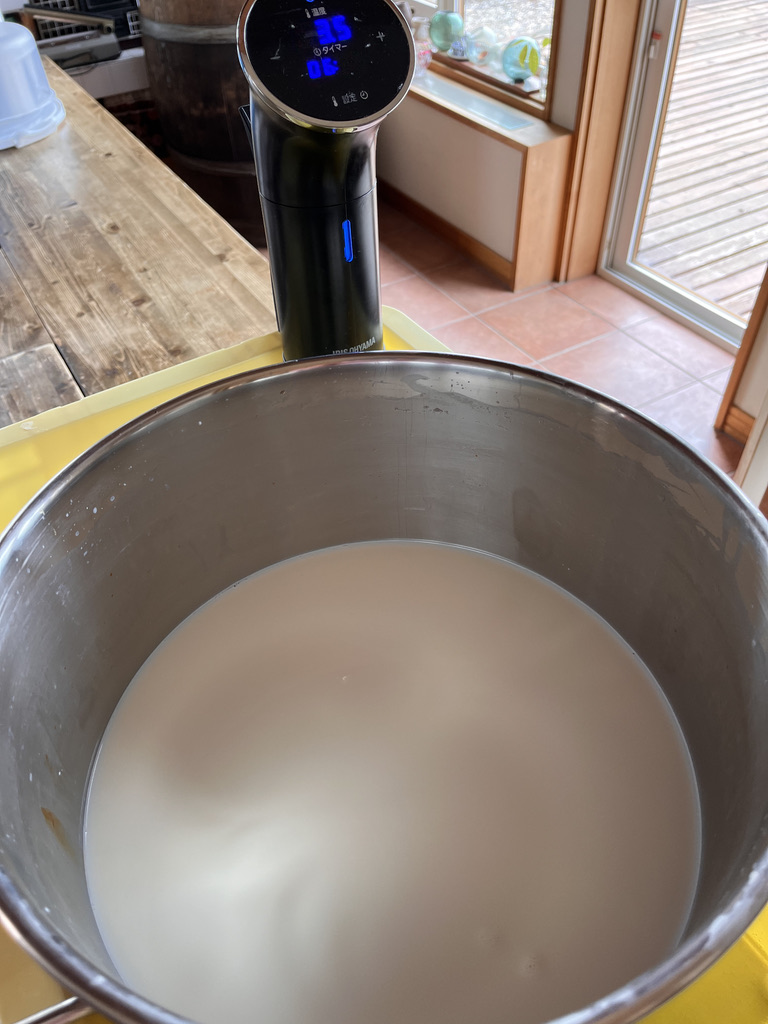
We have the tools to make cheese at home. ・Stainless steel pot ・A pickle barrel (type 36) to keep the temperature constant. ・Low temperature cooker to keep the temperature constant ・Cheese mold ( self-made ) We are going to create a wire cutter (vertical and horizontal cutting) using a grill net and a propeller device for electric stirring. The cheese prototype will be made in June, and the production will also be uploaded.
Cream cheese is known to pair well with traditional Japanese pickles such as “Nara-zuke” and “Iburigakko”. Inspired by this, we came up with the idea of mixing these pickles into mozzarella cheese and wrapping them in mozzarella cheese skin to create “mochi”.
Instructions: Cut the pickles into small squares of about 2mm beforehand. Cut the mozzarella card into pieces of about 1cm square, and knead it in 85℃ hot water until it becomes shiny and stretchy. Divide it into two portions. Add the cut pickles to one portion of the cheese and mix well. Form the mixture into 3-5cm balls. Use the other portion of mozzarella cheese to create the skin and wrap the balls, shaping them into your desired form. Chill the finished mochi in cold water.
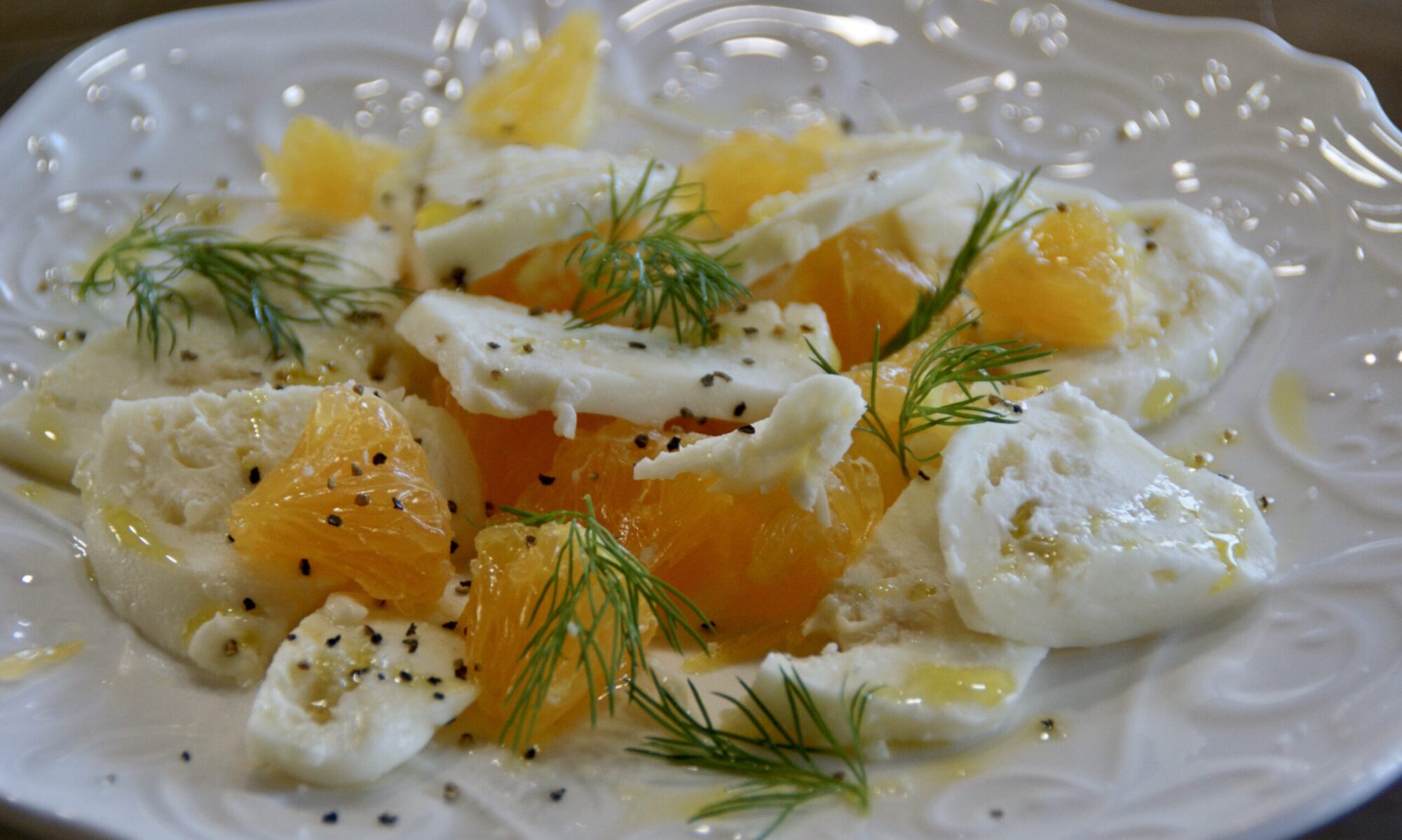
The photo shows a Caprese made with this mozzarella cheese, flavored with orange, black pepper, dill, olive oil, and salt. Please give it a try.
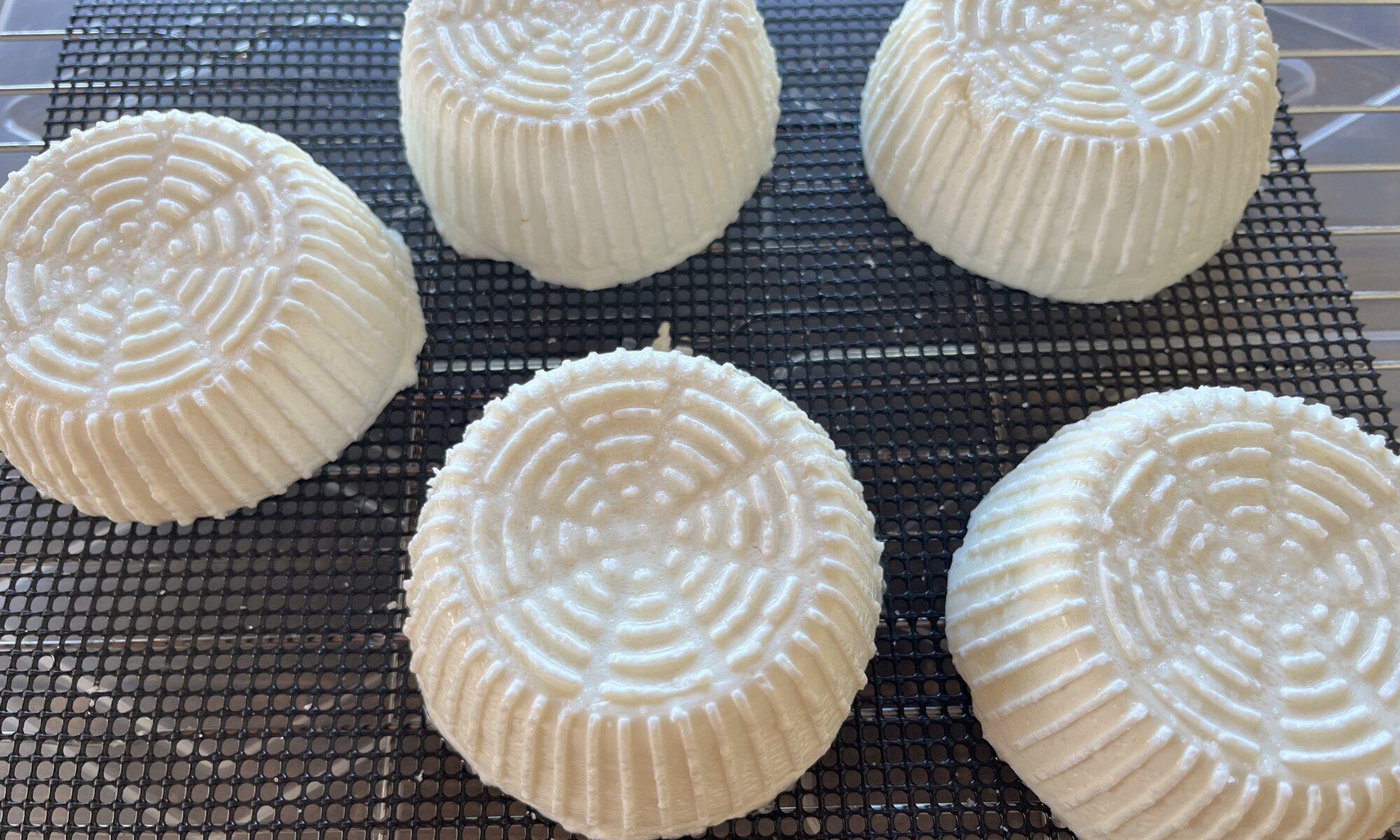
The byproduct of cheese making is a lot of whey. One type of cheese that can be made using this whey is Ricotta. This cheese does not melt even when heat is applied, and has a shelf life of about one week when stored in the refrigerator. If you have the opportunity to make cheese, please try making Ricotta cheese using the whey – it’s definitely worth it!
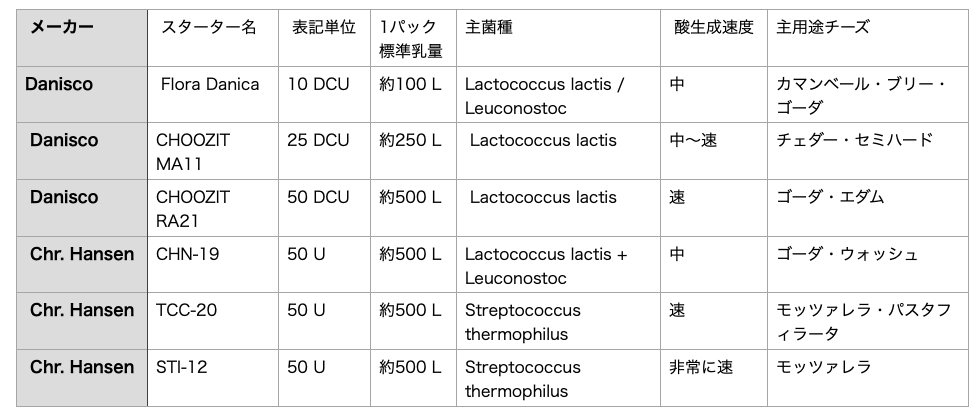
このレシピはモッツァレラチーズとストリングチーズ、カチョカバロなどのパスタフィラータタイプのチーズを作るためのレシピです。 このレシピではスターターとしてクリスチャン・ハンセン社のTCC3を用いています。 ピザなど料理でモッツァレラチーズの褐変を少なくしたい場合にはTCC20を使用してください。 TCC20にはLactobacillus helveticus とStreptococcus thermophilus が含まれており、helveticus がガラクトースも乳酸に変換するので糖分が少なくなり褐変し辛くなります。
This recipe is for making pasta filata-type cheese such as Mozzarella, String Cheese, and Caciocavallo. The starter culture used in this recipe is Christian Hansen’s TCC-3. If you want to reduce browning of Mozzarella cheese in dishes like pizza, use TCC-20 instead. TCC-20 contains Lactobacillus helveticus and Streptococcus thermophilus, and helveticus converts galactose to lactic acid, reducing the sugar content and making browning less likely to occur.
The Faculty of Food Science at the University of Guelph in Guelph, Ontario, Canada, is offering a short course, “Introduction to Cheese Technology Online Course”. Details can be found on the university’s website for those interested. In addition, a systematic compilation of technical materials on cheese production called “Cheese Making Technology e-Book” is available to the public. This e-book is available online free of charge to anyone. You may use the content for personal reference and educational purposes, provided you include a citation with the appropriate URL, such as [Hill and Ferrer, Cheese Making Technology e-Book, accessed October 27, 2020].
In addition “Dairy Science and Technology eBook.” An “Ice Cream Technology e-Book” are also available to the public and will help you learn more about a wide range of dairy products, including milk. If you are interested, please click on the e-Book to view it.
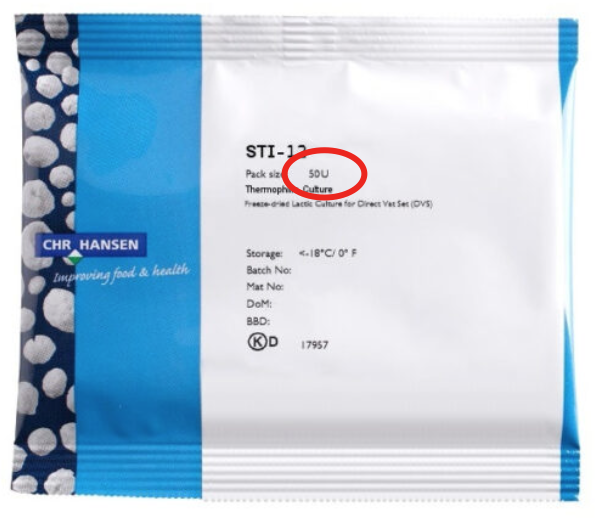
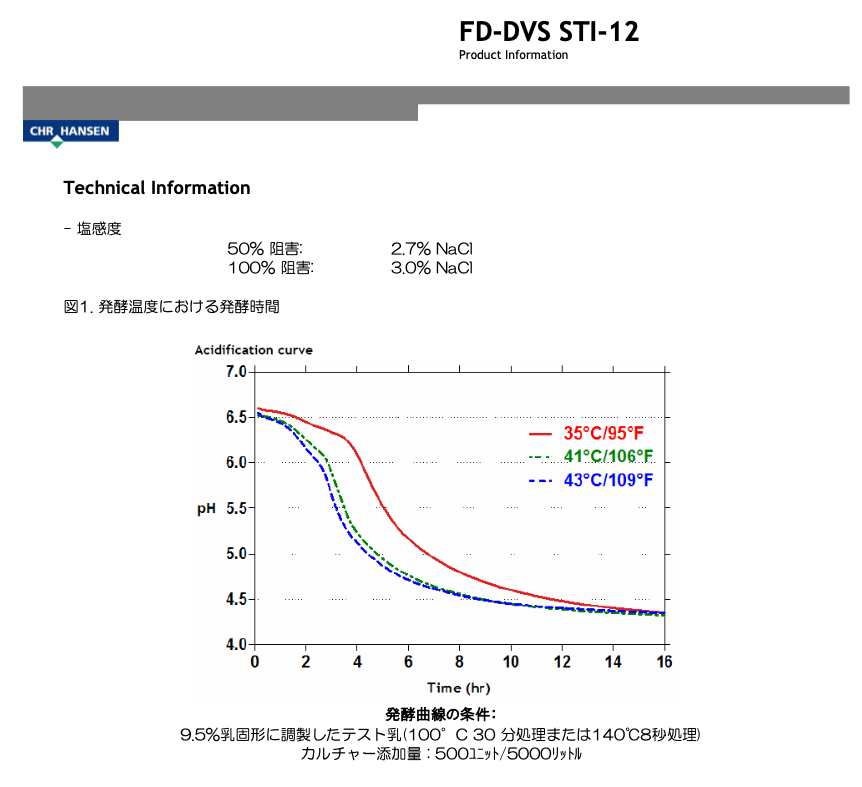
This recipe is what we use when making cheddar cheese. We use a mixture of R-series cheddar cultures (R-704) from Christian Hansen, along with STI-12 (Streptococcus thermophilus) and LHB-01 (Lactobacillus helveticus) lactic acid bacteria. We expect this combination to increase the aroma and flavor components during the aging process. Since the curdling time of rennet varies depending on the amount used, we use a quantity of rennet that curdles within about 10-15 minutes. The cutting is done three times the curdling time. As variations of cheddar cheese, we also make ones with black pepper, chili peppers, and those soaked in wine.
We do not have a photo, but the dairy farmer gave us milk from days 6 and 7 after the birth. I decided to make mozzarella cheese after reading a paper on colostrum to see the composition of colostrum and how it changes. The dairy had been fed corn before giving birth, and the resulting cheese smelled of corn from the time it was pasteurized and had the aroma of both milk and corn.